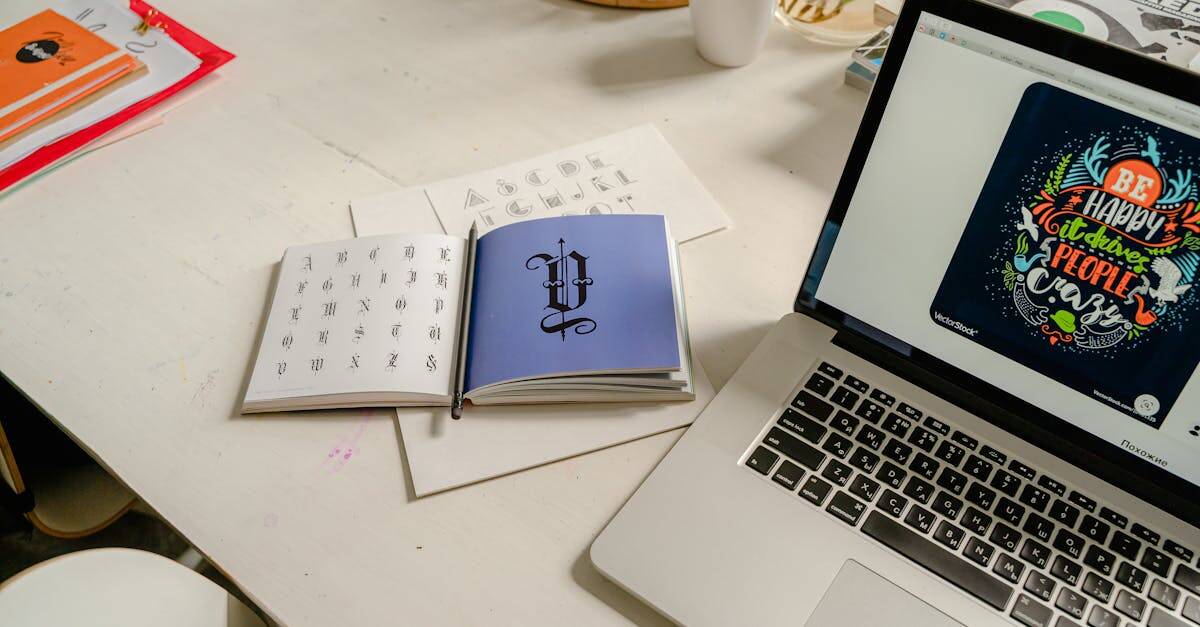
Beginner Calligraphy Alphabet: Start Here
Learning a beginner calligraphy alphabet is the single best investment you can make if you want to develop beautiful handwriting, create hand-lettered designs, or simply enjoy a meditative creative practice. Calligraphy can seem intimidating when you see the elaborate scripts on social media, but every calligrapher started with the same foundational strokes you will learn in this guide. This comprehensive, step-by-step tutorial covers everything from your first tool purchase to writing your first complete alphabet. No prior experience is required.
We will focus on the Foundational Hand, a broad-edge pen script developed by Edward Johnston in the early twentieth century. It is the ideal beginner calligraphy alphabet because its letterforms are clear, logical, and based on simple geometric principles. Once you master the Foundational Hand, you will have the skills and muscle memory to progress to more complex scripts like Italic, Uncial, and eventually formal scripts like Copperplate.
Essential Calligraphy Tools for Beginners
You do not need expensive equipment to start. Here is what to buy first, organized from essential to optional, with budget-friendly recommendations.
The Pen: Start with a Broad-Edge Nib
The Foundational Hand uses a broad-edge (also called broad-nib or chisel-edge) pen. This is a flat-tipped nib that creates thick and thin strokes based on the direction you move it, which is the defining characteristic of calligraphic writing.
Best starter options:
- Pilot Parallel Pen (3.8mm): This is the single best beginner tool available. It costs under $15, uses refillable ink cartridges, requires no dipping, and produces crisp, consistent lines immediately. The 3.8mm size is ideal for learning because it is large enough to see your letterforms clearly but not so large that it is unwieldy. Buy this pen first.
- Speedball C-series nibs: A set of flat nibs (C-0 through C-4) that fit into a standard pen holder. These are the traditional choice and cost about $10-15 for a set. They require dipping in ink and a bit more maintenance but give you a more authentic calligraphy experience. Start with the C-2 or C-3 size.
- Automatic pens or Brause nibs: Also good options, but the Pilot Parallel is more forgiving for absolute beginners.
The Ink
If you use a Pilot Parallel Pen, the included ink cartridges are all you need to start. For dip nibs, use a non-waterproof ink that flows freely:
- Higgins Eternal Ink: Inexpensive, widely available, and flows well. This is the standard beginner recommendation.
- Sumi ink (Moon Palace or Kuretake): Beautiful, deep black with a slightly thicker consistency. Thin it with a few drops of water if it does not flow smoothly from your nib.
- Winsor & Newton Calligraphy Ink: Available in multiple colors and formulated specifically for broad-edge work.
Avoid: India ink (it clogs nibs), acrylic-based inks (too thick for practice), and calligraphy fountain pen ink in dip nibs (too thin).
The Paper
Cheap paper bleeds and feathers, ruining your letterforms and frustrating your practice. Good calligraphy paper is smooth and resists ink spread.
- HP Premium LaserJet Paper (32lb): The most commonly recommended budget calligraphy paper. Smooth, bright white, and available at any office supply store. A ream costs about $15 and will last months.
- Rhodia Dot Pad: Fountain pen-friendly paper with a light dot grid that helps with letter spacing. More expensive but excellent quality.
- Canson Marker Paper: Very smooth with minimal bleed-through. Good for practice and for final pieces.
Guidelines
You will need ruled lines to keep your letters consistent. Options include:
- Print your own: Use a free guideline generator like Calligrapher.com or the one on IAMPETH.com. Set your nib width, and it calculates the correct x-height, ascender, and descender lines. Place the guideline sheet under your practice paper (if the paper is translucent enough) or print directly on your paper.
- Draw your own: Use a T-square or ruler and a sharp pencil to draw light guidelines. This takes more time but teaches you to understand the proportional system.
Optional but Helpful
- A slant board: Working on a surface angled at 30-45 degrees improves ink flow and reduces wrist strain. A simple solution is propping a cutting board against books on your desk.
- A guard sheet: A piece of paper placed under your writing hand to prevent oils from your skin from affecting ink adhesion on the practice sheet.
- Pencil and eraser: For sketching letter structures before inking.
Understanding the Foundational Hand: Your Beginner Calligraphy Alphabet
The Foundational Hand was developed by Edward Johnston (1872-1944), the father of the modern calligraphy revival. Johnston studied medieval manuscripts at the British Museum and distilled their principles into a teachable system. His Foundational Hand is based on the round letterforms found in tenth-century English manuscripts, particularly the Ramsey Psalter.
Key Principles
Before writing any calligraphy letters, understand these core principles:
- Pen angle: Hold your broad-edge nib at a consistent 30-degree angle to the baseline. This single angle, maintained throughout every stroke, is what creates the characteristic thick-thin pattern of the Foundational Hand. The pen angle does not change between letters (with a few exceptions we will note).
- Nib widths: Letter proportions are measured in nib widths (nw). For the Foundational Hand, the x-height (the height of lowercase letters like a, o, and x) is 4.5 nib widths. Ascenders extend 3 nib widths above the x-height. Descenders extend 3 nib widths below the baseline. Stack your nib sideways like a ladder to measure these heights and draw your guidelines.
- O is the mother letter: The lowercase o defines the shape of the alphabet. In the Foundational Hand, the o is nearly circular. Every curved letter (a, b, c, d, e, g, p, q) borrows its curve from the o. Learning to write a consistent o is the foundation of the entire script.
- Stroke direction: Almost all strokes move downward or to the right. You pull the pen toward you, never push it against the paper (pushing catches the nib edge and splatters ink). Curves move counterclockwise for left-side curves and clockwise for right-side curves.
- Pen lifts: Most letters are formed with two or three separate strokes, lifting the pen between each. You are not writing in a single continuous motion. Each stroke begins and ends cleanly.
Beginner Calligraphy Alphabet: Stroke-by-Stroke Letter Groups
The most effective way to learn the beginner calligraphy alphabet is not to work through the letters in alphabetical order. Instead, group letters by their shared structural elements. This approach, used by every serious calligraphy instructor, builds consistency by reinforcing the same strokes across multiple letters before introducing new ones.
Group 1: The I-Family (Straight Downstrokes)
Letters: i, l, t, j
Start here because these letters use the most basic stroke in calligraphy: the straight vertical downstroke.
The downstroke: Position your nib at the top of the x-height line (or ascender line for l and t). Pull straight down to the baseline, maintaining your 30-degree pen angle. The stroke should be smooth and even. At the baseline, either stop cleanly or add a small finishing serif by curving slightly to the right.
- i: One downstroke plus a dot. The dot is a small diamond shape created by touching the nib to the paper at the pen angle. Place the dot directly above the downstroke, about one nib width above the x-height line.
- l: One downstroke from the ascender line to the baseline. Identical to the i stroke but taller.
- t: One downstroke from slightly below the ascender line (about two-thirds of the way up to the ascender) plus a horizontal crossbar just below the x-height line. The crossbar extends slightly past the downstroke on both sides.
- j: One downstroke from the x-height that curves left below the baseline into the descender space, plus a dot above.
Practice drill: Write rows of downstrokes before attempting any letters. Fill an entire line with evenly spaced, parallel downstrokes. They should be identically tall, identically thick, and identically spaced. This drill trains your hand to maintain the pen angle and stroke consistency that the entire alphabet depends on.
Group 2: The O-Family (Round Letters)
Letters: o, c, e, d, g, q
These letters are all built around the circular form of the o. Master the o and you have mastered the curves for the entire group.
The o: This is formed with two strokes. Stroke 1: starting at approximately 11 o’clock on the circle, draw a counterclockwise curve down and around to about 5 o’clock. Stroke 2: return to the 11 o’clock position and draw a clockwise curve down the right side, meeting the first stroke at about 5 o’clock. The two strokes should meet cleanly, forming a smooth, nearly circular shape. The thinnest parts of the stroke will be at the top and bottom; the thickest parts will be on the left and right sides.
- c: The first stroke of the o, but ending at about 4 o’clock instead of continuing all the way around.
- e: Like the c, but with a horizontal stroke at the midpoint of the x-height that connects to the upper curve.
- d: An o with a tall vertical stroke rising from its right side to the ascender line. Write the o first, then add the ascender stroke.
- g: An o with a descender stroke dropping from the right side below the baseline, curving left, and finishing with a horizontal stroke or loop.
- q: An o with a straight descender dropping from the right side.
Practice drill: Write rows of o’s, focusing on making them as circular and consistent as possible. Then write alternating o’s and c’s to practice opening and closing the circular form.
Group 3: The N-Family (Arched Letters)
Letters: n, m, h, r, b, p, k
These letters combine straight downstrokes with an arch (also called a branching stroke). The arch is the second most important structural element after the o.
The arch: Starting from the top of a downstroke, about two-thirds of the way up the x-height, a branch curves outward and upward to the right, then turns and descends as a second downstroke. The critical rule: the branch should emerge from the stem gradually, not with a sharp angle. The arch at its highest point should approach (but not quite touch) the x-height line, creating a smooth, rounded shape that echoes the upper half of the o.
- n: One downstroke plus one arching stroke that branches to the right and descends. Two strokes total.
- m: One downstroke plus two arching strokes. The two arches should be identical in width and height.
- h: Like the n, but the initial downstroke begins at the ascender line rather than the x-height.
- r: A downstroke with a short branch that begins curving right but does not descend into a second vertical. It simply curves out and stops.
- b: A tall downstroke from the ascender line, with a bowl (like the right half of an o) attached at the baseline.
- p: A downstroke descending into the descender space, with a bowl attached at the x-height.
- k: A tall downstroke with two diagonal strokes meeting at the midpoint: one coming in from the upper right, one going out to the lower right.
Practice drill: Write rows of n’s, then alternate n and m. Pay special attention to the branching point: it should be consistent from letter to letter, always about two-thirds up the x-height.
Group 4: The Diagonal Letters
Letters: v, w, x, y, z
These letters use diagonal strokes, which require extra attention to pen angle. Maintain your 30-degree angle even on diagonals.
- v: Two diagonal strokes meeting at a point on the baseline. The left stroke descends from left to right; the right stroke descends from right to left.
- w: Like two v’s sharing a central stroke, creating three meeting points at the baseline. Keep the angles consistent.
- x: Two crossing diagonal strokes. Write the downward-left-to-right stroke first, then cross it with the downward-right-to-left stroke.
- y: Like a v, but the right-side stroke continues below the baseline into the descender space, curving left.
- z: A horizontal stroke at the x-height, a diagonal stroke descending from right to left, and another horizontal stroke at the baseline. Some calligraphers slightly steepen the pen angle to 45 degrees for the diagonal to prevent it from appearing too thin.
Group 5: Special Letters
Letters: a, f, s, u
These letters have unique constructions that do not fit neatly into the other groups.
- a: Begin with a c-shape (the left side of the o), then add a downstroke on the right side that touches the top and bottom of the c-shape. The counter (interior space) should be open and round.
- f: A curved stroke starting above the x-height (at the ascender line), bending right and descending straight to the baseline, with a horizontal crossbar at the x-height. The top curve should be smooth and confident.
- s: The most challenging letter in the beginner calligraphy alphabet. It is essentially two opposing curves stacked vertically: the top curves to the right, the bottom curves to the left. Start with the spine (the central diagonal curve) and think of it as a flattened, backwards S shape. The width should be slightly narrower than the o.
- u: The inverse of the n. A downstroke that curves right along the baseline (like the bottom of an o), rises, and transitions into a second downstroke. Think of it as an upside-down arch.
Beginner Calligraphy Alphabet: Uppercase Letters
Once you are comfortable with the lowercase alphabet, add uppercase (capital) letters. In the Foundational Hand, capitals are based on Roman square capitals and are typically 7 nib widths tall (compared to 4.5 for the lowercase x-height). The pen angle for capitals shifts to 30-40 degrees depending on the letter.
Key uppercase letter groups:
- Round capitals (O, C, G, Q, D): Based on a circle 7 nib widths in diameter. O is the reference letter, just as with lowercase.
- Rectangular capitals (H, I, E, F, L, T): Built from vertical and horizontal strokes within a rectangular frame.
- Wide capitals (M, W): These letters are wider than the standard rectangle. M can be nearly square; W is typically the widest letter in the alphabet.
- Narrow capitals (B, P, R, S, J): These occupy roughly half the width of the O.
- Diagonal capitals (A, V, X, Y, Z, K, N): Built from diagonal strokes that require careful pen-angle management.
Practice the uppercase alphabet after you have spent at least a week on lowercase letters. Trying to learn both simultaneously often leads to inconsistency in both.
Common Beginner Calligraphy Mistakes and How to Fix Them
Every beginner makes these mistakes. Recognizing them early saves weeks of frustrated practice.
Inconsistent Pen Angle
The problem: Your thick and thin strokes vary from letter to letter because your pen angle drifts during writing.
The fix: Draw a 30-degree reference line on a sticky note and place it at the top of your practice sheet. Glance at it before each stroke. Also, try writing more slowly. Angle inconsistency usually increases with speed.
Pointed Arches (Gothic n’s)
The problem: Your n’s, m’s, and h’s have pointed arches that look Gothic rather than rounded.
The fix: The branch needs to start lower on the stem (about two-thirds up) and curve outward more gradually. Think of the arch as tracing the top of the o shape. If your arches are pointed, you are branching too high and too sharply.
Wobbly Curves
The problem: Your o’s and curved letters look shaky rather than smooth.
The fix: Move your whole arm from the shoulder, not just your fingers. Finger movement produces small, shaky strokes. Arm movement produces smooth, confident curves. Also, work larger. Use a wider nib (5mm or 6mm) until your curves are smooth, then scale down.
Uneven Spacing
The problem: The space between letters varies, making words look uneven.
The fix: Spacing in calligraphy is optical, not mechanical. Two straight-sided letters (like n and i) need more space between them than two curved letters (like o and c) because the curves create visual space at their edges. A common rule: the area of white space between any two adjacent letters should be approximately equal to the area inside the letter o. Practice writing “minimum” repeatedly, as this word tests consistent spacing with all straight-sided letters.
Ink Problems
The problem: Ink blobs at the start of strokes, skipping mid-stroke, or bleeding into the paper.
The fix: Blobs happen when too much ink sits on the nib; touch the nib to a scrap paper before each line to remove excess. Skipping means the ink is too thick or the nib is not making full contact; thin your ink slightly or check that you are holding the nib flat against the paper. Bleeding means your paper is too absorbent; switch to a smoother, heavier paper.
A Beginner Calligraphy Practice Schedule
Consistency beats intensity. A realistic practice schedule for beginners:
Week 1-2: Strokes and the I-Family
Practice 20-30 minutes daily. Spend the first 10 minutes on straight downstrokes (fill at least two lines). Then practice i, l, t, and j. Focus on consistency, not speed. At the end of week 2, you should be able to write these letters with nearly identical height, weight, and spacing.
Week 3-4: The O-Family
Continue with 20-30 minutes daily. Begin each session with a warm-up line of downstrokes and o’s. Then work through c, e, d, g, and q. The o is the hardest shape to master, so do not rush. Spend extra time here if needed.
Week 5-6: The N-Family and Remaining Letters
Add the arched letters and work through the diagonal group and special letters. By the end of week 6, you should be able to write the complete lowercase beginner calligraphy alphabet. It will not be perfect, but every letter should be recognizable and reasonably consistent.
Week 7-8: Words and Sentences
Start writing complete words and short sentences. This is where spacing becomes the primary challenge. Practice pangrams (sentences using every letter, like “the quick brown fox jumps over the lazy dog”) to work through the full alphabet in context.
Week 9-12: Uppercase, Numerals, and Refinement
Add uppercase letters and numerals. Begin working on small projects: addressing envelopes, writing quotes, or creating simple designs. Continue refining your letterforms through regular practice.
After three months of consistent practice, you will have a solid command of the Foundational Hand and be ready to explore other scripts.
Progressing Beyond the Beginner Calligraphy Alphabet
The Foundational Hand is a gateway to the full world of calligraphy. Here is where to go next:
Italic Script
The logical next step. Italic calligraphy introduces a slant (usually 5-10 degrees) and slightly compressed letterforms. It is faster to write than the Foundational Hand and has a more elegant, flowing character. The skills you built with the Foundational Hand transfer directly. [LINK: /calligraphy-styles/]
Uncial
A rounder, more historical script based on early medieval manuscripts. Uncial has no uppercase/lowercase distinction and has a distinctive, ancient character. It is relatively easy for beginners and makes a good second script.
Copperplate (English Roundhand)
A pointed-pen script that uses a flexible nib rather than a broad-edge nib. Copperplate is the flowing, elegant style most people picture when they think of calligraphy. It requires different tools and techniques but builds on the discipline and letterform awareness you developed with the Foundational Hand. [LINK: /calligraphy-tools/]
Blackletter (Gothic)
The angular, dense script of medieval manuscripts. Blackletter uses the same broad-edge nib as the Foundational Hand but at a steeper pen angle (40-45 degrees). Its compressed, geometric letterforms are a dramatic contrast to the Foundational Hand’s open roundness.
Frequently Asked Questions
What is the easiest calligraphy alphabet for beginners?
The easiest calligraphy alphabet for beginners is the Foundational Hand, also known as the Round Hand, developed by Edward Johnston. Its letterforms are based on simple circular shapes, the pen angle remains consistent at 30 degrees throughout most letters, and the stroke order is logical and systematic. Italic calligraphy is a close second and is sometimes taught first because it connects more naturally to everyday handwriting.
Can I learn calligraphy with a regular pen?
You can practice basic letterforms with any pen, but you will not achieve the characteristic thick-thin variation that defines calligraphy without a specialized tool. A broad-edge pen (like the Pilot Parallel) or a pointed flex nib creates the stroke width variation that transforms writing into calligraphy. However, practicing letter structures and spacing with a regular pen or pencil is a valuable exercise that many calligraphy instructors recommend as a preliminary step.
How long does it take to learn the beginner calligraphy alphabet?
With consistent daily practice of 20-30 minutes, most people can write a recognizable foundational hand alphabet in four to six weeks. Achieving consistent, polished letterforms typically takes three to six months. Reaching a level where you can confidently create finished pieces for envelopes, cards, or artwork usually takes six to twelve months. Like any skill, calligraphy improves continuously with practice, and even experienced calligraphers devote regular time to drills and refinement.
What size calligraphy nib should a beginner use?
Beginners should start with a 3.5-4mm broad-edge nib, which corresponds to the Pilot Parallel 3.8mm or a Speedball C-2 nib. This size is large enough that you can clearly see the thick-thin stroke variation and identify errors in your pen angle, but manageable enough to write letters at a comfortable size on standard practice paper. Avoid starting with very small nibs (under 2mm), as they make it harder to see and correct your letterforms during the learning phase.
Do I need to be good at drawing to learn calligraphy?
No. Calligraphy and drawing are different skills. Calligraphy is closer to a craft or a physical discipline: it relies on consistent repetition of specific strokes rather than on freehand artistic ability. Many accomplished calligraphers have no particular drawing talent. What calligraphy does require is patience, attention to detail, and willingness to practice the same strokes repeatedly until they become second nature. If you can follow instructions and commit to regular practice, you can learn calligraphy regardless of your drawing ability.