Movement in Design Explained
Movement in design is the principle that governs how the eye travels across a composition. Even a completely still image can imply motion and lead the gaze along an intended path — and that control is what separates a directed design from a static one. Designers create movement with leading lines, directional cues, rhythm, diagonals, and implied motion. These techniques build on our broader design principles guide and work hand in hand with composition in design, where visual flow is a central concern.
How does the eye travel through a design?
The eye does not see a layout all at once; it moves in a sequence, and movement is the principle that choreographs that sequence. Western viewers default to predictable scanning patterns — a Z-pattern across sparse pages and an F-pattern down text-heavy ones — but a designer can override these defaults by building stronger cues. The goal is to decide what should be seen first, second, and third, then arrange the design so the eye obeys.
Every movement technique works by creating a pull: a line to follow, a direction to chase, a rhythm to ride. Get these pulls aligned with your intended order and the viewer absorbs the message effortlessly; let them conflict and the eye stalls or bounces.
What are leading lines and how do they direct the eye?
Leading lines are the most direct tool for creating movement. They are real or implied lines — a road receding into the distance, a row of windows, an outstretched arm, the edge of a shape — that the eye instinctively follows to wherever they point. Aim leading lines at your focal point and you guarantee the viewer arrives there.
Lines can also be implied rather than drawn: a series of elements arranged in a curve creates an invisible path, and a person’s gaze in a photo pulls the viewer’s eye in the same direction. Because the brain compulsively follows lines, this is one of the most reliable ways to control flow. It is closely tied to the framing and focal-point techniques in our composition guide.
Why do diagonals create the strongest sense of motion?
Direction carries emotion, and diagonal lines carry the most energy. Horizontal lines feel calm and stable; vertical lines feel formal and strong; diagonal lines feel active and dynamic, because they imply movement against gravity. A composition built on diagonals reads as energetic and in motion, which is why sports, action, and tech visuals use them so often.
| Technique | How it creates movement | Best for |
|---|---|---|
| Leading lines | Eye follows a line to a focal point | Directing attention precisely |
| Diagonals | Imply energy and dynamic motion | Action, sports, tech visuals |
| Rhythm / repetition | Eye hops between repeated elements | Patterns, sequences, lists |
| Directional cues | Arrows, gazes, gestures point the way | Guiding a specific next step |
| Motion blur | Suggests literal speed and motion | Photography, sports, dynamic ads |
Choosing your dominant line direction is therefore an emotional decision as much as a structural one. If you want a layout to feel charged and moving, lean on diagonals; if you want it to feel settled, keep the major lines horizontal.
How does rhythm create movement?
Rhythm is the repetition of elements at regular or varied intervals, and it creates movement by giving the eye a series of stepping stones to hop between. Regular rhythm — evenly spaced, identical elements — feels steady and calm, like a metronome. Varied or progressive rhythm — elements that change in size or spacing — feels more energetic and propulsive, pulling the eye forward as the pattern shifts.
You can think of rhythm as movement built from repetition rather than from a single line. A row of cards, a sequence of icons, or a gradient of growing shapes all use rhythm to march the eye in a direction. This connects rhythm to symmetry in design, since translational symmetry is essentially rhythm in its most regular form.
How do directional cues and implied motion guide flow?
Beyond lines and rhythm, designers use explicit directional cues — arrows, pointing gestures, a subject’s gaze — to tell the eye exactly where to go next. These are blunt but effective; an arrow pointing at a button removes all ambiguity about the next step, which is why call-to-action design relies on them.
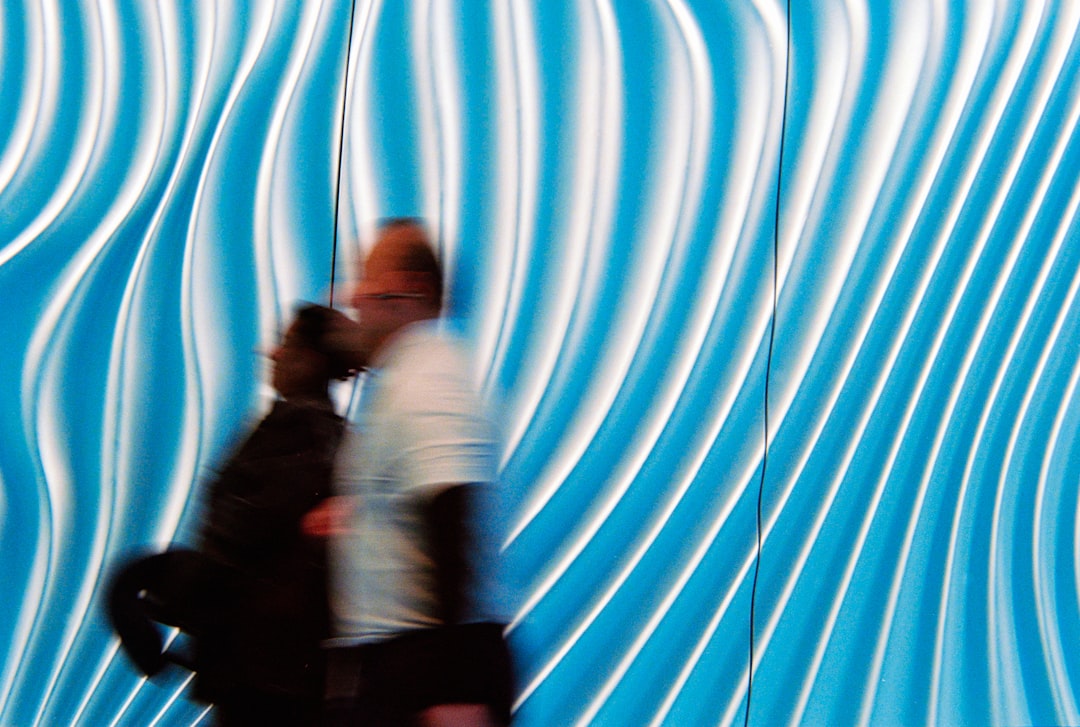
Motion blur and gesture lines push further, suggesting literal speed. A blurred background behind a sharp subject, or trailing lines behind a moving object, reads instantly as “this is fast,” borrowing the visual language of photography and illustration. Used sparingly, implied motion injects energy; overused, it becomes noise — so reserve it for the moments that genuinely need to feel fast.
How do you control movement on purpose?
The professional approach is to decide the intended path first, then stack techniques to reinforce it. Establish a focal point, aim leading lines at it, set the dominant line direction to match the mood, and use rhythm or directional cues to carry the eye onward to the next step. When every cue agrees, movement feels invisible and the design simply “reads well.”
Test it by tracing your own gaze on first glance: does the eye land where intended, then move in the right order? If it stalls or backtracks, find the conflicting cue — a stray strong diagonal, a competing focal point — and resolve it. Controlled movement is what turns a static arrangement into a guided experience, and it works best on a stable foundation built from sound layout principles.
Frequently Asked Questions
What is movement in design?
Movement in design is the way a composition guides the viewer’s eye from one element to the next, creating a sense of motion or a deliberate reading path. Even a still image can imply motion. Designers create movement with leading lines, diagonals, rhythm, directional cues, and implied motion like motion blur.
How do you create movement in a design?
You create movement by aiming leading lines at a focal point, using diagonal lines for energy, repeating elements to build rhythm, and adding directional cues like arrows or a subject’s gaze. Stack these techniques so they all reinforce the same intended path, and the eye will follow it effortlessly.
Why are diagonal lines associated with movement?
Diagonal lines imply motion because they run against the stable horizontal and vertical axes, suggesting action and instability rather than rest. The eye reads them as energetic and dynamic, like an object in mid-motion. That is why action, sports, and tech designs use diagonals to make compositions feel charged and moving.
What is the difference between movement and rhythm?
Movement is the overall path the eye travels through a design. Rhythm is one technique that creates movement, using repeated elements at regular or varied intervals to give the eye stepping stones to follow. Rhythm is essentially repetition-based movement, while movement is the broader principle of guiding visual flow.
How is movement related to visual flow?
Movement and visual flow describe the same idea from two angles: movement is the principle of guiding the eye, and visual flow is the resulting path it takes. When movement techniques like leading lines and rhythm are working, they produce smooth visual flow, leading the viewer through the content in the intended order.