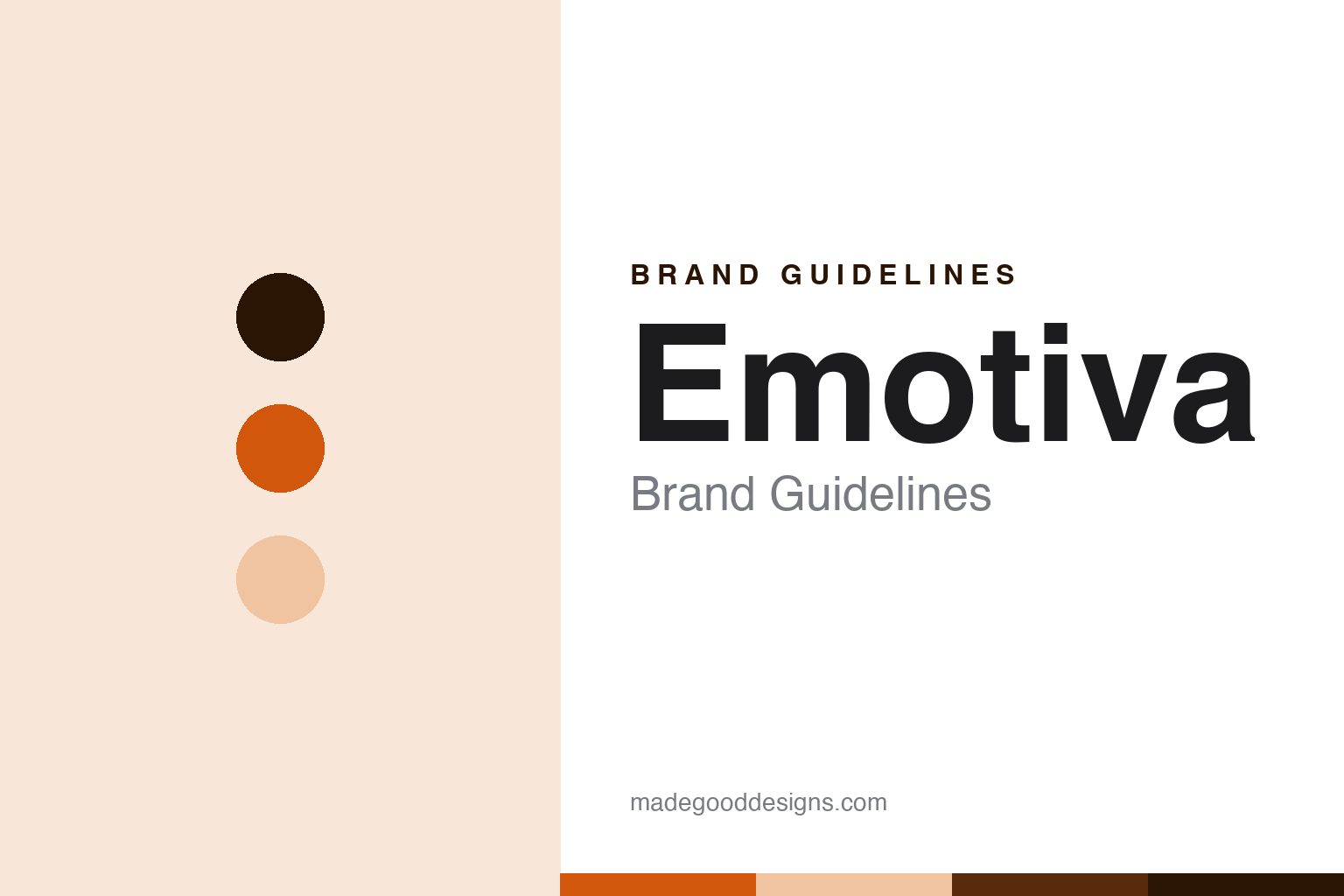
Emotiva Brand Guidelines
The American independent value brand.
Aa
Two constants: an Emotiva-orange palette and a separates-sans register. Abstract homage — not an Emotiva product or mark; no amplifier, dial or logo is reproduced.
The American independent value brand
Emotiva is a founder-owned Franklin, Tennessee maker (Dan Laufman) — selling XPA power amps and home-theater separates direct-to-consumer to “rethink high-end” pricing.
Emotiva follows Quad as the round’s American-independent node — a founder-owned Tennessee maker that sells home-theater and hi-fi separates direct, undercutting high-end pricing. Its answer to a round about who owns the amplifier world is the independent one: a family-owned brand that skipped the dealer.
Its identity is the American independent value brand. The Franklin founding, the founder ownership and the direct-to-consumer separates are the story here. Rethink high-end. The American independent value brand.
(Honest notes, so the founding, the ownership, the making and a claim are framed accurately, with hedges. Emotiva sells amplifiers and processors as its heroes — the XPA power amps, the BasX line and the RMC and XMC processors; we report its language as the brand’s own. On founding: Emotiva Audio Corporation was founded by Dan Laufman, its chief executive, in Franklin, Tennessee, a Nashville suburb, with its own history straddling 2003 to 2005, so we date it as around 2003. On ownership: it is a private, founder-and-family-owned US company selling direct to consumers, with no parent. On the making: Emotiva says its products are designed in the USA, while manufacturing has long been in Asia, which we attribute rather than assert as current wording. On a claim: its billing as the first direct-to-consumer high-end audio brand is Emotiva’s own claim, which we present as such. Its designs and the Emotiva name are IP we describe but do not reproduce; there is no official brand hex; these tones are an unofficial interpretation.)
Colour
Emotiva lives in an Emotiva orange. Click a swatch to copy the hex.
Emotiva’s identity is independent, value and direct — an Emotiva orange, an ink, a pale orange, a deep umber, and a paper. The palette leans Emotiva orange and deep umber: a bold, enthusiast register that nods to a value-separates brand rather than a loud logo colour. It signals the American independent value brand — independent, value and direct. The honest caveat: with no official brand hex, and a black-with-blue-accent identity documented, these values are an enthusiast, unofficial interpretation, not first-party colours.
The lesson is an Emotiva orange signals a value, direct identity. Emotiva’s world is the enthusiast’s rack bought online. For designers, it is a reminder that a bold orange and a pale orange can carry a value, direct brand — an enthusiast tone held as an accent, not a product shot. Because a bright hue fails as small text, keep type dark and let the colour live in the accents, palette and band. The takeaways: place the founding around 2003 and Franklin; keep the ownership independent and founder-owned; keep the making designed-USA, made-Asia; and attribute the first-DTC claim. A further design lesson is that a value brand earns trust by looking capable rather than cheap — a bold accent over a dark ground signals engineering confidence and lets the specifications, not the styling, carry the pitch, which is exactly how a direct-to-consumer challenger undercuts the high-end without looking like a bargain bin.
Typography
The register is a separates sans — independent, value, direct.
Emotiva’s identity carries an independent, value spirit — a family brand that skipped the dealer. A separates sans captures the mood: clean, bold and practical, the register of a direct-to-consumer amplifier. Set in an Emotiva-orange palette, the separates sans feels approachable and confident — exactly the personality Emotiva carries. It behaves like a made, shipped thing rather than a loud logo, mirroring a power-band and a signal-line. (Emotiva’s real products and the name are things we describe but do not reproduce, and the exact typeface is not ours to use.) Because it is not ours to use, the honest description is “a separates-sans brand,” shown here in a stand-in. The type behaves like the brand: independent, value and direct.
Aa
A separates-sans brand — approachable and confident. (Specimen set in Jost, a separates-sans STAND-IN; NOT the Emotiva logo or products.)
The amp node
Emotiva stands for the American independent value brand.
Emotiva sits sixth in the round as its American-independent node. An Emotiva-orange palette, a separates sans and a Franklin founding make one thing — the American independent value brand — the whole identity: independent, value and direct. The Franklin founding is the pitch, the founder ownership is the frame, and the direct-to-consumer separates are the substance. The point is a family-owned brand that skipped the dealer, in a round about who owns the amplifier world.
Put to work, the identity is the brand told straight, the ownership kept independent and a claim attributed. A brand in this spirit would place the founding around 2003 and Franklin, keep the ownership independent and founder-owned, keep the making designed-USA and made-Asia, and attribute the first-DTC claim. A reader in this spirit would keep the facts right: Emotiva sells the XPA amps and the RMC and XMC processors; it was founded around 2003 by Dan Laufman in Franklin, Tennessee; it is private and founder-owned; and it sells direct to consumers. Emotiva sits after Quad and before Schiit. The honest editorial moves are to place the founding, to keep the ownership independent, to attribute the making, and to attribute the claim.
For designers and brand-builders, Emotiva carries the amp node: keep a brand independent — and attribute its self-claims. The lessons: a brand can undercut the high-end by selling direct, here Emotiva; a founding is placed around 2003 by Dan Laufman in Franklin, Tennessee, a Nashville suburb, with the exact year hedged since its own history straddles 2003 to 2005; an ownership is kept accurate as private, founder-and-family-owned and direct-to-consumer, with no parent; a making is attributed as designed in the USA with manufacturing long in Asia, rather than asserting current country wording; and a claim is attributed, its billing as the first direct-to-consumer high-end audio brand kept as Emotiva’s own. It is also a reminder to stay precise: Emotiva is the independent, US value-separates brand of the amplifier aisle — with the palette here an unofficial interpretation. The hook is that model: Emotiva is the American independent value brand, a founder-owned Franklin, Tennessee maker under Dan Laufman, selling XPA power amps and home-theater separates direct-to-consumer to rethink high-end pricing. Read that way, Emotiva is less a single amplifier than the American independent value brand: independent, value, direct. The lesson for a brand is that keeping a brand independent and attributing its self-claims reinforce the honesty, and placing the founding keeps it earned. Emotiva made the-American-independent-value-brand the identity — proof that an honestly-attributed independent can anchor a node.
Explore & save
Keep Emotiva’s identity on hand — save it to a board in the Made Good inspiration library.
Emotiva identity set
Pin the Emotiva-orange palette and the separates-sans register to your own board.