Irix Brand Guidelines
Swiss name, Korean lens.
Aa
Two constants: a crimson palette and a value-sans register. Abstract homage — not an Irix product or mark.
Swiss name, Korean lens
Irix is the wide-angle and cine lens brand run by Swiss company TH Swiss, whose lenses are made in South Korea.
Irix is the round’s clearest name-isn’t-origin case — a Swiss-run brand whose lenses are Korean. Under the Irix name, manual-focus wide-angle photographic primes and value cine lenses are made, weather-sealed and affordable. Its answer to how a maker becomes a name is a split of roles: pair a Swiss brand and design direction with Korean manufacturing, and sell capable wide-angles for less. A wide-angle lens, Swiss in name, Korean in make.
Its identity is Swiss name, Korean lens. Irix’s wide-angle primes, its value cine line and its Swiss-brand-Korean-made split are the work it is known for. A lens, made in South Korea. A Swiss name, on Korean glass.
(Honest notes, so the story stays precise. Irix — at irixlens.com — makes manual-focus wide-angle photographic primes, above all the 15mm f/2.4 and 11mm f/4, each in a lighter Firefly and a tougher Blackstone trim, plus a value Irix Cine line and filters; weather-sealing is a recurring feature. On where it is made — a theme of this round — Irix is operated by TH Swiss, a Switzerland-based company, but the lenses are made in South Korea; the brand’s own framing is “Swiss precision and Korean innovation,” so we present the Korean manufacture as reported, corroborated by that language, rather than a printed “Made in Korea” line. On its history, it launched around 2016, which we present as reported. On ownership, it is run by TH Swiss, a Swiss company; the exact legal form we present as reported. Its name and marks are IP, described but never reproduced, and there is no official brand hex; these tones are an unofficial interpretation. This is design commentary and does not promote any product.)
Colour
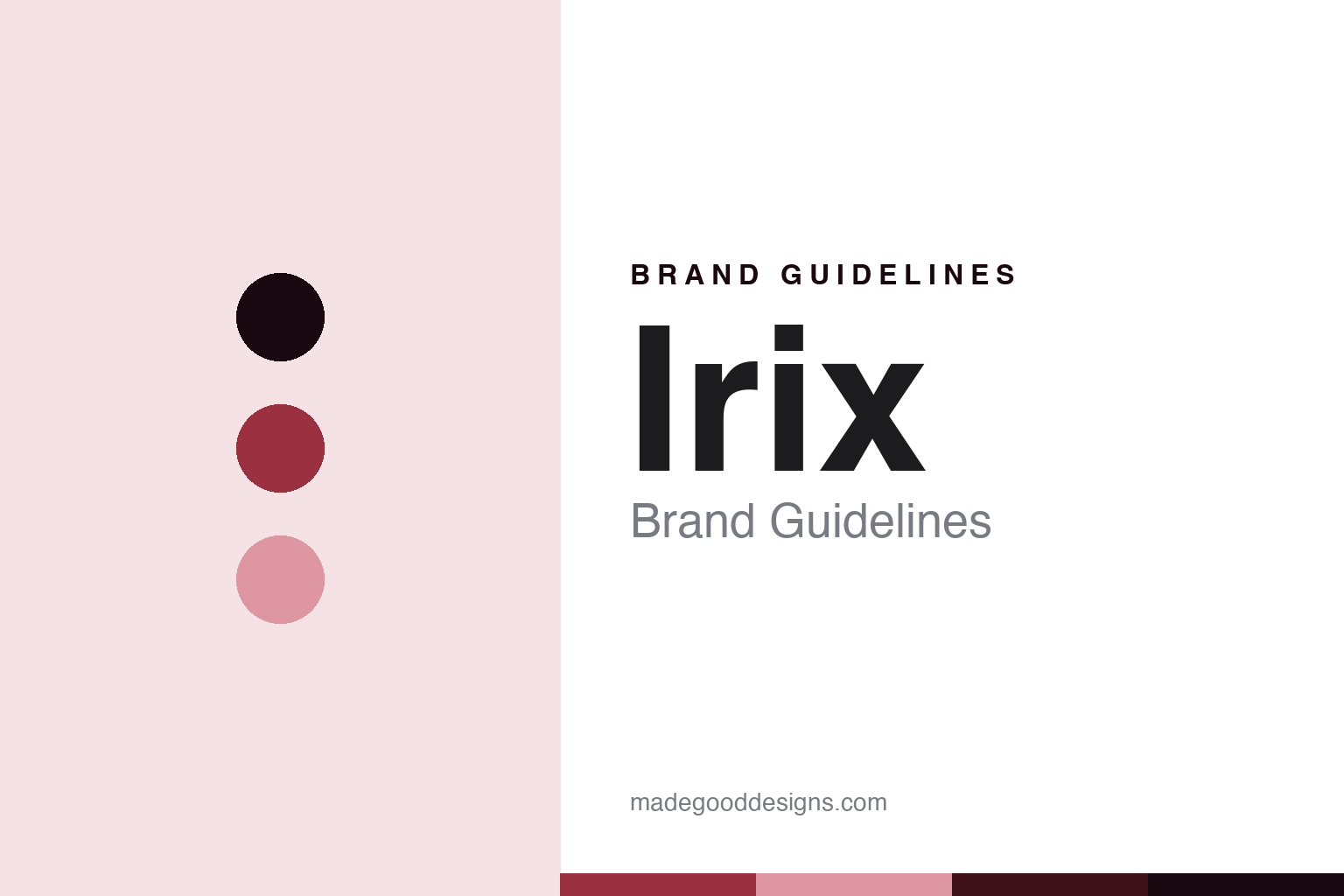
Irix lives in a crimson palette. Click a swatch to copy the hex.
Irix’s identity is value, made and split — a crimson, an ink, a rose, a deep crimson, and a paper. The palette leans crimson and rose: a distinctive register for a brand that pairs a Swiss name with a Korean make. It signals a value wide-angle lens. The honest caveat: with no published brand hex, these values are an original, unofficial interpretation, not first-party colours.
The lesson is a crimson palette signals a value, name-isn’t-origin identity. Irix’s world is a value, glass-and-metal object. For designers, it is a reminder that a deep crimson and a soft rose can carry a value lens brand — a distinctive tone for a maker whose name and make sit in different countries. Because these tones can fail as small text, keep type dark and let the colour live in the accents, palette and band. The takeaways: split the roles honestly; make it well; keep it affordable; and treat any single hex as unofficial.
Typography
The register is a value sans — plain, honest, made.
Irix’s identity carries a plain, honest, made spirit — a value lens brand, not a premium house. A value sans captures the mood: even, unpretentious and practical, the register of an affordable wide-angle maker. Set in a crimson palette, the value sans feels honest and made — exactly the personality Irix carries. It is value optics rather than a logo, mirroring a wide-angle prime. (Irix’s real wordmark is a thing we describe but do not reproduce, and the exact typeface is not ours to use.) Because it is not ours to use, the honest description is “a value-sans spirit,” shown here in a stand-in. The type behaves like the lens: plain, honest and made.
Aa
A value-sans spirit — honest and made. (Specimen set in Mulish, a value-sans STAND-IN; NOT the Irix logo.)
The lens makers
Irix stands for the Swiss name and the Korean lens.
Irix is a lesson in how a split of name and make can be an identity, told honestly. A crimson palette, a value sans and a wide-angle prime make one thing — Swiss name, Korean lens — the whole identity: value, made and split. The Swiss-brand-Korean-made structure is the differentiator, and the honesty about it is the meaning. The point is a value wide-angle brand that pairs a Swiss name with Korean manufacturing, and is candid, in its own words, about both halves.
Put to work, the identity is a split of roles, told straight, as design. A maker in this spirit would pair a brand and a make honestly and sell for less — wide-angle primes, Swiss in name, Korean in build. A reader in this spirit would keep the name and the origin apart: Irix is run by a Swiss company, TH Swiss, but its lenses are made in South Korea, so the name is not the origin. Irix holds the round’s name-isn’t-origin pole with the American-brand-German-made boutique that follows, and its where-made thread at the split end, against the openly-Chinese-made new wave. The honest editorial moves are to present the Korean make as reported, corroborated by the brand’s own “Swiss precision and Korean innovation,” to present the founding and legal form as reported, and to keep the name distinct from the origin. The lesson Irix teaches is that a split can hold an identity when it is told honestly: the value glass gives it substance, and the candour about the split keeps it credible. The split is the personality, and the wide-angle prime is the proof.
For designers and brand-builders, Irix holds a name-isn’t-origin pole in the lens makers: split the roles — and tell it honestly. The lessons: pair a brand with a make; keep the value real; state a made-in as reported when it is not printed; keep the name distinct from the origin; and never reproduce a logo. It is also a reminder to stay precise: Irix is the wide-angle and cine lens brand run by Swiss company TH Swiss, whose lenses are made in South Korea — with the palette here an unofficial interpretation. The value glass carries the substance, and the candour about the split carries the trust; together they show that a brand need not pretend its name and its factory share a country to be taken seriously. Irix made the Swiss-name-Korean-lens split the identity — proof that a lens, honestly told, can be the difference.
Explore & save
Keep Irix’s identity on hand — save it to a board in the Made Good inspiration library.
Irix identity set
Pin the crimson palette and the value-sans register to your own board.