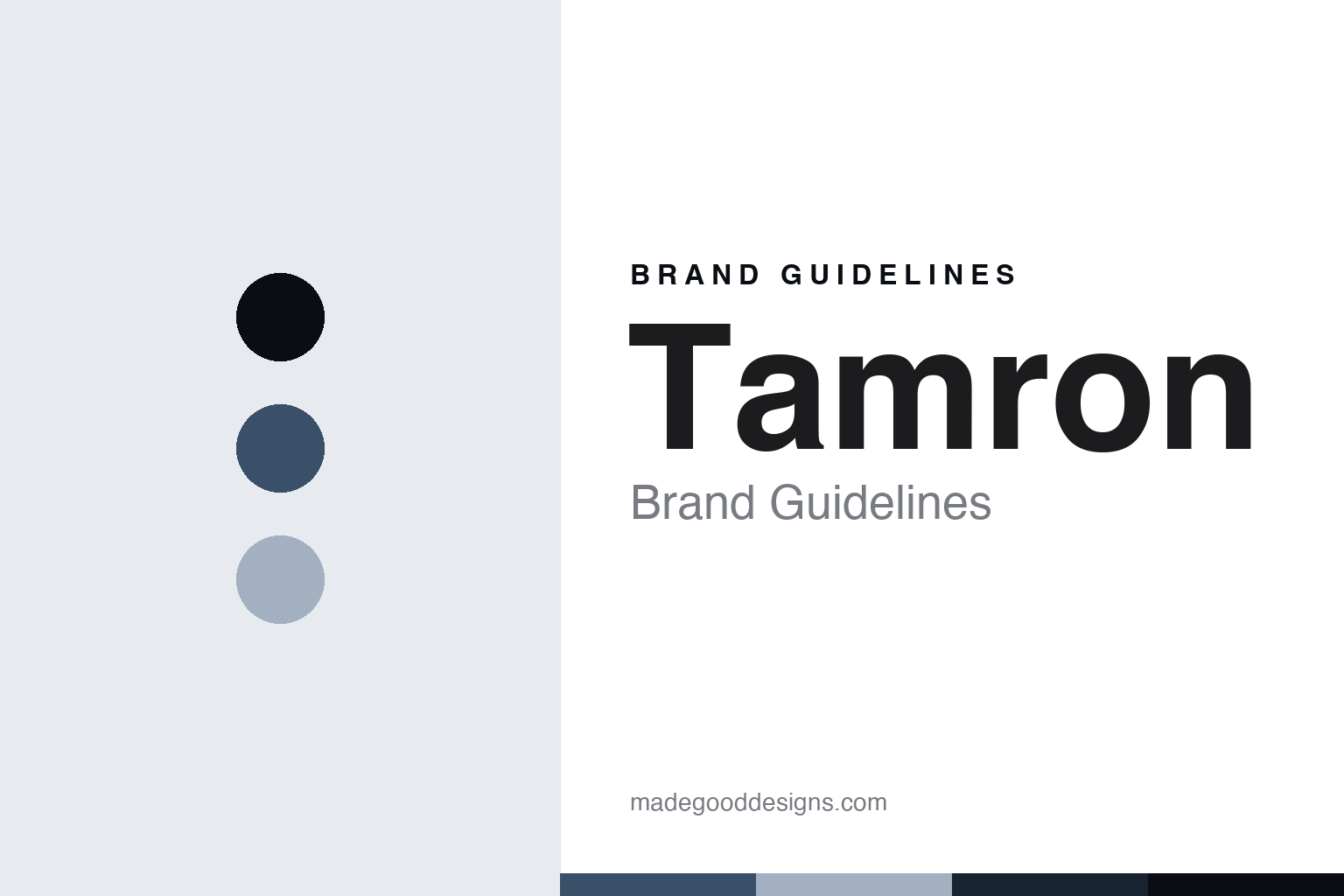
Tamron Brand Guidelines
The third-party lens.
Aa
Two constants: a steel-blue palette and a third-party-sans register. Abstract homage — not a Tamron product or mark.
The third-party lens
Tamron is the listed Japanese third-party lens maker whose largest shareholder is Sony, making lenses in Japan, Vietnam and China.
Tamron opens the round as the archetypal third-party lens maker — a house that makes lenses for other companies’ cameras. From Japan, Tamron makes interchangeable photographic lenses for the mirrorless mounts of Sony, Nikon, Fujifilm and Canon, along with a large business in industrial, surveillance and OEM optics. Its answer to how a maker becomes a name is value and versatility: build well-priced, capable lenses — fast standard zooms and long all-in-one zooms — for the systems photographers already own. A lens, for another maker’s camera.
Its identity is the third-party lens. Tamron’s versatile zooms, its listed ownership with Sony as top shareholder, and its multi-country making are the work it is known for. A lens, made for many mounts. The third-party house.
(Honest notes, so the story stays precise. Tamron — at tamron.com — makes third-party interchangeable lenses for Sony E, Nikon Z, Fujifilm X and Canon RF mounts, plus industrial, CCTV and OEM optics; its signature is the fast 28-75mm f/2.8 for Sony E, and it pioneered the high-ratio all-in-one zoom. It was founded in 1950 in Japan as Taisei Optical, later named after the optical designer Uhyoue Tamura, and is headquartered in Saitama. On ownership — a key thread of this vein — Tamron is listed on the Tokyo Stock Exchange, and its largest shareholder is Sony, which held a reported stake of around fifteen per cent in 2024; we present the exact figure as reported. On where the lenses are made, Tamron manufactures in Japan, in Aomori, alongside factories in Vietnam and China, so we do not imply everything is Japan-made. Its in-lens stabilization is branded VC, for Vibration Compensation. Its name and marks are IP, described but never reproduced, and there is no official brand hex; these tones are an unofficial interpretation. This is design commentary and does not promote any product.)
Colour
Tamron lives in a steel-blue palette. Click a swatch to copy the hex.
Tamron’s identity is versatile, made and value-minded — a steel blue, an ink, a chambray, a deep steel, and a paper. The palette leans steel blue and chambray: the register of coated glass and a metal barrel. It signals a third-party lens house. The honest caveat: with no published brand hex, these values are an original, unofficial interpretation, not first-party colours.
The lesson is a steel-blue palette signals a versatile, third-party identity. Tamron’s world is a versatile, glass-and-metal object. For designers, it is a reminder that a steel blue and a soft chambray can carry a lens maker — the tone of coated glass and the neutral of a barrel. Because these tones can fail as small text, keep type dark and let the colour live in the accents, palette and band. The takeaways: serve other systems; make in many places; be honest about the ownership; and treat any single hex as unofficial.
Typography
The register is a third-party sans — plain, versatile, made.
Tamron’s identity carries a plain, versatile, made spirit — a third-party lens maker, not a camera brand. A third-party sans captures the mood: even, practical and adaptable, the register of a maker that serves many mounts. Set in a steel-blue palette, the third-party sans feels versatile and made — exactly the personality Tamron carries. It is third-party optics rather than a logo, mirroring a zoom barrel. (Tamron’s real wordmark is a thing we describe but do not reproduce, and the exact typeface is not ours to use.) Because it is not ours to use, the honest description is “a third-party-sans spirit,” shown here in a stand-in. The type behaves like the lens: plain, versatile and made.
Aa
A third-party-sans spirit — versatile and made. (Specimen set in Work Sans, a third-party-sans STAND-IN; NOT the Tamron logo.)
The lens makers
Tamron stands for the third-party lens, listed and Sony-held.
Tamron opens the round with the vein’s two questions ready: who owns the lens maker, and where are the lenses made? A steel-blue palette, a third-party sans and a versatile zoom make one thing — the third-party lens — the whole identity: versatile, made and value-minded. The listed ownership with Sony as top shareholder is the differentiator, and the multi-country making is the meaning. The point is a house that makes lenses for other companies’ cameras, is publicly traded, and counts a camera giant among its owners.
Put to work, the identity is a third-party position, told straight, as design. A maker in this spirit would serve other systems well and price fairly — fast zooms, for the mounts people own. A reader in this spirit would hold the ownership thread: Tamron is not owned by a family or a foundation but is publicly listed, with Sony — a camera maker it also supplies — as its largest shareholder, a quietly remarkable arrangement. And a reader would hold the where-made nuance: Japanese by HQ, but made across Japan, Vietnam and China. Tamron sets the round’s ownership variety at the listed, camera-giant-held pole, and its where-made thread at the multi-country pole. The honest editorial moves are to present the Sony stake and its figure as reported, to name the three manufacturing countries, and to keep the founding precise. The lesson Tamron teaches is that a third-party position can hold an identity: the versatility gives it substance, and the honesty about the ownership keeps it credible. The third-party lens is the personality, and the versatile zoom is the proof.
For designers and brand-builders, Tamron opens the lens makers, from Japan: serve other systems — and be honest about who owns you and where you make. The lessons: build for the mounts people own; price for value; disclose an unusual ownership plainly; name your manufacturing countries; and never reproduce a logo. It is also a reminder to stay precise: Tamron is the listed Japanese third-party lens maker whose largest shareholder is Sony, making lenses in Japan, Vietnam and China — with the palette here an unofficial interpretation. Tamron made the third-party lens the identity — proof that a lens, honestly made, can be the difference.
Explore & save
Keep Tamron’s identity on hand — save it to a board in the Made Good inspiration library.
Tamron identity set
Pin the steel-blue palette and the third-party-sans register to your own board.