Meyer-Optik Görlitz Brand Guidelines
The character revived.
Aa
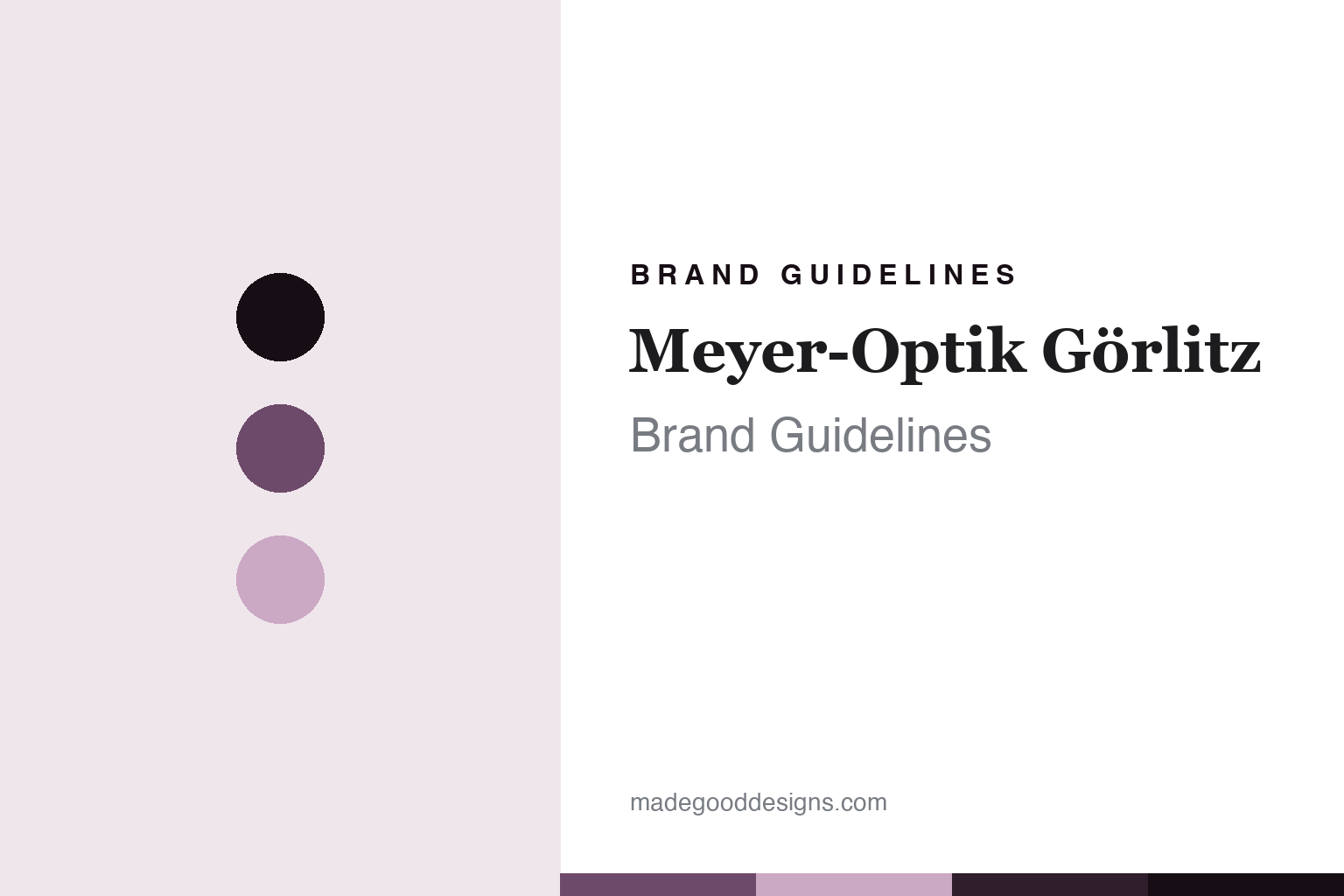
Two constants: a bokeh-mauve palette and a character-serif register. Abstract homage — not a Meyer-Optik Görlitz product or mark.
The character revived
Meyer-Optik Görlitz is the German character-lens name behind the soap-bubble-bokeh Trioplan, revived after a turbulent history and made in Germany.
Meyer-Optik Görlitz closes the round with the return of lens character — and a turbulent revival. Under the Meyer-Optik name, character and art photographic lenses are made, prized for distinctive rendering, above all the Trioplan and its famous soap-bubble bokeh. Its answer to how a maker becomes a name is one unmistakable look: revive a historic German lens name and its character optics, and make them in Germany. A lens, made for its character.
Its identity is the character revived. Meyer-Optik Görlitz’s Trioplan bokeh, its character lenses and its turbulent-but-ongoing revival are the work it is known for. A lens, made in Germany. The character revived.
(Honest notes, so the story stays precise, because the history is genuinely complicated. Meyer-Optik Görlitz — at meyer-optik-goerlitz.com — makes character and art lenses, with the Trioplan and its soap-bubble bokeh the signature, alongside the Primoplan, Biotar and others. The name is old: the original Hugo Meyer & Co. was founded in 1896 in Görlitz; after the Second World War it was expropriated into an East German works, and the Meyer-Optik name faded from lenses after 1971. The modern story is a revival that collapsed and came back: the name was revived for character lenses through crowdfunding from around 2014, run by a company, net SE, which collapsed into insolvency in the mid-to-late 2010s, leaving many backers without lenses; then, at the end of 2018, the German firm OPC Europe acquired the rights and re-revived it, and it has operated as an independent company since 2021. On where it is made — a theme of this round — its lenses are made in Germany, with OPC based in Bad Kreuznach and the Meyer-Optik manufactory in Hamburg. On ownership, it is owned by OPC; the current legal entity is Meyer Optik Görlitz GmbH. Its name and marks are IP, described but never reproduced, and there is no official brand hex; these tones are an unofficial interpretation. This is design commentary and does not promote any product.)
Colour
Meyer-Optik Görlitz lives in a bokeh-mauve palette. Click a swatch to copy the hex.
Meyer-Optik Görlitz’s identity is characterful, made and revived — a bokeh mauve, an ink, a lilac, a deep mauve, and a paper. The palette leans bokeh mauve and lilac: the register of the iridescent, dreamy rendering the brand is known for, evoked as colour, not as a bokeh diagram. It signals a character-lens house. The honest caveat: with no published brand hex, these values are an original, unofficial interpretation, not first-party colours.
The lesson is a bokeh-mauve palette signals a characterful, revived identity. Meyer-Optik Görlitz’s world is a characterful, glass object. For designers, it is a reminder that a soft bokeh mauve and a pale lilac can carry a character-lens maker — the iridescence of a dreamy rendering — without drawing a single bubble. Because these tones can fail as small text, keep type dark and let the colour live in the accents, palette and band. The takeaways: own a look; revive it honestly; make it at home; and treat any single hex as unofficial.
Typography
The register is a character serif — expressive, storied, made.
Meyer-Optik Görlitz’s identity carries an expressive, storied, made spirit — a character-lens house with a long, turbulent past. A character serif captures the mood: romantic, distinctive and German, the register of a revived Görlitz name. Set in a bokeh-mauve palette, the character serif feels expressive and storied — exactly the personality Meyer-Optik carries. It is a signature look rather than a logo, mirroring a soap-bubble rendering. (Meyer-Optik Görlitz’s real wordmark is a thing we describe but do not reproduce, and the exact typeface is not ours to use.) Because it is not ours to use, the honest description is “a character-serif spirit,” shown here in a stand-in. The type behaves like the lens: expressive, storied and made.
Aa
A character-serif spirit — expressive and storied. (Specimen set in Playfair Display, a character-serif STAND-IN; NOT the Meyer-Optik Görlitz logo.)
The lens makers
Meyer-Optik Görlitz stands for the character revived, honestly.
Meyer-Optik Görlitz closes the round with the return of character — and an honest telling of a hard road. A bokeh-mauve palette, a character serif and a soap-bubble rendering make one thing — the character revived — the whole identity: characterful, made and revived. The Trioplan bokeh is the differentiator, and the honest, turbulent revival is the meaning. The point is a historic German lens name, brought back for its character, that collapsed once and came back, and now makes in Germany.
Put to work, the identity is a look and an honest history, told straight, as design. A maker in this spirit would revive an unmistakable character and make it at home — the Trioplan, in Germany. A reader in this spirit would hold the hard facts: the name is 1896, but the modern revival is recent; a crowdfunded first attempt collapsed into insolvency and stranded backers; and the current maker, OPC, re-revived it from the end of 2018. Meyer-Optik closes the round’s character thread with Tribe7 and Irix, and its German-heartland thread with Schneider and Tribe7’s IB/E, and it closes the round on the honest note that a revival can be worth telling even when it has failed once. The honest editorial moves are to split the 1896 name from the recent revival, to present the net SE collapse and its date as reported, to state the German making with OPC in Bad Kreuznach and the manufactory in Hamburg, and to omit an unverified owner name. The lesson Meyer-Optik teaches is that a character can hold an identity through a turbulent history: the look gives it substance, and the honesty about the collapse and comeback keeps it credible. The character is the personality, and the Trioplan bokeh is the proof. Across the round, seven lens makers — an established third-party name, a heritage optics house, two of the Chinese new wave, a Swiss-named Korean-made brand, an American-led German-built boutique and a revived German character name — answer the vein’s question: in the second wave of lens makers, who really makes the glass, and where?
For designers and brand-builders, Meyer-Optik closes the lens makers, from Germany: revive a character — and tell the hard history honestly. The lessons: own an unmistakable look; split a heritage name from a recent revival; disclose a collapse rather than hide it; make it at home; and never reproduce a logo. It is also a reminder to stay precise: Meyer-Optik Görlitz is the German character-lens name behind the soap-bubble-bokeh Trioplan, revived after a turbulent history and made in Germany — with the palette here an unofficial interpretation. Meyer-Optik made the character revived the identity — proof that a lens, honestly told, can be the difference.
Explore & save
Keep Meyer-Optik Görlitz’s identity on hand — save it to a board in the Made Good inspiration library.
Meyer-Optik Görlitz identity set
Pin the bokeh-mauve palette and the character-serif register to your own board.