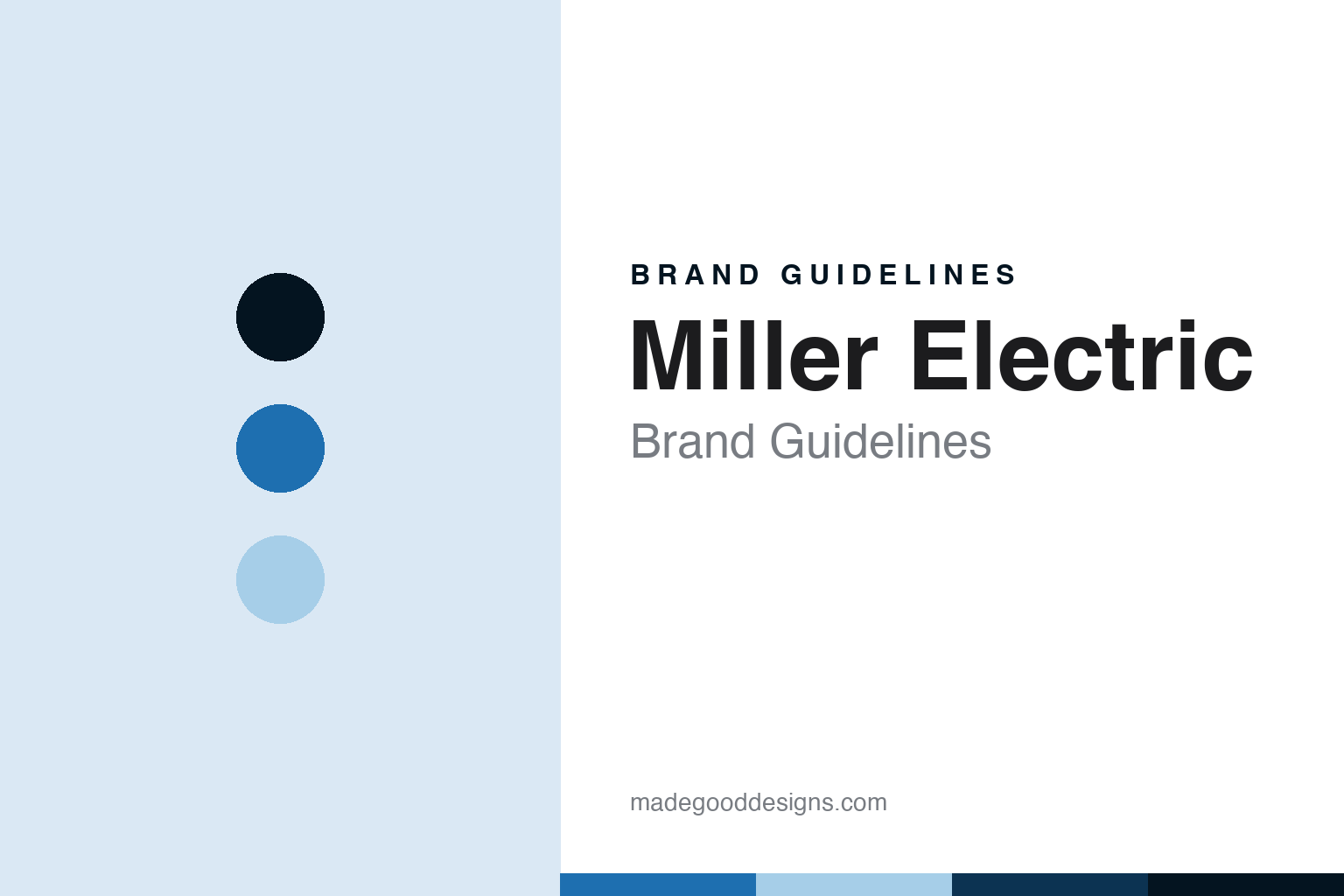
Miller Electric Brand Guidelines
The blue standard, under ITW.
Aa
Two constants: a Miller-blue palette and a standard-sans register. Abstract homage — not a Miller Electric product or mark; no welder, arc or logo is reproduced.
The blue standard, under ITW
Miller Electric is a 1929 Appleton, Wisconsin maker whose 1971 Millermatic broadened MIG welding — owned since 1993 by Illinois Tool Works.
Miller Electric follows Lincoln as the round’s standard node — the blue equipment that set a shop benchmark, a 1929 Wisconsin maker whose Millermatic broadened MIG welding, now owned by a large industrial conglomerate. Its answer to a round about who owns the welders is the conglomerate one: a strong brand run within a bigger group.
Its identity is the blue standard, under ITW. The 1929 founding, the Millermatic milestone and the ITW ownership are the story here. Blue, benchmark, group-owned. The blue standard, under ITW.
(Honest notes, so the founding, the ownership and the milestone are framed accurately. Miller Electric sells welding equipment as its heroes — the Millermatic MIG, the Dynasty and Syncrowave TIG, and engine-driven and multiprocess machines; we report its language as the brand’s own. On origin: Miller was founded in 1929 by Niels Miller in Appleton, Wisconsin, building his first arc welder in his basement to run on rural power, and was incorporated as Miller Electric Mfg. Co. in 1935. On ownership: it is owned by Illinois Tool Works, which acquired it in 1993, and it operates within the ITW Welding segment, still based in Appleton. On the milestone: the Millermatic, which combined the power source and wire feed in one unit, was introduced in 1971 and is credited with broadening access to MIG welding. On colour, attributed: blue is the recognised equipment colour, cited by forums as a specific Pantone and paint code, which we treat as community and paint-match information rather than an official brand hex, and we note there are no significant recalls identified, keeping Miller distinct from unrelated companies that share the Bobcat or Miller names. Its designs and the Miller Electric name are IP we describe but do not reproduce; there is no official brand hex; these tones are an unofficial interpretation.)
Colour
Miller Electric lives in a Miller blue. Click a swatch to copy the hex.
Miller Electric’s identity is benchmark, ITW-owned and MIG-broadening — a Miller blue, an ink, a pale blue, a deep navy, and a paper. The palette leans Miller blue and deep navy: a strong, capable register that nods to the recognised blue machines rather than a loud logo colour. It signals the blue standard, under ITW — benchmark, ITW-owned and MIG-broadening. The honest caveat: with no official brand hex, and only a community “Miller blue” Pantone documented, these values are a capable, unofficial interpretation, not first-party colours.
The lesson is a Miller blue signals a benchmark, capable identity. Miller Electric’s world is the shop standard. For designers, it is a reminder that a strong blue and a deep navy can carry a benchmark, industrial brand — a capable tone held as an accent, not a product shot. Because a mid hue can fail as small text, keep type dark and let the colour live in the accents, palette and band. The takeaways: date the founding to 1929 and Niels Miller in Appleton; note the ITW ownership since 1993; credit the 1971 Millermatic; and treat the “Miller blue” colour as community information.
Typography
The register is a standard sans — benchmark, ITW-owned, MIG-broadening.
Miller Electric’s identity carries a benchmark, ITW-owned spirit — a shop standard in a big group. A standard sans captures the mood: clean, capable and industrial, the register of a benchmark machine. Set in a Miller-blue palette, the standard sans feels strong and reliable — exactly the personality Miller carries. It behaves like a made, working thing rather than a loud logo, mirroring a bead-band and a seam-line. (Miller’s real products and the name are things we describe but do not reproduce, and the exact typeface is not ours to use.) Because it is not ours to use, the honest description is “a standard-sans brand,” shown here in a stand-in. The type behaves like the brand: benchmark, ITW-owned and MIG-broadening.
Aa
A standard-sans brand — strong and reliable. (Specimen set in Archivo, a standard-sans STAND-IN; NOT the Miller Electric logo or products.)
The welding node
Miller Electric stands for the blue standard, under ITW.
Miller Electric sits second in the round as its standard node. A Miller-blue palette, a standard sans and a 1929 founding make one thing — the blue standard, under ITW — the whole identity: benchmark, ITW-owned and MIG-broadening. The 1929 founding is the pitch, the Millermatic is the milestone, and the ITW ownership is the frame. The point is a strong brand run within a bigger group, in a round about who owns the welders.
Put to work, the identity is the brand told straight, the ownership named and the milestone dated. A brand in this spirit would date the founding to 1929 and Niels Miller in Appleton, note the ITW ownership since 1993, credit the 1971 Millermatic, and treat the “Miller blue” colour as community information. A reader in this spirit would keep the facts right: Miller sells the Millermatic, Dynasty and Syncrowave; it was founded in 1929 by Niels Miller in Appleton, Wisconsin; it is owned by Illinois Tool Works since 1993; and the Millermatic dates to 1971. Miller sits after Lincoln and before Hobart. The honest editorial moves are to date the founding, to name the owner, to credit the milestone, and to attribute the colour.
For designers and brand-builders, Miller Electric carries the welding node: name a conglomerate owner — and date a real milestone. The lessons: a brand can be the shop standard inside a larger group, here Miller under Illinois Tool Works; a founding is dated to 1929 and Niels Miller in Appleton, Wisconsin, with the basement first welder and the 1935 incorporation noted; an ownership is named as ITW since the 1993 acquisition, within the ITW Welding segment; a milestone is dated and credited, the 1971 Millermatic that combined the power source and wire feed and broadened MIG access; and a colour is attributed, “Miller blue” cited by forums as a Pantone and paint code, treated as community and paint-match information rather than an official brand hex, with no significant recalls identified and the brand kept distinct from unrelated Bobcat and Miller names. It is also a reminder to stay precise: Miller Electric is the ITW-owned blue standard of the welding aisle — with the palette here an unofficial interpretation. The hook is that benchmark: Miller Electric is the blue standard, under ITW, a 1929 Appleton, Wisconsin maker whose 1971 Millermatic broadened MIG welding, owned since 1993 by Illinois Tool Works. Read that way, Miller is less a single welder than the blue standard, under ITW: benchmark, ITW-owned, MIG-broadening. The lesson for a brand is that naming a conglomerate owner and dating a real milestone reinforce the clarity, and dating the founding keeps it earned. Miller Electric made the-blue-standard the identity — proof that a group-owned benchmark can anchor a node.
Explore & save
Keep Miller Electric’s identity on hand — save it to a board in the Made Good inspiration library.
Miller Electric identity set
Pin the Miller-blue palette and the standard-sans register to your own board.