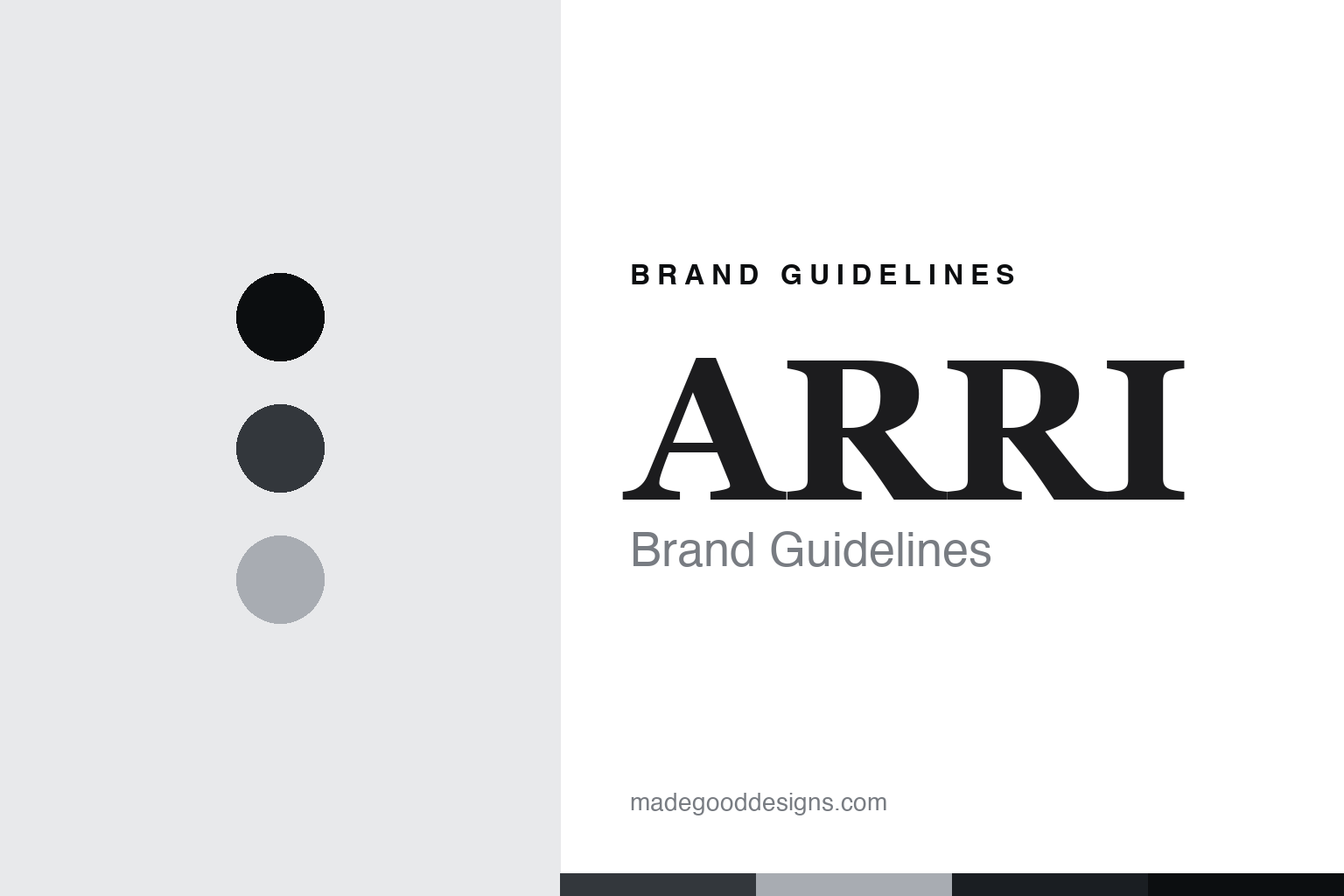
ARRI Brand Guidelines
A century, then sold.
Aa
Two constants: a graphite palette and a heritage-serif register. Abstract homage — not an ARRI product or mark.
A century, then sold
ARRI is the Munich cinema house, maker of the Alexa and its own Signature lenses, family-owned from 1917 until a reported 2026 sale.
ARRI is the round’s cinema institution — a century-old German house that makes both the camera and the lens. From Munich, ARRI makes professional cinema cameras, the Alexa line above all, and its own Signature cine lenses, along with lighting and camera-support systems. Its answer to how a maker becomes a name is to build the whole cinema toolkit, from the body to the glass, over more than a hundred years. A cinema camera, and the lens to match.
Its identity is a century, then sold. ARRI’s Alexa cameras, its Signature lenses and its just-changed ownership are the work it is known for. A lens, made in Germany. A century of family, then a sale.
(Honest notes, so the story stays precise, and the ownership has changed. ARRI — at arri.com, formally Arnold & Richter Cine Technik — makes cinema cameras (the Alexa, Alexa 35 and Amira), its own Signature Prime and Signature Zoom lenses, and lighting and camera support; its historic Master and Ultra Prime lenses were made in collaboration with Zeiss, which we present as reported. It was founded on 12 September 1917 in Munich by August Arnold and Robert Richter — the “A” and “R” of ARRI. On ownership — a key thread of this vein — ARRI was privately held and family-owned by the Arnold and Richter descendants for over a century, from 1917; but it is reported that on 14 April 2026 it was acquired by Thomas Riedel of Riedel Communications, ending that family ownership. Because we could reach only a single source for the sale, we present the acquisition as reported. On where it is made, ARRI is headquartered and manufactures in Munich, Germany; the lens-by-lens make we state as reported. Its many Academy technical awards we describe as more than a dozen. Its name and marks are IP, described but never reproduced, and there is no official brand hex; these tones are an unofficial interpretation. This is design commentary and does not promote any product.)
Colour
ARRI lives in a graphite palette. Click a swatch to copy the hex.
ARRI’s identity is cinematic, made and institutional — a graphite, an ink, a silver, a deep graphite, and a paper. The palette leans graphite and silver: the register of a cinema-camera body and machined metal. It signals a heritage cinema house. The honest caveat: with no published brand hex, these values are an original, unofficial interpretation, not first-party colours.
The lesson is a graphite palette signals a cinematic, institutional identity. ARRI’s world is a cinematic, metal-and-glass object. For designers, it is a reminder that a deep graphite and a cool silver can carry a cinema house — the tone of a camera body and the neutral of a machined part. Because these tones can fail as small text, keep type dark and let the colour live in the accents, palette and band. The takeaways: build the whole toolkit; make it at home; tell an ownership change honestly; and treat any single hex as unofficial.
Typography
The register is a heritage serif — classical, cinematic, made.
ARRI’s identity carries a classical, cinematic, institutional spirit — a century-old cinema house, not a consumer brand. A heritage serif captures the mood: traditional, weighty and cinematic, the register of a Munich house founded in 1917. Set in a graphite palette, the heritage serif feels classical and cinematic — exactly the personality ARRI carries. It is cinema heritage rather than a logo, mirroring a movie camera and its lens. (ARRI’s real wordmark is a thing we describe but do not reproduce, and the exact typeface is not ours to use.) Because it is not ours to use, the honest description is “a heritage-serif spirit,” shown here in a stand-in. The type behaves like the camera: classical, cinematic and made.
Aa
A heritage-serif spirit — classical and cinematic. (Specimen set in Cormorant Garamond, a heritage-serif STAND-IN; NOT the ARRI logo.)
The lens makers
ARRI stands for the cinema house whose century of family ownership just ended.
ARRI is a lesson in how an ownership change can be part of the identity. A graphite palette, a heritage serif and a cinema lens make one thing — a century, then sold — the whole identity: cinematic, made and institutional. The century-old cinema toolkit is the differentiator, and the just-changed ownership is the meaning. The point is a Munich house that made the movies’ cameras and lenses for over a hundred years as a family firm, and, it is reported, was sold in 2026.
Put to work, the identity is a century and a turning point, told honestly, as design. A maker in this spirit would build the whole toolkit and make it at home — cameras and Signature lenses, in Munich. A reader in this spirit would hold the ownership thread carefully: ARRI was family-owned from 1917 for over a century, but is reported to have been acquired in April 2026 by Thomas Riedel, so “still family-owned” is no longer accurate, and the sale, single-sourced, is best stated as reported. ARRI holds the round’s ownership variety at its most dramatic — a family firm at the exact moment it changed hands — against the round’s listed maker, conglomerate and independents. The honest editorial moves are to confirm it genuinely makes its own Signature lenses, to present the Zeiss collaboration and lens-by-lens make as reported, and to state the 2026 sale as reported and single-sourced. The lesson ARRI teaches is that an ownership change can hold an identity: the century gives it substance, and the honesty about the sale keeps it credible. The century is the personality, and the Signature lens is the proof.
For designers and brand-builders, ARRI holds the Germany pole in the lens makers: build the whole toolkit — and tell an ownership change honestly. The lessons: make cameras and lenses alike; manufacture at home; mark a family firm’s sale plainly; flag a single-sourced claim as reported; and never reproduce a logo. It is also a reminder to stay precise: ARRI is the Munich cinema house, maker of the Alexa and its own Signature lenses, family-owned from 1917 until a reported 2026 sale — with the palette here an unofficial interpretation. ARRI made a century-and-a-turning-point the identity — proof that a lens, honestly made, can be the difference.
Explore & save
Keep ARRI’s identity on hand — save it to a board in the Made Good inspiration library.
ARRI identity set
Pin the graphite palette and the heritage-serif register to your own board.