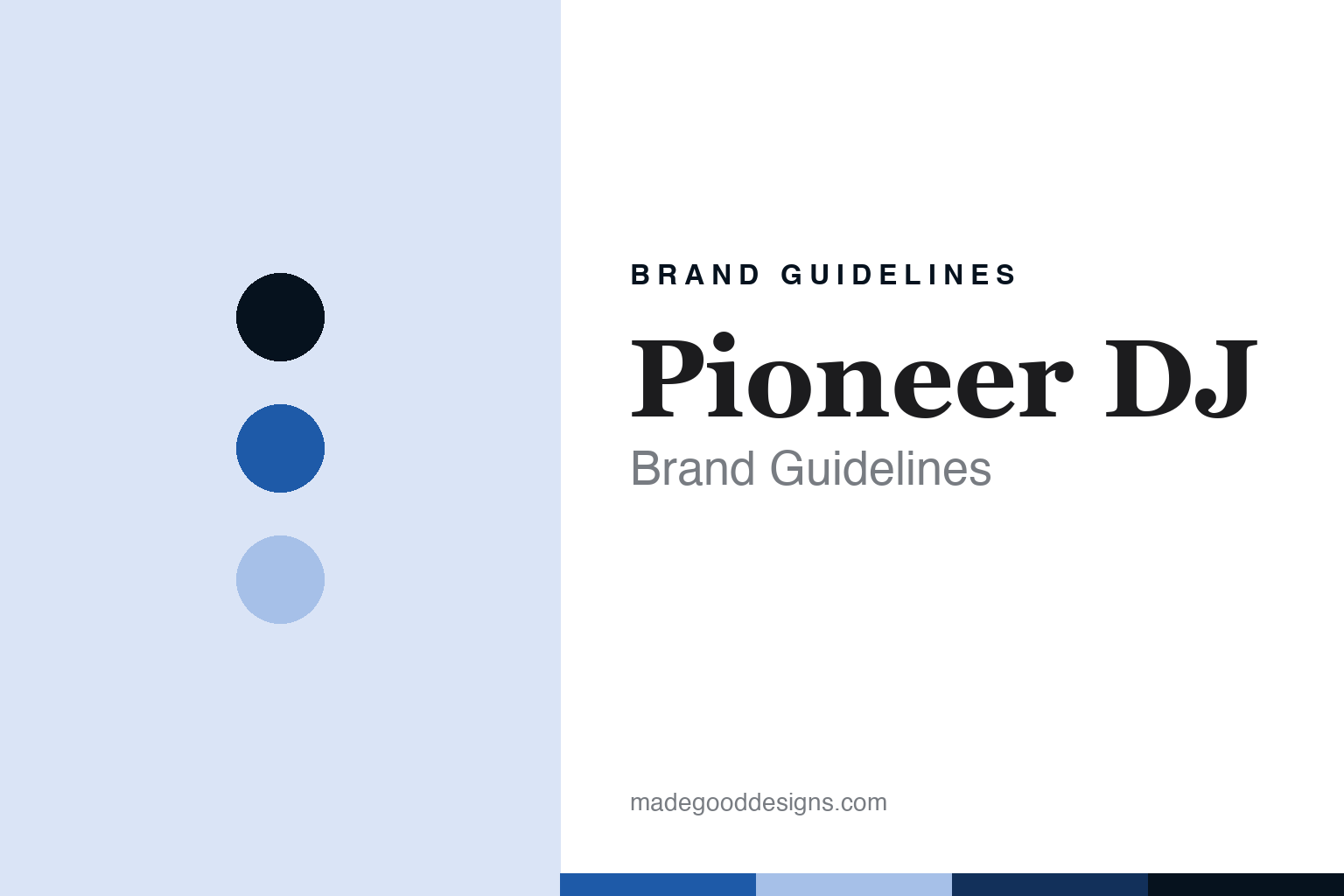
Pioneer DJ Brand Guidelines
The club-standard deck.
Aa
Two constants: a Pioneer-blue palette and a standard-serif register. Abstract homage — not a Pioneer DJ product or mark; no deck, mixer or logo is reproduced.
The club-standard deck
Pioneer DJ is the CDJ-and-DJM setup in nearly every pro booth — a brand of Japan’s AlphaTheta (owned since 2020 by photo-equipment maker Noritsu Koki) that regulators blocked from buying Serato.
Pioneer DJ opens the DJ-gear round as its standard node — the media players and mixers that make up the reference setup in professional club booths, a Japanese brand whose ownership hides a genuine surprise and whose attempt to buy the industry’s software was blocked. Its answer to a round about who owns the DJ world is the standard-bearer one: the club default, held by an unexpected parent.
Its identity is the club-standard deck. The AlphaTheta and Noritsu ownership, the CDJ and DJM lines and the blocked Serato deal are the story here. The booth default. The club-standard deck.
(Honest notes, so the ownership, the making, the blocked deal and one trap are framed accurately. Pioneer DJ sells DJ gear as its heroes — the CDJ media players, the DJM mixers, rekordbox software and DDJ controllers; we report its language as the brand’s own. On ownership, corrected and dated: Pioneer DJ is a brand of AlphaTheta Corporation, which was carved out of Pioneer Corporation to the firm KKR around 2015, renamed AlphaTheta in 2020, and then bought outright in 2020 by Noritsu Koki, a Japanese photofinishing-equipment maker listed in Tokyo, so AlphaTheta’s ultimate parent is a photo-equipment company. On a blocked deal: AlphaTheta announced in 2023 that it would buy Serato, but New Zealand’s competition regulator declined clearance in 2024 and the deal was abandoned, so Pioneer DJ does not own Serato. On the making: designed in Japan, with manufacturing reportedly shifted to Malaysia and China. On a trap: Pioneer DJ is not Pioneer Corporation, now an automotive-electronics firm, nor Pioneer home audio, which was sold to Onkyo, so three separate Pioneers exist. Its designs and the Pioneer DJ name are IP we describe but do not reproduce; there is no official brand hex; these tones are an unofficial interpretation.)
Colour
Pioneer DJ lives in a Pioneer blue. Click a swatch to copy the hex.
Pioneer DJ’s identity is standard, Noritsu-owned and blue — a Pioneer blue, an ink, a pale blue, a deep navy, and a paper. The palette leans Pioneer blue and deep navy: a club-professional register that nods to the booth-standard deck rather than a loud logo colour. It signals the club-standard deck — standard, Noritsu-owned and blue. The honest caveat: with no official brand hex, and only a black-and-blue identity documented, these values are a professional, unofficial interpretation, not first-party colours.
The lesson is a Pioneer blue signals a standard, professional identity. Pioneer DJ’s world is the club booth. For designers, it is a reminder that a professional blue and a deep navy can carry a standard, club brand — a booth tone held as an accent, not a product shot. Because a mid hue can fail as small text, keep type dark and let the colour live in the accents, palette and band. The takeaways: trace the ownership to Noritsu since 2020; note the blocked Serato deal; keep the making Japan-designed and Asia-built; and separate the three Pioneers.
Typography
The register is a standard serif — standard, Noritsu-owned, blue.
Pioneer DJ’s identity carries a standard, Noritsu-owned spirit — the default brand of its category. A standard serif captures the mood: classic, authoritative and established, the register of the booth default. Set in a Pioneer-blue palette, the standard serif feels solid and trusted — exactly the personality Pioneer DJ carries. It behaves like a made, working thing rather than a loud logo, mirroring a jog-wheel-ring and a waveform-line. (Pioneer DJ’s real products and the name are things we describe but do not reproduce, and the exact typeface is not ours to use.) Because it is not ours to use, the honest description is “a standard-serif brand,” shown here in a stand-in. The type behaves like the brand: standard, Noritsu-owned and blue.
Aa
A standard-serif brand — solid and trusted. (Specimen set in Fraunces, a standard-serif STAND-IN; NOT the Pioneer DJ logo or products.)
The DJ node
Pioneer DJ stands for the club-standard deck.
Pioneer DJ opens the round as its standard node. A Pioneer-blue palette, a standard serif and the AlphaTheta ownership make one thing — the club-standard deck — the whole identity: standard, Noritsu-owned and blue. The Noritsu ownership is the surprise, the CDJ and DJM lines are the icons, and the blocked Serato deal is the drama. The point is the club default held by an unexpected parent, the anchor of the round about who owns the DJ world.
Put to work, the identity is the brand told straight, the ownership traced and the blocked deal recorded. A brand in this spirit would trace the ownership to Noritsu since 2020, note the blocked Serato deal, keep the making Japan-designed and Asia-built, and separate the three Pioneers. A reader in this spirit would keep the facts right: Pioneer DJ sells the CDJ-3000 and DJM mixers; it is a brand of AlphaTheta, owned by Noritsu Koki; it was blocked from buying Serato in 2024; and its gear is designed in Japan and built in Asia. Pioneer DJ opens the round, before Denon DJ. The honest editorial moves are to trace the ownership, to record the blocked deal, to hedge the making, and to separate the Pioneers.
For designers and brand-builders, Pioneer DJ opens the DJ node: trace a surprising parent — and record a deal that did not happen. The lessons: a brand can be the professional default of its category, here Pioneer DJ and the CDJ-and-DJM booth setup; an ownership is traced precisely, carved from Pioneer Corporation to KKR around 2015, renamed AlphaTheta in 2020, then bought that year by the Japanese photofinishing-equipment maker Noritsu Koki, whose ultimate parentage is the who-owns surprise; a blocked deal is recorded, that AlphaTheta announced buying Serato in 2023 but New Zealand’s competition regulator declined clearance in 2024 and the deal was abandoned, so Pioneer DJ does not own Serato; a making is hedged as designed in Japan and reportedly built in Malaysia and China; and three Pioneers are separated, Pioneer DJ from Pioneer Corporation, now automotive, and from Pioneer home audio, sold to Onkyo. It is also a reminder to stay precise: Pioneer DJ is the Noritsu-owned, club-standard deck of the DJ aisle — with the palette here an unofficial interpretation and the market-share figures industry estimates. The hook is that standing: Pioneer DJ is the club-standard deck, the CDJ-and-DJM setup in nearly every pro booth, a brand of Japan’s AlphaTheta, owned since 2020 by photo-equipment maker Noritsu Koki, that regulators blocked from buying Serato. Read that way, Pioneer DJ is less a single deck than the club-standard deck: standard, Noritsu-owned, blue. The lesson for a brand is that tracing a surprising parent and recording a deal that did not happen reinforce the honesty, and separating the Pioneers keeps it earned. Pioneer DJ made the-club-standard-deck the identity — proof that the default brand can open a round.
Explore & save
Keep Pioneer DJ’s identity on hand — save it to a board in the Made Good inspiration library.
Pioneer DJ identity set
Pin the Pioneer-blue palette and the standard-serif register to your own board.