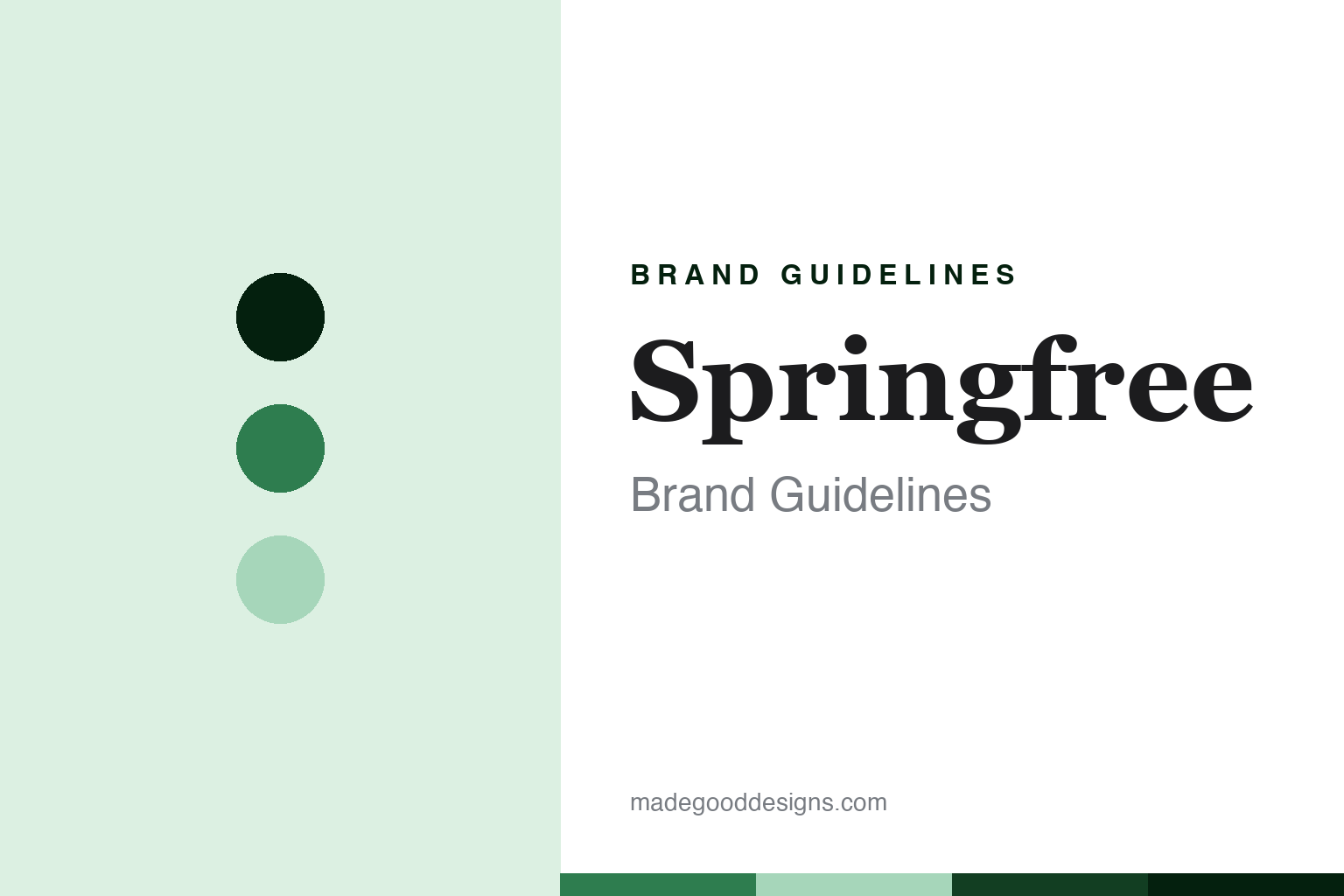
Springfree Brand Guidelines
The springless design invented in New Zealand, run from Canada.
Aa
Two constants: a Springfree-green palette and an innovator-serif register. Abstract homage — not a Springfree product or mark; no trampoline, mat or logo is reproduced.
The springless design invented in New Zealand, run from Canada
Springfree is the trampoline Dr. Keith Alexander re-engineered without steel springs (composite rods below the mat) — commercialised by a Canadian owner and sold in dozens of countries.
Springfree opens the trampoline round as its innovator node — the springless design that reworked the trampoline’s engineering, invented in New Zealand and commercialised under Canadian ownership. Its answer to a round about who makes and owns trampolines is the invention one: an engineering rethink from an academic.
Its identity is the springless design invented in New Zealand, run from Canada. The Keith Alexander invention, the composite-rod design and the Canadian ownership are the story here. The engineered one. The springless design invented in New Zealand, run from Canada.
(Honest notes, so the invention, the ownership, the making and a claim are framed accurately and neutrally, since children use these. Springfree sells springless trampolines as its heroes; we report its language as the brand’s own and attribute its safety claims. On invention: the springless trampoline was invented by Dr. Keith Alexander, a mechanical-engineering professor at the University of Canterbury in Christchurch, New Zealand, with development from around 1989 and commercial sales from about 2004, replacing steel coil springs with flexible composite rods below the mat. On ownership: it was commercialised under the Canadian entrepreneur Steve Holmes, who acquired the rights in the early 2000s, and it is a privately held, Canadian-run company today rather than a New Zealand one, though we hedge the exact HQ city. On the making: China is widely reported but not documented in primary sources, so we attribute it cautiously. On a claim: Springfree markets itself as the “world’s safest trampoline,” which we attribute rather than assert. Its designs and the Springfree name are IP we describe but do not reproduce; there is no official brand hex; these tones are an unofficial interpretation.)
Colour
Springfree lives in a Springfree green. Click a swatch to copy the hex.
Springfree’s identity is engineered, Canadian-run and springless — a Springfree green, an ink, a pale green, a deep forest, and a paper. The palette leans Springfree green and deep forest: a clean, considered register that stands in for an engineering-led brand rather than a loud logo colour. It signals the springless design invented in New Zealand, run from Canada — engineered, Canadian-run and springless. The honest caveat: with no official brand hex, these values are an engineered, unofficial interpretation, not first-party colours.
The lesson is a Springfree green signals an engineered, considered identity. Springfree’s world is the back garden reimagined by an engineer. For designers, it is a reminder that a clean green and a pale green can carry an engineered, considered brand — a considered tone held as an accent, not a product shot. Because a mid hue can fail as small text, keep type dark and let the colour live in the accents, palette and band. The takeaways: credit Keith Alexander and New Zealand for the invention; note the Canadian ownership and hedge the HQ; attribute the made-in-China cautiously; and attribute the “safest” claim.
Typography
The register is an innovator serif — engineered, Canadian-run, springless.
Springfree’s identity carries an engineered, Canadian-run spirit — an academic’s rethink turned brand. An innovator serif captures the mood: considered, precise and confident, the register of an engineering-led maker. Set in a Springfree-green palette, the innovator serif feels dependable and deliberate — exactly the personality Springfree carries. It behaves like a made, engineered thing rather than a loud logo, mirroring a mat-ring and a spring-dot. (Springfree’s real products and the name are things we describe but do not reproduce, and the exact typeface is not ours to use.) Because it is not ours to use, the honest description is “an innovator-serif brand,” shown here in a stand-in. The type behaves like the brand: engineered, Canadian-run and springless.
Aa
An innovator-serif brand — dependable and deliberate. (Specimen set in Fraunces, an innovator-serif STAND-IN; NOT the Springfree logo or products.)
The trampoline node
Springfree stands for the springless design invented in New Zealand, run from Canada.
Springfree opens the round as its innovator node. A Springfree-green palette, an innovator serif and a springless invention make one thing — the springless design invented in New Zealand, run from Canada — the whole identity: engineered, Canadian-run and springless. The Keith Alexander invention is the pitch, the composite-rod design is the substance, and the Canadian ownership is the frame. The point is an engineering rethink from an academic, anchoring the round about who makes and owns trampolines.
Put to work, the identity is the brand told straight, the invention credited and the ownership placed. A brand in this spirit would credit Keith Alexander and New Zealand for the invention, note the Canadian ownership and hedge the HQ, attribute the made-in-China cautiously, and attribute the “safest” claim. A reader in this spirit would keep the facts right: Springfree makes springless trampolines; the design was invented by Keith Alexander in New Zealand; it was commercialised under Canadian ownership; and it is not a New Zealand company today. Springfree opens the round, before Vuly. The honest editorial moves are to credit the inventor, to place the ownership, to attribute the making, and to attribute the claim.
For designers and brand-builders, Springfree opens the trampoline node: credit an inventor precisely — and separate origin from ownership. The lessons: a product can be invented in one country and owned from another, here Springfree invented in New Zealand and run from Canada; an invention is credited to Dr. Keith Alexander, a mechanical-engineering professor at the University of Canterbury, whose springless design from around 1989 to 2004 replaced steel springs with composite rods below the mat; an ownership is placed, that it was commercialised under the Canadian entrepreneur Steve Holmes and is a privately held, Canadian-run company today rather than a New Zealand one, with the exact HQ hedged; a making is attributed cautiously, China reported but not documented; and a claim is attributed, the “world’s safest trampoline” tagline framed as the company’s own rather than asserted. It is also a reminder to stay precise and calm on a topic involving children: Springfree is the Canadian-run, New-Zealand-invented springless trampoline of the category — with the palette here an unofficial interpretation, and no safety outcome asserted. The hook is that invention: Springfree is the springless design invented in New Zealand, run from Canada, the trampoline Dr. Keith Alexander re-engineered without steel springs, commercialised by a Canadian owner and sold in dozens of countries. Read that way, Springfree is less a single trampoline than the springless design invented in New Zealand, run from Canada: engineered, Canadian-run, springless. The lesson for a brand is that crediting an inventor precisely and separating origin from ownership reinforce the honesty, and dating the invention keeps it earned. Springfree made the-springless-design the identity — proof that an engineering rethink can open a round.
Explore & save
Keep Springfree’s identity on hand — save it to a board in the Made Good inspiration library.
Springfree identity set
Pin the Springfree-green palette and the innovator-serif register to your own board.