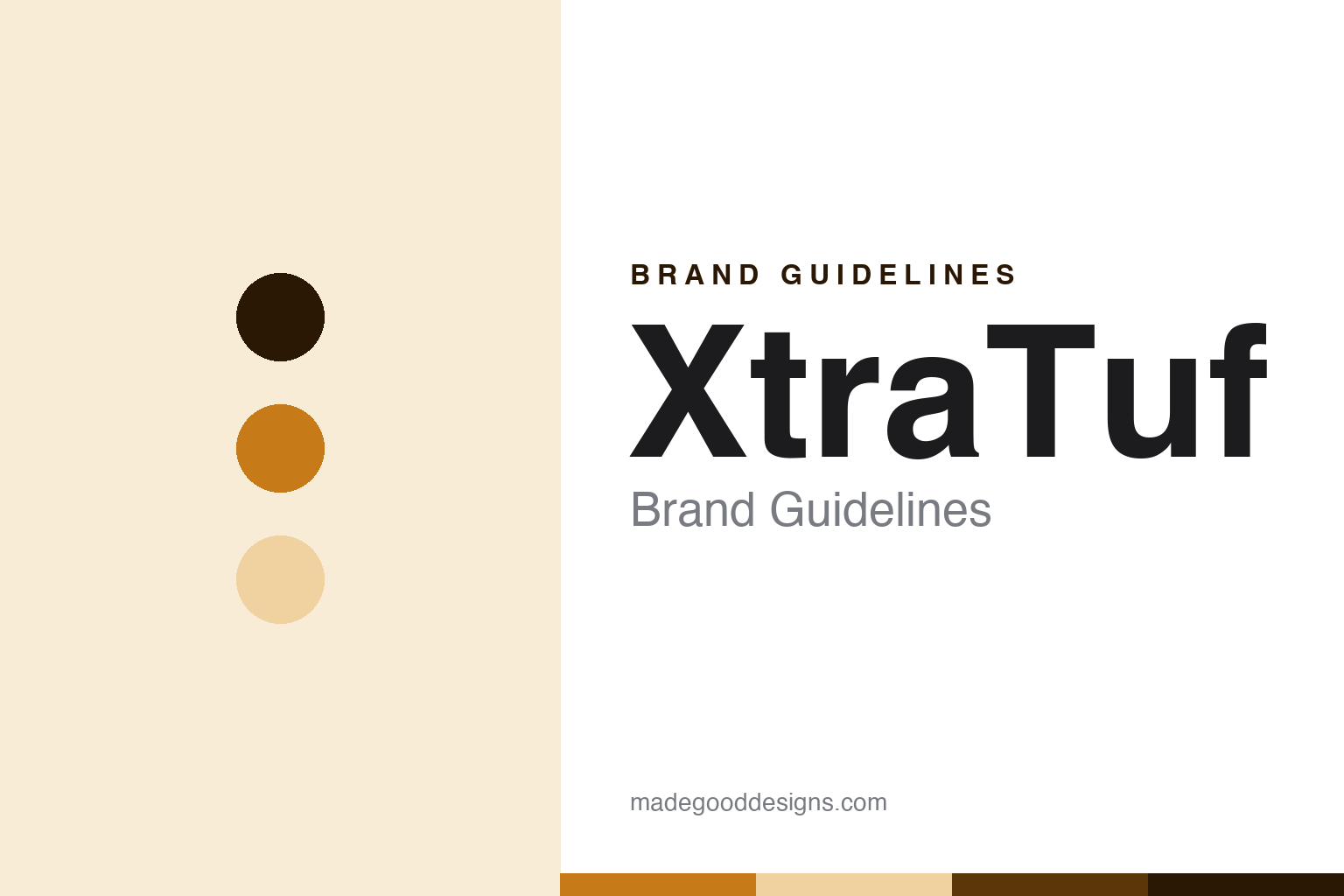
XtraTuf Brand Guidelines
The Alaskan deck boot, Rocky Brands’ second boot.
Aa
Two constants: an XtraTuf-amber palette and a deck-sans register. Abstract homage — not an XtraTuf product or mark; no boot, deck or logo is reproduced.
The Alaskan deck boot, Rocky Brands’ second boot
XtraTuf is the tan neoprene fishing boot first made in Illinois in the 1950s, now (with Muck Boot) part of Rocky Brands — and made in China since a controversial 2011 move.
XtraTuf follows Muck Boot as the round’s second Rocky Brands node — the tan deck boot beloved by Alaskan fishers, which shares its owner with Muck after the same 2011 Honeywell deal, and whose production famously moved offshore. Its answer to a round about who owns the boot world is the paired one: the second Rocky boot.
Its identity is the Alaskan deck boot, Rocky Brands’ second boot. The 1950s Illinois origin, the Rocky Brands ownership and the 2011 China move are the story here. Deck boot, Rocky-owned. The Alaskan deck boot, Rocky Brands’ second boot.
(Honest notes, so the origin, the ownership, the making and a controversy are framed accurately. XtraTuf sells deck and fishing boots as its heroes — the Legacy pull-on; we report its language as the brand’s own. On origin: XtraTuf was first made in Rock Island, Illinois in the 1950s by Norcross Safety Products, commissioned by B.F. Goodrich, as a tan neoprene fishing boot with a slip-resistant chevron outsole. On ownership: it passed from B.F. Goodrich to Norcross in 1985, to Honeywell in 2008, and to Rocky Brands in 2021 in the same $230 million Honeywell deal that brought Muck Boot, so XtraTuf and Muck share the Rocky Brands parent. On the making and controversy: production moved from Rock Island to China at the end of 2011, with about 250 to 300 US jobs lost, which was controversial with Alaskan fishers, and we attribute the quality claims that followed. Its designs and the XtraTuf name are IP we describe but do not reproduce; there is no official brand hex; these tones are an unofficial interpretation.)
Colour
XtraTuf lives in an XtraTuf amber. Click a swatch to copy the hex.
XtraTuf’s identity is deck-boot, Rocky-owned and tan — an XtraTuf amber, an ink, a pale amber, a deep umber, and a paper. The palette leans XtraTuf amber and deep umber: a warm, working register that nods to the iconic tan-copper neoprene rather than a loud logo colour. It signals the Alaskan deck boot, Rocky Brands’ second boot — deck-boot, Rocky-owned and tan. The honest caveat: with no official brand hex, these values are a working, unofficial interpretation, not first-party colours.
The lesson is an XtraTuf amber signals a deck-boot, working identity. XtraTuf’s world is the fishing deck and the harbour. For designers, it is a reminder that a warm amber and a pale amber can carry a deck-boot, working brand — a working tone held as an accent, not a product shot. Because a warm hue can fail as small text, keep type dark and let the colour live in the accents, palette and band. The takeaways: date the origin to the 1950s and Illinois; trace the chain to Rocky Brands and note the shared parent with Muck; record the 2011 China move factually; and attribute the quality claims.
Typography
The register is a deck sans — deck-boot, Rocky-owned, tan.
XtraTuf’s identity carries a deck-boot, Rocky-owned spirit — a fishing icon under a footwear conglomerate. A deck sans captures the mood: clean, sturdy and utilitarian, the register of a working deck boot. Set in an XtraTuf-amber palette, the deck sans feels dependable and honest — exactly the personality XtraTuf carries. It behaves like a made, working thing rather than a loud logo, mirroring a pull-tab-dot and a shaft-band. (XtraTuf’s real products and the name are things we describe but do not reproduce, and the exact typeface is not ours to use.) Because it is not ours to use, the honest description is “a deck-sans brand,” shown here in a stand-in. The type behaves like the brand: deck-boot, Rocky-owned and tan.
Aa
A deck-sans brand — dependable and honest. (Specimen set in Jost, a deck-sans STAND-IN; NOT the XtraTuf logo or products.)
The boot node
XtraTuf stands for the Alaskan deck boot, Rocky Brands’ second boot.
XtraTuf sits fifth in the round as its second Rocky Brands node. An XtraTuf-amber palette, a deck sans and a 1950s origin make one thing — the Alaskan deck boot, Rocky Brands’ second boot — the whole identity: deck-boot, Rocky-owned and tan. The 1950s Illinois origin is the pitch, the Rocky Brands ownership is the frame, and the 2011 China move is the turn. The point is the second Rocky boot, sharing its parent with Muck, in a round about who owns the boot world.
Put to work, the identity is the brand told straight, the chain traced and the move recorded factually. A brand in this spirit would date the origin to the 1950s and Illinois, trace the chain to Rocky Brands and note the shared parent with Muck, record the 2011 China move factually, and attribute the quality claims. A reader in this spirit would keep the facts right: XtraTuf makes the Legacy deck boot; it was first made in Illinois in the 1950s; Rocky Brands owns it since 2021; and it shares that parent with Muck. XtraTuf sits after Muck Boot and before LaCrosse. The honest editorial moves are to date the origin, to trace the chain, to record the move, and to attribute the claims.
For designers and brand-builders, XtraTuf carries the boot node: record an offshoring controversy factually — and note the shared parent. The lessons: a beloved boot can move production offshore, here XtraTuf to China; an origin is dated, first made in Rock Island, Illinois in the 1950s by Norcross for B.F. Goodrich, a tan neoprene fishing boot with a chevron outsole; a chain is traced, B.F. Goodrich to Norcross in 1985, to Honeywell in 2008, to Rocky Brands in 2021 in the same $230 million deal that brought Muck Boot; a shared parent is noted, XtraTuf and Muck both under Rocky Brands; a move is recorded factually, production moving from Rock Island to China at the end of 2011 with about 250 to 300 US jobs lost, controversial with Alaskan fishers; and quality claims are attributed rather than asserted. It is also a reminder to stay precise: XtraTuf is the Rocky-Brands-owned Alaskan deck boot of the boot aisle — with the palette here an unofficial interpretation, and any current made-in-USA line verified directly. The hook is that pairing: XtraTuf is the Alaskan deck boot, Rocky Brands’ second boot, the tan neoprene fishing boot first made in Illinois in the 1950s, now with Muck Boot part of Rocky Brands, and made in China since a controversial 2011 move. Read that way, XtraTuf is less a single boot than the Alaskan deck boot, Rocky Brands’ second boot: deck-boot, Rocky-owned, tan. The lesson for a brand is that recording an offshoring controversy factually and noting the shared parent reinforce the honesty, and dating the origin keeps it earned. XtraTuf made the-Alaskan-deck-boot the identity — proof that an honestly-recorded icon can anchor a node.
Explore & save
Keep XtraTuf’s identity on hand — save it to a board in the Made Good inspiration library.
XtraTuf identity set
Pin the XtraTuf-amber palette and the deck-sans register to your own board.