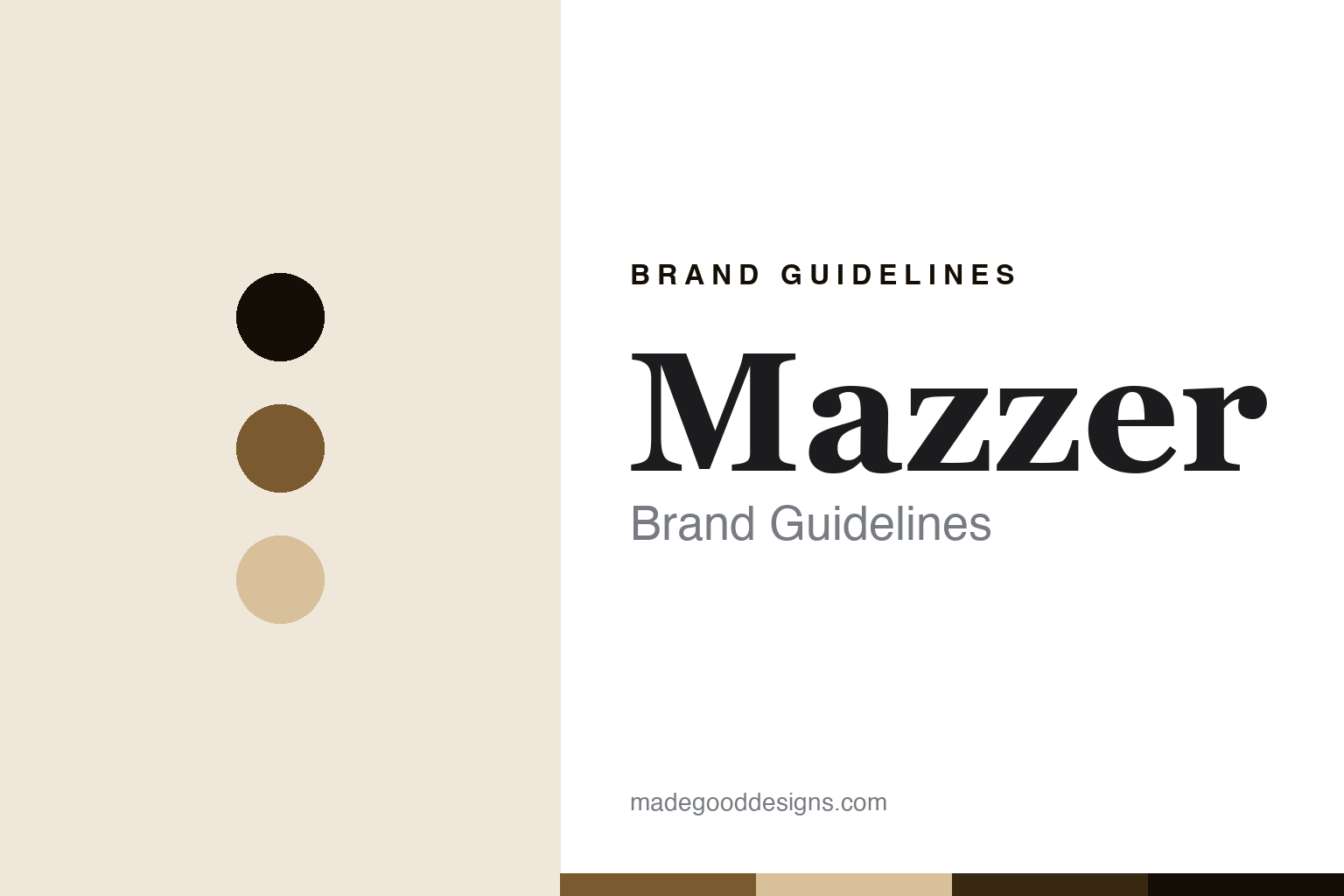
Mazzer Brand Guidelines
The café workhorse.
Aa
Two constants: a bronze palette and a workhorse-serif register. Abstract homage — not a Mazzer product or mark.
The café workhorse
Mazzer is the Venetian grinder house of 1948, the café-standard workhorse, 100% made in Scorzè by the Mazzer family.
Mazzer is the round’s workhorse — the Venetian grinder maker whose machines became the café standard. From Scorzè, near Venice, Mazzer makes professional espresso and coffee grinders, on a lineage that runs the world’s bars. Its answer to how a maker becomes a name is reliability at scale: build a grinder that runs all day in a busy café, make it entirely in Venice, and let a million of them prove the point. A grinder, that the trade relies on.
Its identity is the café workhorse. Mazzer’s Super Jolly and Major, its café reliability and its Venetian making are the work it is known for. A grinder, made in Italy. The café workhorse.
(Honest notes, so the story stays precise. Mazzer — at mazzer.com — makes professional espresso and coffee grinders: the Super Jolly, Major, Mini, Robur, Kony, Philos and ZM are the well-known lines, spanning doser, on-demand and single-dose, with the burrs designed and produced in-house. It was founded in 1948 by Luigi Mazzer, in Scorzè, in the province of Venice; a detail to get right is that the town is Scorzè, in the Veneto. On where it is made — a theme of this round — Mazzer states it is one hundred per cent made in Venice, at Scorzè, so we state the Italian making plainly and fully. On ownership, it is an independent, family firm: Luigi led it until 1988, when his son Giovanni Mazzer took over. Its reputation as the café workhorse is genuine, with a reported million-plus grinders in daily use; aftermarket doserless conversions we present as reported. Its name and marks are IP, described but never reproduced, and there is no official brand hex; these tones are an unofficial interpretation. This is design commentary and does not promote any product.)
Colour
Mazzer lives in a bronze palette. Click a swatch to copy the hex.
Mazzer’s identity is reliable, made and solid — a bronze, an ink, a sand, a deep bronze, and a paper. The palette leans bronze and sand: the register of machined metal and a burr set, the warm tone of a tool built to last. It signals a professional café grinder. The honest caveat: with no published brand hex, these values are an original, unofficial interpretation, not first-party colours.
The lesson is a bronze palette signals a reliable, made-in-Italy identity. Mazzer’s world is a solid, machined object. For designers, it is a reminder that a warm bronze and a soft sand can carry a grinder maker — the finish of machined metal and the weight of a workhorse. Because these tones can fail as small text, keep type dark and let the colour live in the accents, palette and band. The takeaways: build for reliability; make it entirely at home; let scale prove it; and treat any single hex as unofficial.
Typography
The register is a workhorse serif — solid, classical, made.
Mazzer’s identity carries a solid, classical, made spirit — a professional workhorse, not a fashion object. A workhorse serif captures the mood: sturdy, traditional and dependable, the register of a Venetian grinder that runs the world’s cafés. Set in a bronze palette, the workhorse serif feels solid and classical — exactly the personality Mazzer carries. It is café reliability rather than a logo, mirroring a grinder that never stops. (Mazzer’s real wordmark, and the grinder’s shape, are things we describe but do not reproduce, and the exact typeface is not ours to use.) Because it is not ours to use, the honest description is “a workhorse-serif spirit,” shown here in a stand-in. The type behaves like the grinder: solid, classical and made.
Aa
A workhorse-serif spirit — solid and made. (Specimen set in Playfair Display, a workhorse-serif STAND-IN; NOT the Mazzer logo.)
The grinder makers
Mazzer stands for the café workhorse, made in Venice.
Mazzer is a lesson in how reliability can be an identity. A bronze palette, a workhorse serif and a café grinder make one thing — the café workhorse — the whole identity: reliable, made and solid. The made-entirely-in-Venice grinders are the differentiator, and the café reliability is the meaning. The point is a Venetian house whose grinders run the world’s bars, made one hundred per cent at home, with a million in daily use.
Put to work, the identity is reliability, told straight, as design. A maker in this spirit would build for all-day use and make it entirely at home — the Super Jolly, in Venice. A reader in this spirit would place it in the round’s where-made thread at the fully-made-at-home end, the clearest case in the round: Mazzer states one hundred per cent made in Venice, with no second country to hedge. Mazzer holds the round’s heritage pole with Eureka, and its ownership thread at the independent, family end — a counterpoint to the group-owned maker later. The honest editorial moves are to correct the town to Scorzè, to state the Italian making plainly and fully, and to present the aftermarket conversions as reported. The lesson Mazzer teaches is that reliability can hold an identity: the Venetian making gives it substance, and the café standard keeps it credible. The café workhorse is the personality, and the Super Jolly is the proof.
For designers and brand-builders, Mazzer holds an Italy pole in the grinder makers: build for reliability — and make it entirely at home. The lessons: earn a trade’s trust; keep the whole make in-country; get a home town right; present aftermarket practice as reported; and never reproduce a logo. It is also a reminder to stay precise: Mazzer is the Venetian grinder house of 1948, the café-standard workhorse, 100% made in Scorzè by the Mazzer family — with the palette here an unofficial interpretation. The Venetian making carries the substance, and the café standard carries the reputation; together they show that reliability, not novelty, is what earns a trade’s trust decade after decade, and that a maker willing to keep the whole build in one town can say so without an asterisk. Mazzer made the café workhorse the identity — proof that a grinder, honestly made, can be the difference.
Explore & save
Keep Mazzer’s identity on hand — save it to a board in the Made Good inspiration library.
Mazzer identity set
Pin the bronze palette and the workhorse-serif register to your own board.