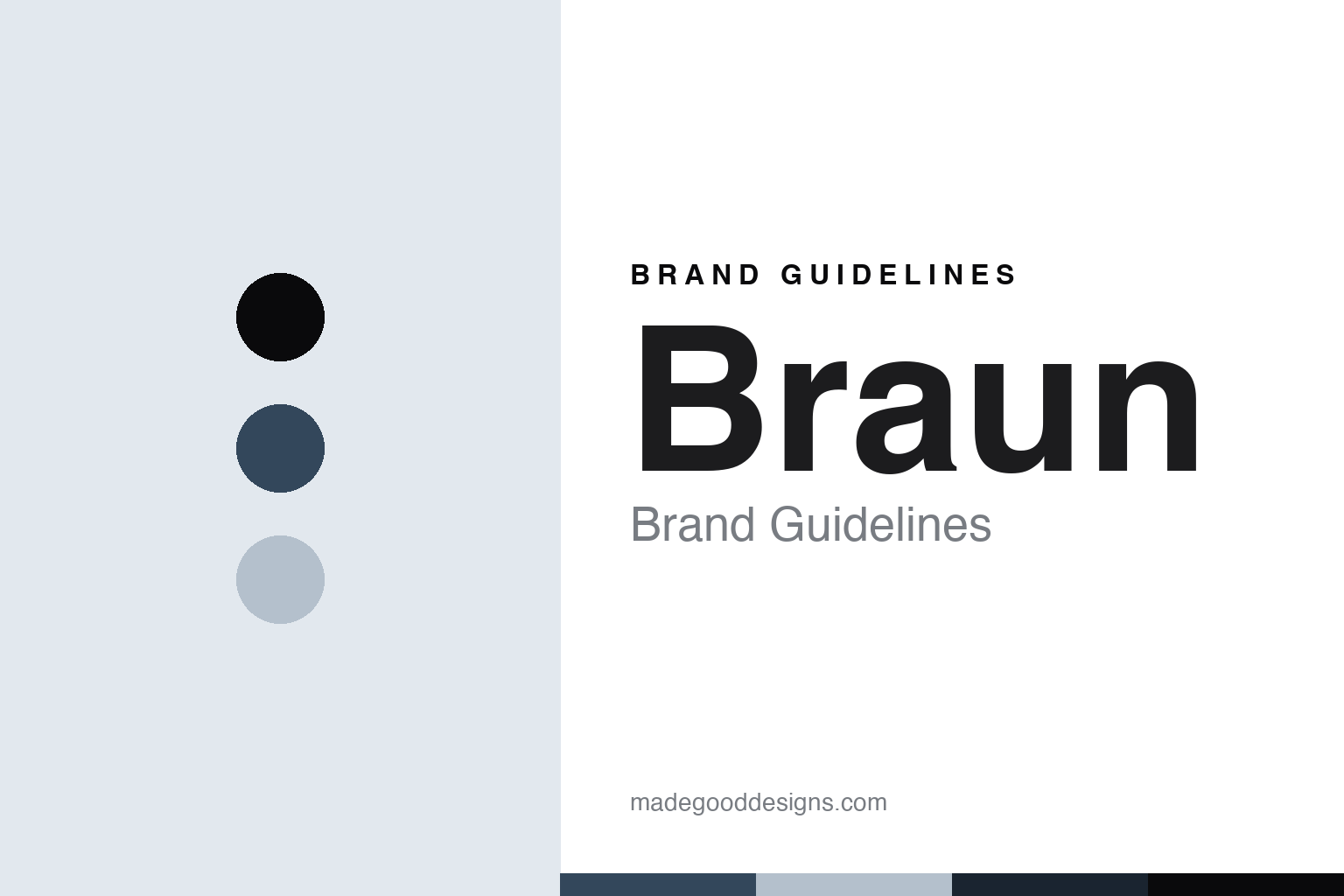
Braun Brand Guidelines
The Rams design house, now a P&G shaver brand.
Aa
Two constants: a Braun-graphite palette and a Rams-sans register. Abstract homage — not a Braun product or mark; no shaver, foil or logo is reproduced.
The Rams design house, now a P&G shaver brand
Braun is the 1921 Frankfurt company whose Dieter-Rams “less but better” aesthetic defined modern product design — and whose grooming line has belonged to Procter & Gamble since the 2005 Gillette deal (while its kitchen appliances are licensed to De’Longhi).
Braun follows Philips Norelco as the round’s design-heritage node — a company revered for shaping modern product design, whose grooming line now sits inside a consumer-goods giant while its name is split across licensees. Its answer to a round about who owns the grooming world is the design-legacy one: a Rams-era icon, grooming owned by P&G.
Its identity is the Rams design house, now a P&G shaver brand. The 1921 founding, the Dieter Rams design era and the P&G ownership are the story here. Design legend, P&G-owned. The Rams design house, now a P&G shaver brand.
(Honest notes, so the founding, the design heritage, the ownership and the split are framed accurately. Braun sells electric shavers and grooming as its heroes — the Series 9 foil shaver and Silk-épil epilators; we report its language as the brand’s own. On founding: Braun was founded in 1921 in Frankfurt, Germany by Max Braun. On the design heritage: Dieter Rams was design chief from 1961 to 1995, establishing the modernist “less but better” aesthetic. On ownership: grooming belongs to Procter & Gamble, which acquired Braun via its 2005 purchase of Gillette. On the split: grooming stays with P&G, while Braun kitchen and small appliances are licensed to De’Longhi since 2012 and Braun health products went to Kaz, now under Helen of Troy, under a P&G license. Its designs and the Braun name are IP we describe but do not reproduce; there is no official brand hex; these tones are an unofficial interpretation of a minimalist identity.)
Colour
Braun lives in a Braun graphite. Click a swatch to copy the hex.
Braun’s identity is design-led, P&G-owned and minimalist — a Braun graphite, an ink, a pale steel, a deep slate, and a paper. The palette leans Braun graphite and deep slate: a restrained, minimalist register that nods to the Rams black-white-grey aesthetic rather than a loud logo colour. It signals the Rams design house, now a P&G shaver brand — design-led, P&G-owned and minimalist. The honest caveat: with no official brand hex, these values are a minimalist, unofficial interpretation, not first-party colours.
The lesson is a Braun graphite signals a design-led, minimalist identity. Braun’s world is the restrained, functional object. For designers, it is a reminder that a restrained graphite and a pale steel can carry a design-led, minimalist brand — a minimalist tone held as an accent, not a product shot. Because a dark hue can flatten small text, keep type dark and even and let the colour live in the accents, palette and band. The takeaways: date the founding to 1921 and Frankfurt; credit the Dieter Rams era; name the P&G ownership via Gillette 2005; and keep the grooming-versus-kitchen split precise.
Typography
The register is a Rams sans — design-led, P&G-owned, minimalist.
Braun’s identity carries a design-led, P&G-owned spirit — a design icon inside a consumer giant. A Rams sans captures the mood: clean, restrained and exact, the register of a minimalist design house. Set in a Braun-graphite palette, the Rams sans feels considered and quiet — exactly the personality Braun carries. It behaves like a made, functional thing rather than a loud logo, mirroring a guard-band and a trimmer-line. (Braun’s real products and the name are things we describe but do not reproduce, and the exact typeface is not ours to use.) Because it is not ours to use, the honest description is “a Rams-sans brand,” shown here in a stand-in. The type behaves like the brand: design-led, P&G-owned and minimalist.
Aa
A Rams-sans brand — considered and quiet. (Specimen set in Jost, a Rams-sans STAND-IN; NOT the Braun logo or products.)
The grooming node
Braun stands for the Rams design house, now a P&G shaver brand.
Braun sits fifth in the round as its design-heritage node. A Braun-graphite palette, a Rams sans and a 1921 founding make one thing — the Rams design house, now a P&G shaver brand — the whole identity: design-led, P&G-owned and minimalist. The 1921 founding is the pitch, the Dieter Rams era is the substance, and the P&G ownership is the frame. The point is a design icon whose grooming line is owned by P&G, in a round about who owns the grooming world.
Put to work, the identity is the brand told straight, the design credited and the split kept precise. A brand in this spirit would date the founding to 1921 and Frankfurt, credit the Dieter Rams era, name the P&G ownership via Gillette 2005, and keep the grooming-versus-kitchen split precise. A reader in this spirit would keep the facts right: Braun makes the Series 9 shaver and epilators; it was founded in 1921 by Max Braun; grooming belongs to P&G; and its kitchen appliances are a De’Longhi license. Braun sits after Philips Norelco and before Remington. The honest editorial moves are to date the founding, to credit the design, to name the owner, and to keep the split precise.
For designers and brand-builders, Braun carries the grooming node: honour a design legacy — and keep the trademark split precise. The lessons: a design-defining brand can have its lines split across owners and licensees, here Braun; a founding is dated to 1921 in Frankfurt, Germany, by Max Braun; a design heritage is credited, that Dieter Rams was design chief from 1961 to 1995 and established the “less but better” aesthetic; an ownership is named, that grooming belongs to Procter & Gamble, acquired via its 2005 purchase of Gillette, not an original P&G house brand; a split is kept precise, that grooming stays with P&G while Braun kitchen and small appliances are licensed to De’Longhi since 2012 and Braun health products went to Kaz, now under Helen of Troy, under a P&G license; and three Brauns are distinguished, grooming, kitchen and the discontinued audio-design legacy. It is also a reminder to stay precise: Braun grooming is the P&G-owned, Rams-heritage shaver of the grooming aisle — with the palette here an unofficial interpretation, and De’Longhi a licensee of the kitchen name, not its owner. The hook is that legacy: Braun is the Rams design house, now a P&G shaver brand, the 1921 Frankfurt company whose Dieter-Rams “less but better” aesthetic defined modern product design, and whose grooming line has belonged to Procter & Gamble since the 2005 Gillette deal, while its kitchen appliances are licensed to De’Longhi. Read that way, Braun is less a single shaver than the Rams design house, now a P&G shaver brand: design-led, P&G-owned, minimalist. The lesson for a brand is that honouring a design legacy and keeping the trademark split precise reinforce the honesty, and dating the founding keeps it earned. Braun made the-Rams-design-house the identity — proof that an honestly-split design icon can anchor a node.
Explore & save
Keep Braun’s identity on hand — save it to a board in the Made Good inspiration library.
Braun identity set
Pin the Braun-graphite palette and the Rams-sans register to your own board.