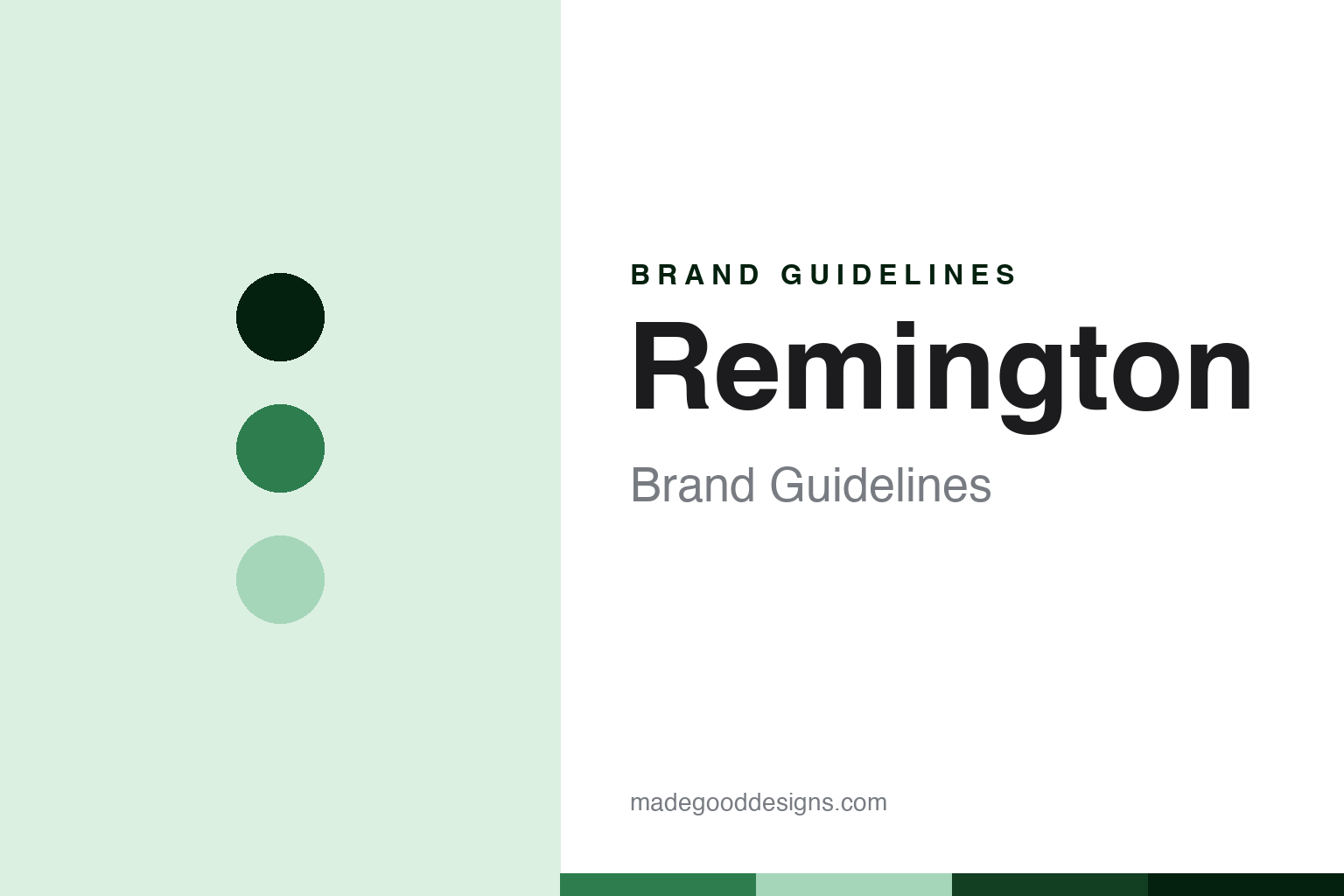
Remington Brand Guidelines
The shaver name that isn’t the gun company.
Aa
Two constants: a Remington-green palette and a separate-sans register. Abstract homage — not a Remington product or mark; no shaver, head or logo is reproduced.
The shaver name that isn’t the gun company
Remington’s grooming brand — from Remington Rand’s 1937 razors, later Victor Kiam’s “I liked it so much I bought the company” — is owned today by Spectrum Brands, and entirely separate from the Remington Arms firearms business it shares a heritage name with.
Remington follows Braun as the round’s shared-name node — a grooming brand whose heritage name it holds in common with a famous firearms business it has no corporate link to. Its answer to a round about who owns the grooming world is the separation one: same old name, entirely different company.
Its identity is the shaver name that isn’t the gun company. The 1937 shaver origin, the Victor Kiam story and the Spectrum Brands ownership are the story here. Shavers, not guns. The shaver name that isn’t the gun company.
(Honest notes, so the origin, the ownership, the separation and a caution are framed accurately. Remington grooming sells shavers and trimmers as its heroes — F-series foil shavers, beard trimmers and the Shortcut Pro; we report its language as the brand’s own. On origin: the shaver line began when Remington Rand made electric shavers in 1937, via the typewriter and office-equipment lineage. On ownership: it is a brand of Spectrum Brands Holdings, having passed from Victor Kiam’s 1979 buyout of the shaver business, through Remington Products and Vestar, to Rayovac in 2003, which renamed itself Spectrum Brands in 2005. On the separation: the grooming brand is a completely separate company from Remington Arms and RemArms, the firearms business, sharing only the heritage name from E. Remington and Sons in 1816. On a caution: firearms matters, such as the Remington 700 trigger litigation, must never be attributed to the grooming brand. Its designs and the Remington name are IP we describe but do not reproduce; there is no official brand hex; these tones are an unofficial interpretation.)
Colour
Remington lives in a Remington green. Click a swatch to copy the hex.
Remington’s grooming identity is separate, Spectrum-owned and mass — a Remington green, an ink, a pale green, a deep forest, and a paper. The palette leans Remington green and deep forest: a plain, mass register that nods to a mass-market shaver brand rather than a loud logo colour. It signals the shaver name that isn’t the gun company — separate, Spectrum-owned and mass. The honest caveat: with no official brand hex, these values are a mass, unofficial interpretation, not first-party colours.
The lesson is a Remington green signals a separate, everyday identity. Remington grooming’s world is the drugstore shaver aisle. For designers, it is a reminder that a plain green and a pale green can carry a separate, everyday brand — a mass tone held as an accent, not a product shot. Because a mid hue can fail as small text, keep type dark and let the colour live in the accents, palette and band. The takeaways: date the shaver origin to 1937; tell the Victor Kiam story and name the Spectrum ownership; keep the firearms company entirely separate; and never attribute gun matters to the grooming brand.
Typography
The register is a separate sans — separate, Spectrum-owned, mass.
Remington’s grooming identity carries a separate, Spectrum-owned spirit — a shaver brand distinct from its namesake. A separate sans captures the mood: clean, plain and everyday, the register of a mass grooming brand. Set in a Remington-green palette, the separate sans feels approachable and practical — exactly the personality Remington grooming carries. It behaves like a made, shipped thing rather than a loud logo, mirroring a head-ring and a guard-band. (Remington’s real products and the name are things we describe but do not reproduce, and the exact typeface is not ours to use.) Because it is not ours to use, the honest description is “a separate-sans brand,” shown here in a stand-in. The type behaves like the brand: separate, Spectrum-owned and mass.
Aa
A separate-sans brand — approachable and practical. (Specimen set in Outfit, a separate-sans STAND-IN; NOT the Remington logo or products.)
The grooming node
Remington stands for the shaver name that isn’t the gun company.
Remington sits sixth in the round as its shared-name node. A Remington-green palette, a separate sans and a 1937 origin make one thing — the shaver name that isn’t the gun company — the whole identity: separate, Spectrum-owned and mass. The 1937 shaver origin is the pitch, the Victor Kiam story is the substance, and the Spectrum ownership is the frame. The point is a heritage name shared with an unrelated firearms business, in a round about who owns the grooming world.
Put to work, the identity is the brand told straight, the ownership named and the two Remingtons separated. A brand in this spirit would date the shaver origin to 1937, tell the Victor Kiam story and name the Spectrum ownership, keep the firearms company entirely separate, and never attribute gun matters to the grooming brand. A reader in this spirit would keep the facts right: Remington grooming makes shavers and trimmers; the shaver line began at Remington Rand in 1937; it is a Spectrum Brands brand; and it is not the firearms company. Remington sits after Braun and before Panasonic. The honest editorial moves are to date the origin, to name the owner, to separate the companies, and to avoid the firearms conflation.
For designers and brand-builders, Remington carries the grooming node: separate two companies that share a heritage name — completely. The lessons: a heritage name can belong to two unrelated companies, here Remington grooming and Remington firearms; an origin is dated to 1937, when Remington Rand made electric shavers, via the typewriter and office-equipment lineage from E. Remington and Sons; an ownership is named, that the grooming brand passed from Victor Kiam’s 1979 buyout (“I liked the shaver so much, I bought the company”), through Remington Products and Vestar, to Rayovac in 2003, which renamed itself Spectrum Brands in 2005, so it is a Spectrum Brands Holdings brand as of last confirmation; a separation is drawn completely, that the grooming brand and Remington Arms or RemArms share only the 1816 heritage name and have no common owner; and a caution is set, that firearms matters such as the Remington 700 trigger litigation must never be attributed to the grooming brand. It is also a reminder to stay precise: Remington grooming is the Spectrum-Brands-owned shaver name of the grooming aisle, entirely separate from the gun company — with the palette here an unofficial interpretation, and the stale “Oak Hill Capital” co-owner claim dropped. The hook is that separation: Remington is the shaver name that isn’t the gun company, the electric-shaver brand from Remington Rand’s 1937 razors, later Victor Kiam’s “I liked it so much I bought the company,” owned today by Spectrum Brands, and entirely separate from the Remington Arms firearms business it shares a heritage name with. Read that way, Remington grooming is less a single shaver than the shaver name that isn’t the gun company: separate, Spectrum-owned, mass. The lesson for a brand is that separating two companies that share a heritage name completely reinforces the honesty, and dating the origin keeps it earned. Remington made the-shaver-name-that-isnt-the-gun-company the identity — proof that an honestly-separated shared name can anchor a node.
Explore & save
Keep Remington’s identity on hand — save it to a board in the Made Good inspiration library.
Remington identity set
Pin the Remington-green palette and the separate-sans register to your own board.