Nicolas Brand Guidelines
The Paris wine merchant of 1822 and its delivery man, Nectar.
Aa
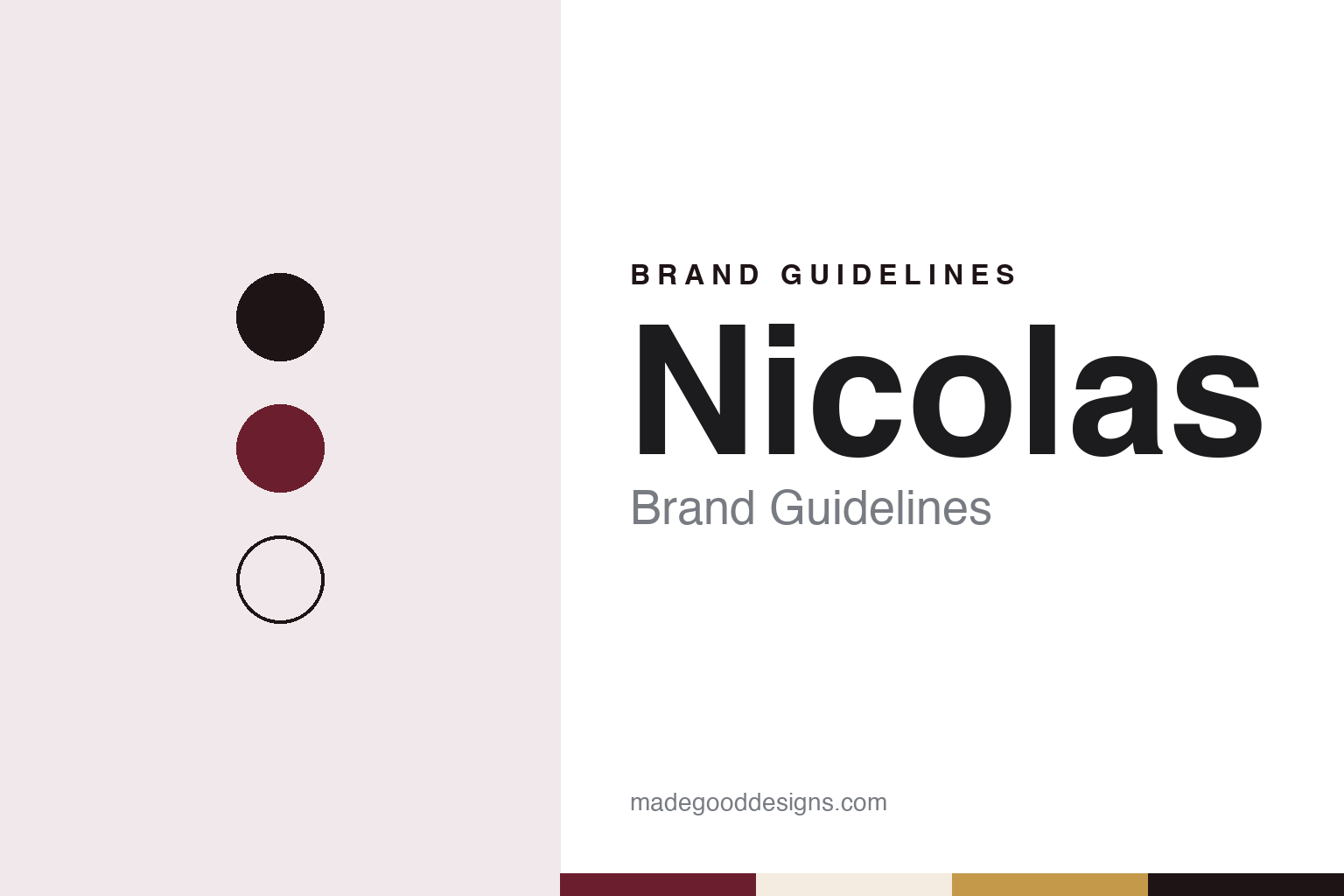
Two constants: a burgundy, cream and gold palette and a rounded sans register. Abstract homage — not a Nicolas poster, character or mark; no logo or label is reproduced.
Paris, 1822
Wine by the bottle, and a shop to buy it in.
Nicolas traces its history to Paris in 1822. The company says Louis Nicolas started with a main shop and three depots in the city, built on an idea it presents as new at the time: selling wine by the bottle, when customers otherwise drank in cabarets or went to a merchant or a producer to buy a cask. L’Express Franchise, in an October 2025 report drawing on AFP, described the chain as a pioneer of bottled wine sales and of home delivery; the French design agency Grapheine, in a December 2025 article, dates the start of home delivery to 1840.
Growth, by the company’s count, was steady: more than 30 points of sale by 1870 and more than 275 shops by 1933. Grapheine writes that Étienne Nicolas, a son of the family, ran the business from 1898 and had the idea of working with well-known artists on advertising and on illustrated price lists for fine bottles. Grapheine also says the company registered a design for its 100cl bottle with France’s industrial-property office, the INPI, in 1955.
The sources used for this guide do not say how the company operated during the occupation of 1940–1944.
The business stayed in family hands for most of its history. The company says it was bought by Castel Frères in 1988, and L’Express Franchise reported in 2025 that Nicolas had been owned since that year by the Castel family, at the head of the wine group of the same name. English Wikipedia adds that the chain has traded in London since 1989.
Colour
Nectar, Dransy and the poster artists.
Advertising sits at the centre of the Nicolas story. The company says it began an intense advertising campaign in 1921, including early animated advertisements shown in cinemas, and in 1922 introduced Nectar, a slight, moustached delivery man drawn by the artist Dransy and, the company says, inspired by one of its own delivery men. Grapheine describes the figure carrying bottles fanned out in each hand, a starburst shape it says was later reworked by many artists, and says he was joined by a partner, Félicité, and a son, Glou-Glou.
Grapheine lists poster artists and illustrators who worked for the firm, among them Dransy, Cassandre, Charles Loupot and Paul Iribe, and later Bernard Buffet and Reiser, and it singles out a strongly geometric Cassandre poster of the mid-1930s. It also retells how the illustrator Jean-Jacques Sempé and the writer René Goscinny named Le Petit Nicolas in 1959 after a bus carrying a Nicolas advertisement passed their café table.
Nectar faded from posters as photographic advertising took over in the 1980s, Grapheine says. The company says the character was given a new face in 2012 for its 190th anniversary, and for the bicentenary in 2022, Grapheine reports, the illustrators Alice Des, Mathieu Persan and Alice Wietzel redrew him in a younger version.
Own-label ranges came later. The company dates its first, Les Petites Récoltes, to 1995, and Les Grumes and the CUB collection to 2016; its website also lists a range named Nectar under the Maison Nicolas name. Its shop staff, it says, take five weeks of training at an in-house school, the École intégrée Nicolas. Grapheine adds two later formats: in 2018, it says, Nicolas brought back bottle deposits for organic Côtes du Rhône Villages wines, and it developed a shop concept for craft beer called Craft Beers & Cie.
Typography
Signs, shelves and owners.
Liquor, beer and wine store chains sell much the same goods, so they rely heavily on what sits around the bottles: the shop sign, the logo, the colours on the fascia and the bags, and the layout inside. The chains in this guide come from Australia, Finland, Canada, France and the Netherlands, and they show how differently that job can be done, from a founder’s portrait on the sign to a set of initials or a plain public-service name.
Store formats vary as much as the signs. At one end are large warehouse-style stores that draw shoppers from a wide area; in 2005 the wine writer Chris Shanahan described Dan Murphy’s stores in Australia as “prairie-like” spaces. At the other are neighbourhood shops beside supermarkets, smaller premium “cellar” stores and, in Australia, drive-through outlets, which BWS said in 2021 numbered 220 in its own fleet.
Ownership shapes the identity too. Some chains in this guide are state or provincial retailers owned by the public sector; others belong, or have belonged, to supermarket groups, as Dan Murphy’s and BWS did under Woolworths before the 2021 listing of Endeavour Group; others again trade as franchises under a shared name. Own-label ranges, tastings, delivery services and loyalty schemes, such as Dan Murphy’s My Dan’s, are part of the brand, and each company names them in its own way.
Most of these chains publish their own histories, on corporate or careers pages that name founders, first shops and owners. This guide uses those pages as the companies’ own accounts, sets them beside independent press and registers where it can, and describes colours and lettering in words; the palettes shown here are an unofficial interpretation, not the companies’ own.
Aa
A soft, rounded sans of the kind Grapheine saw in the 2025 identity. (Specimen set in Nunito, a sans STAND-IN; NOT the Nicolas or Maison Nicolas logo.)
Maison Nicolas
A new name, a kept colour.
In October 2025 the chain renamed itself Maison Nicolas. L’Express Franchise reported on 15 October 2025 that the change came with a five-year plan under the general manager Cathy Collart Geiger, who had arrived that April, covering a new name, a new logo and reworked ranges. The new logo is burgundy and white, with a small silhouette of a wine merchant set into the letters, the magazine said. Grapheine credits the identity to the agency 181 degrés, notes that the burgundy was kept while the rest was redrawn, describes rounded letterforms, and says the previous image had not changed since the 1980s. It records that discussion of the new logo centred on the smaller, floating A in the name, and reads the soft, rounded type as a break from the slender, Gothic or serif letters it associates with wine. The new signature line, according to Grapheine, was “Source de convivialité depuis 1822.”
Store counts differ by date and source. Grapheine gave 481 shops in France in December 2025; in the October 2025 statement quoted by L’Express Franchise, the company spoke of some 500 shops in France and abroad and 700 cavistes. English Wikipedia mentions branches in the UK, Belgium, Germany and Poland. Grapheine adds that Nicolas was voted favourite brand in the wine-merchant category in 2022 and again in 2024.
For a design guide, Nicolas shows how a two-century-old retailer can carry a mascot, a poster tradition and a single colour into a new identity. Compare V and B, another French chain, and Oddbins in Britain. For this guide we use a deep burgundy, a warm cream and a soft gold with a rounded sans, an unofficial interpretation; no product or logo is reproduced.
Explore & save
Keep Nicolas’s identity on hand — save it to a board in the Made Good inspiration library.
Nicolas identity set
Pin the Nicolas burgundy, cream and gold palette and the rounded sans register to your own board.
Source & notes
Frequently Asked Questions
What font can I use to match the Nicolas look?
This guide describes Nicolas’ type as “A soft, rounded sans of the kind Grapheine saw in the 2025 identity”. Its type specimen is set in Nunito from Google Fonts as a stand-in; Nunito is not Nicolas’ own lettering.
What colours are in the Nicolas palette?
This guide’s Nicolas palette is Cellar burgundy #6B1E2E, Ink #1E1416, Soft gold #C49A4A, Warm cream #F4ECE0 and Paper #FAF6F0. The tones are the guide’s own unofficial interpretation, not official Nicolas hex codes.
When was Nicolas founded?
Nicolas was founded in 1822, in Paris, France. This guide lists Castel group (since 1988) as its owner.
Who founded Nicolas?
Nicolas was founded by Louis Nicolas in 1822. This guide lists Castel group (since 1988) as its owner.
Who owns Nicolas?
Nicolas is owned by Castel group (since 1988). This guide dates Nicolas to 1822, in Paris, France.