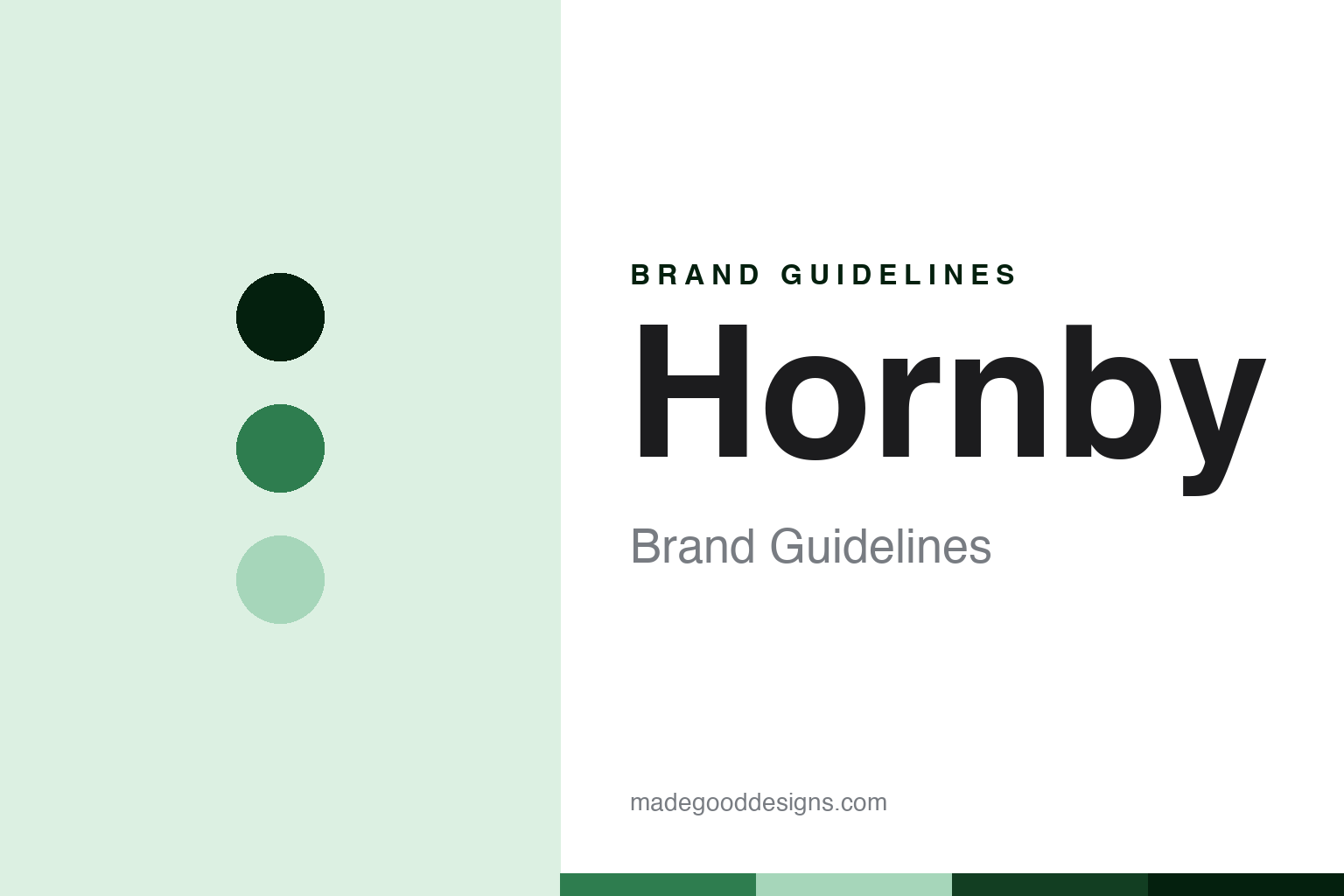
Hornby Brand Guidelines
The British heritage-brand group.
Aa
Two constants: a Hornby-green palette and a heritage-sans register. Abstract homage — not a Hornby product or mark; no train, track or logo is reproduced.
The British heritage-brand group
Hornby is the 1901 Liverpool model-railway name (Frank Hornby of Meccano) that owns Airfix, Corgi and Humbrol, went private in 2025 under Phoenix Asset Management — and sold Scalextric that same year.
Hornby follows Bachmann as the round’s heritage-conglomerate node — a British model-railway name that is also the parent of a family of classic hobby brands, recently taken private. Its answer to a round about who owns model trains is the group one: a train brand that owns other icons.
Its identity is the British heritage-brand group. The 1901 founding, the Airfix-Corgi-Humbrol family and the 2025 going-private are the story here. A brand that owns brands. The British heritage-brand group.
(Honest notes, so the founding, the ownership, the portfolio and a divestment are framed accurately. Hornby sells OO-gauge British model railways as its heroes; we report its language as the brand’s own. On founding: Hornby was founded in 1901 in Liverpool by Frank Hornby, the inventor of Meccano, with its first clockwork trains in 1920. On ownership: it is majority-owned by Phoenix Asset Management Partners, which reached 55.2 percent in 2017, and Hornby delisted from the London Stock Exchange AIM in April 2025, so it is now privately held, headquartered in Margate, Kent. On the portfolio: Hornby owns Airfix, Humbrol and Corgi, among railway sub-brands. On a divestment: Hornby sold Scalextric to Purbeck Capital Partners in April 2025, so we do not list Scalextric as a current Hornby brand. On the making: China. Its designs and the Hornby name are IP we describe but do not reproduce; there is no official brand hex; these tones are an unofficial interpretation.)
Colour
Hornby lives in a Hornby green. Click a swatch to copy the hex.
Hornby’s identity is heritage, Phoenix-owned and group-wide — a Hornby green, an ink, a pale green, a deep forest, and a paper. The palette leans Hornby green and deep forest: a classic, heritage register that stands in for a British hobby-brand group rather than a loud logo colour. It signals the British heritage-brand group — heritage, Phoenix-owned and group-wide. The honest caveat: with no official brand hex, and a red livery historically, these values are a heritage, unofficial interpretation, not first-party colours.
The lesson is a Hornby green signals a heritage, group identity. Hornby’s world is the British hobby shelf. For designers, it is a reminder that a classic green and a pale green can carry a heritage, group brand — a heritage tone held as an accent, not a product shot. Because a mid hue can fail as small text, keep type dark and let the colour live in the accents, palette and band. The takeaways: date the founding to 1901 and Frank Hornby; name the Phoenix ownership and the 2025 going-private; list Airfix, Corgi and Humbrol; and note the 2025 Scalextric sale.
Typography
The register is a heritage sans — heritage, Phoenix-owned, group-wide.
Hornby’s identity carries a heritage, Phoenix-owned spirit — a train brand that owns other icons. A heritage sans captures the mood: classic, orderly and established, the register of a British hobby-brand group. Set in a Hornby-green palette, the heritage sans feels dependable and storied — exactly the personality Hornby carries. It behaves like a made, collected thing rather than a loud logo, mirroring a track-line and a coupler-dot. (Hornby’s real products and the name are things we describe but do not reproduce, and the exact typeface is not ours to use.) Because it is not ours to use, the honest description is “a heritage-sans brand,” shown here in a stand-in. The type behaves like the brand: heritage, Phoenix-owned and group-wide.
Aa
A heritage-sans brand — dependable and storied. (Specimen set in Archivo, a heritage-sans STAND-IN; NOT the Hornby logo or products.)
The model-train node
Hornby stands for the British heritage-brand group.
Hornby sits third in the round as its heritage-conglomerate node. A Hornby-green palette, a heritage sans and a 1901 founding make one thing — the British heritage-brand group — the whole identity: heritage, Phoenix-owned and group-wide. The 1901 founding is the pitch, the Airfix-Corgi-Humbrol family is the substance, and the 2025 going-private is the frame. The point is a train brand that owns other icons, in a round about who owns model trains.
Put to work, the identity is the brand told straight, the portfolio listed and a divestment noted. A brand in this spirit would date the founding to 1901 and Frank Hornby, name the Phoenix ownership and the 2025 going-private, list Airfix, Corgi and Humbrol, and note the 2025 Scalextric sale. A reader in this spirit would keep the facts right: Hornby makes OO-gauge British model railways; it was founded in 1901 by Frank Hornby; it owns Airfix, Corgi and Humbrol; and it sold Scalextric in 2025. Hornby sits after Bachmann and before Märklin. The honest editorial moves are to date the founding, to name the owner, to list the portfolio, and to note the divestment.
For designers and brand-builders, Hornby carries the model-train node: list a brand’s portfolio accurately — including what it just sold. The lessons: a brand can be the parent of several classic hobby names, here Hornby with Airfix, Corgi and Humbrol; a founding is dated to 1901 in Liverpool by Frank Hornby, the inventor of Meccano, its first clockwork trains in 1920; an ownership is named, that Hornby is majority-owned by Phoenix Asset Management Partners, which reached 55.2 percent in 2017, and delisted from the London Stock Exchange AIM in April 2025 to become privately held, headquartered in Margate, Kent; a portfolio is listed, Airfix, Humbrol and Corgi among railway sub-brands; and a divestment is noted, that Hornby sold Scalextric to Purbeck Capital Partners in April 2025, so it is no longer a current Hornby brand. It is also a reminder to stay precise: Hornby is the Phoenix-owned British heritage-brand group of the model-train aisle — with the palette here an unofficial interpretation, and Scalextric correctly excluded from its current stable. The hook is that portfolio: Hornby is the British heritage-brand group, the 1901 Liverpool model-railway name from Frank Hornby of Meccano that owns Airfix, Corgi and Humbrol, went private in 2025 under Phoenix Asset Management, and sold Scalextric that same year. Read that way, Hornby is less a single train than the British heritage-brand group: heritage, Phoenix-owned, group-wide. The lesson for a brand is that listing a brand’s portfolio accurately, including what it just sold, reinforces the honesty, and dating the founding keeps it earned. Hornby made the-British-heritage-brand-group the identity — proof that a brand-of-brands can anchor a node.
Explore & save
Keep Hornby’s identity on hand — save it to a board in the Made Good inspiration library.
Hornby identity set
Pin the Hornby-green palette and the heritage-sans register to your own board.


