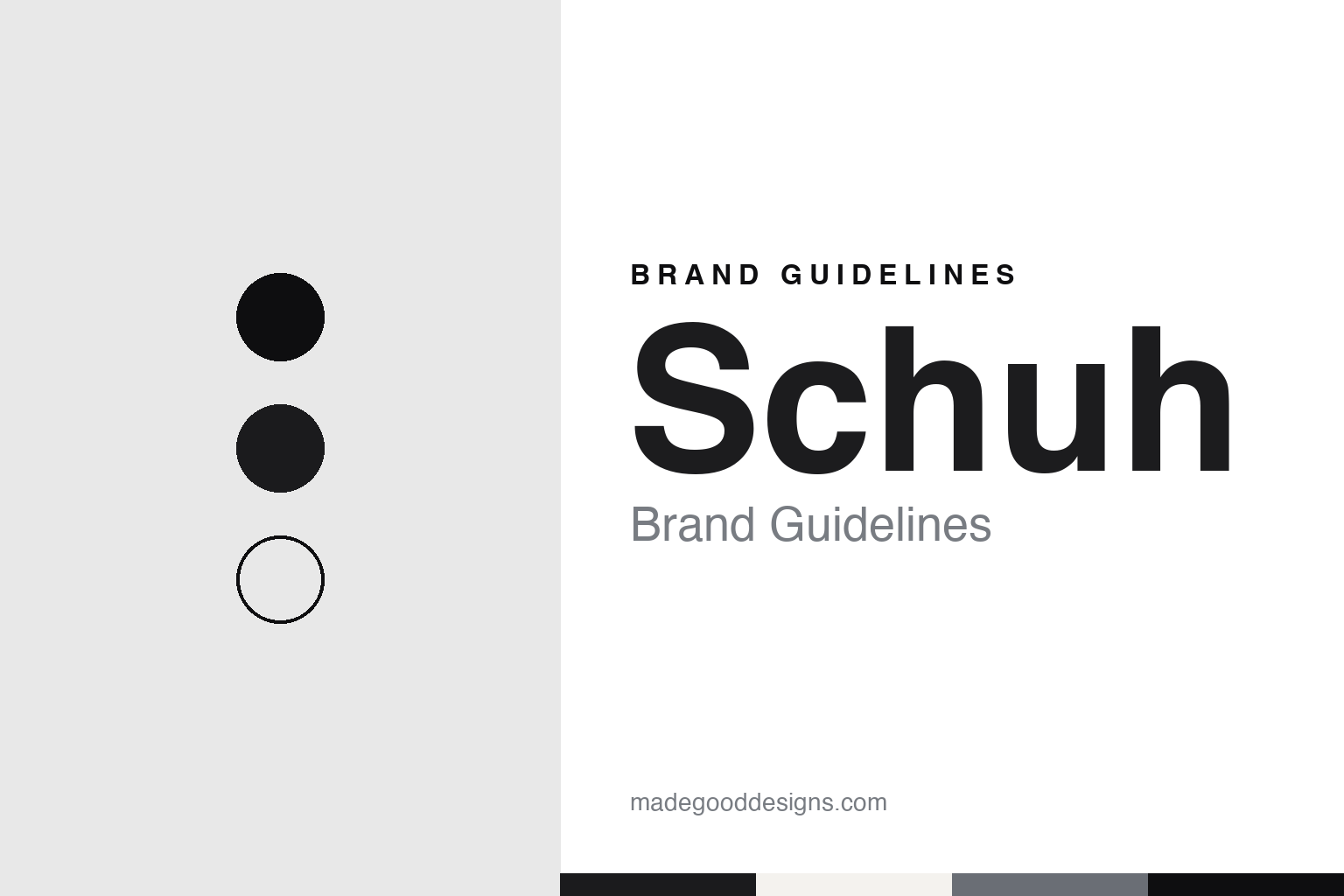
Schuh Brand Guidelines
The Edinburgh shoe chain with a German name, written in lower case.
Aa
Two constants: a black, warm white and slate grey palette and a lower-case sans register. Abstract homage — not a Schuh product or mark; no logo, shop sign or shoe is reproduced.
North Bridge
A shoe shop in an Edinburgh arcade.
Schuh began in Edinburgh in 1981. The company’s careers site says it “stepped on the footwear scene” in the city that year, and in April 2025 TheIndustry.fashion described Edinburgh as “the city where Schuh was founded in 1981.” English Wikipedia names the founder as Sandy Alexander and places the first shop in the North Bridge Arcade, opened in November 1981, after he saw room for fashion footwear shops outside London.
The name is German for “shoe.” English Wikipedia says the shop was at first to be called Lizard, until the word “Schuhe” was spotted at the top of a footwear trade magazine and the final “e” was dropped. The company pronounces the name like the English word “shoe,” and its own pages write it in lower case, as “schuh.”
Early growth came in Scotland and the north of England. English Wikipedia lists shops in Edinburgh, Glasgow, Newcastle and Aberdeen in the first years, and says that in 1987 the business and its four remaining branches were bought by A. Goldberg & Sons, the Glasgow retail group, which ran Schuh as a semi-autonomous division, with concessions inside its own fashion shops and department stores as well as standalone branches. When Goldberg went into administration in 1990, Wikipedia says, Schuh regained its independence through a management buy-out, and in 1991 its head office moved to Livingston, West Lothian, where the company is still based.
Through the 1990s and 2000s Schuh spread across the UK and into Ireland. Wikipedia dates its first Dublin store to 1997 and an Oxford Street flagship in London to 2004. It also records staffed concessions inside other fashion chains, which ended as those chains closed, and a short-lived franchise store in Dubai in 2003 and 2004.
Colour
Genesco, schuh kids and the store count.
In June 2011 the business changed hands. WPLN, Nashville’s public radio station, reported on 23 June 2011 that the Nashville footwear and accessories group Genesco had bought the Scotland-based chain, which then had nearly 60 stores. Genesco said it would keep the Schuh name and its management, and aimed to double the number of Schuh shops in the UK; its chief executive described the deal as a presence “across the pond” from which it could consider further opportunities in Europe. WPLN noted that Schuh’s stores were closest in style to Genesco’s own Journeys chain.
Under Genesco the formats widened. English Wikipedia says schuh kids launched in 2012, first as children’s areas inside branches and then as standalone shops, and that a schuh kids store received a POPAI interiors award in 2013. Wikipedia also records three stores opened in Germany in 2015 and 2016, in Oberhausen and Essen, which closed in 2019, after which German customers were served only online.
The store count has moved up and down since then. FashionUnited reported in March 2026, from the company’s accounts, that Schuh operated 123 stores across the UK, the Channel Islands and the Republic of Ireland as of 1 February 2026, and named Genesco Inc as its ultimate parent. In April 2025 TheIndustry.fashion reported a 5,500 sq ft new-concept flagship for the St James Quarter in Edinburgh, opened with Asics in May, with a redesigned layout, updated product displays and digital screens for the company’s campaigns.
Schuh is mainly a stockist of other makers’ footwear. TheIndustry.fashion said the Edinburgh store would carry more than 80 brands, naming Nike, Adidas, UGG and Converse. English Wikipedia adds that the company sells its own schuh label, designed by an in-house team, and that it launched a men’s own label, Momentum, in 2002.
Typography
How shoe chains present themselves.
Shoe store chains in Europe present themselves first through the shop sign. The name over the door, its lettering and its colours are what a shopper sees from a car park or a high street, and the same mark is repeated on carrier bags, loyalty apps and websites. When a chain changes hands or merges its banners, the sign can change with it: in 2024 the German group Kienast announced that it would rename around 250 of its shops under the Reno name, replacing the logo lettering inside and outside each store, as the company and the trade title Shoez reported.
The chains in this guide come from Germany, the Netherlands, Switzerland, Poland, France and the United Kingdom, and they trade in different formats. As the companies describe them, these run from large shoe centres on retail parks and the edges of towns to smaller units on high streets and in shopping centres, and most now add an online shop and often an app.
Ownership varies as much as format. Some chains are still run by founding families, some are listed on a stock exchange, and some belong to larger shoe-retail groups that run several banners side by side, each with its own sign and its own own-label ranges. Ownership can also change quickly: Reno was sold by its long-time owner in 2022, entered insolvency proceedings in March 2023 and now continues as a brand of the Kienast group, according to WirtschaftsWoche and the company itself.
Each guide sets out what can be checked about one chain: when and where it was founded, who owns it today, how it describes its shops and its own-label ranges, and what its corporate pages say about founders and owners. Where a fact rests only on a company’s own word, the guide says so. The palettes and type pairings are our own unofficial interpretations; no logo or shop sign is reproduced.
Aa
A lower-case sans, after the way the company writes its own name. (Specimen set in Archivo, a sans STAND-IN; NOT the Schuh logo.)
schuh
A borrowed word in lower case.
Schuh’s identity rests on the name. The lower-case wordmark “schuh” runs across its websites, and the company’s careers page says that although the name was unusual, “it didn’t take long for people to learn to pronounce” it. English Wikipedia notes that many shoppers have assumed the company is German.
Its marketing has leant on festivals, schools and in-store schemes. English Wikipedia describes a Welly Exchange launched at Scotland’s RockNess festival in 2009, which swapped festival-goers’ old shoes for wellington boots and won a brand-activation prize at the UK Festival Awards that year; a design challenge for schools near Livingston, run with West Lothian Council since 1997; a store magazine published from 1998 to 2006; and a loyalty scheme, the schuh Club, launched in 2022. The careers site describes employee-led “Purpose Pillars,” and Wikipedia says these were renamed “do more GOOD” in January 2026.
Wikipedia also lists prizes at the Drapers Footwear Awards in 2022, 2023 and 2025, among them a store-design award in 2023 for the schuh kids shop at the Trafford Centre in Manchester and a marketing award in 2025 for a scheme selling single shoes and mixed sizes. The company calls its shops “branches,” and its careers site says it has stores across the UK, Ireland and the Channel Islands as well as home delivery.
For a design guide, Schuh shows how a borrowed foreign word, set in lower case, can carry a high-street footwear chain for more than four decades and through three owners. Compare Shoe Zone, another UK shoe chain, and JD Sports, a UK footwear and sportswear retailer. For this guide we use near-black, warm white and a slate grey with a sans, an unofficial interpretation; no product or logo is reproduced.
Explore & save
Keep Schuh’s identity on hand — save it to a board in the Made Good inspiration library.
Schuh identity set
Pin the Schuh black, warm white and slate grey palette and the lower-case sans register to your own board.
Source & notes
Frequently Asked Questions
What font can I use to match the Schuh look?
This guide describes Schuh’s type as “A lower-case sans, after the way the company writes its own name”. Its type specimen is set in Archivo from Google Fonts as a stand-in; Archivo is not Schuh’s own lettering.
What colours are in the Schuh palette?
This guide’s Schuh palette is Livingston black #1B1B1D, Ink #0E0E10, Arcade white #F4F2EE, Slate grey #6A6E75 and Paper #FAF9F7. The tones are the guide’s own unofficial interpretation, not official Schuh hex codes.
When was Schuh founded?
Schuh was founded in 1981, in Edinburgh, Scotland. This guide lists Genesco Inc, since 2011 as its owner.
Who founded Schuh?
Schuh was founded in 1981 by Sandy Alexander, per Wikipedia.
Who owns Schuh?
Schuh is owned by Genesco Inc, since 2011. This guide dates Schuh to 1981, in Edinburgh, Scotland.