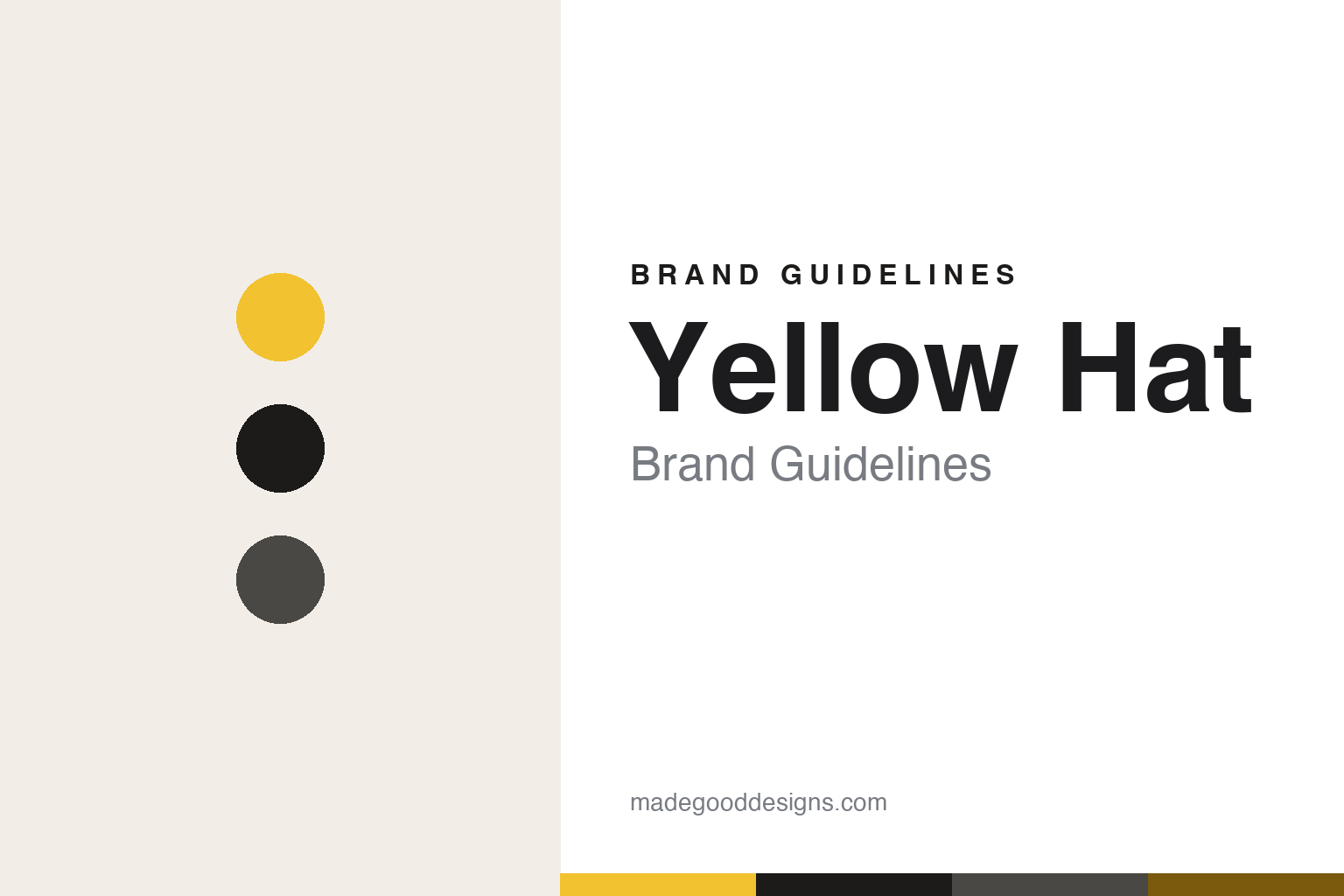
Yellow Hat Brand Guidelines
The Tokyo car-accessory chain that began as Royal in 1961.
Aa
Two constants: a Yellow Hat yellow, ochre and asphalt palette and a Roadside sans register. Abstract homage — not a Yellow Hat product or mark; no sign, logo or mascot is reproduced.
Royal
A wholesaler that became a store name.
Yellow Hat started life under another name. The company’s history says Royal was founded in October 1961 in Kojimachi, in Tokyo’s Chiyoda ward, to sell car accessories and parts, and was incorporated as Royal Co., Ltd. in March 1962. Its founder was Hidesaburo Kagiyama. A January 2011 profile in Kodansha’s Gendai Business said he had joined a Tokyo firm, Detroit Shokai, in 1953 before going independent in 1961, and quoted him saying he started Royal by peddling goods from a bicycle.
For its first years Royal was a wholesaler. It opened sales offices in Sendai in 1965 and in Nagoya and Osaka in 1966, and in 1967 it spun off its petrol-station wholesale arm as Corner Royal, the company says. In June 1969 it began selling directly to drivers through car corners inside large retailers. The first store it ran itself, Yellow Hat Utsunomiya Minami, opened in November 1975, and in April 1982 it signed its first Yellow Hat group store, in Kamagaya, opening the way for a network of stores run by partner companies alongside its own.
The store name later became the company name. Royal merged in April 1981 with Royal Co., formerly Shimada Sangyo, and in October 1997 the company changed its name to Yellow Hat Ltd., its history records; Gendai Business gives the same year for the rename and says Kagiyama stepped down as president the following year.
Colour
A broom, a yellow hat and a growing map.
The company’s cleaning habit became a public story. Gendai Business described how Kagiyama began cleaning the company’s toilets himself, by hand, as a way of calming a workforce in an industry he said was then seen as second-rate; he told the magazine it took about ten years before staff joined in of their own accord, starting with car washing and corridors. Staff cleaning later spread outside the company, to litter picking on the streets around the office, and the profile said that cleaning groups linked to his society for a beautiful Japan were active at 122 places across Japan in 2011, with groups abroad as well. The motto he promoted, bonji tettei, roughly “doing ordinary things thoroughly”, runs through the piece. The company’s website still links to one of those cleaning groups.
The name itself is literal. Yellow Hat says its company name comes from a yellow hat, and since 2019 it has used that link in campaigns timed to the government’s spring and autumn national traffic campaigns, according to a company press release of September 2025. That autumn’s edition ran a road-rules quiz on social media and gave in-store reflector key rings featuring the cat mascot Hattonyan. The yellow of the name is the obvious cue for the palette here, though the tones are our own.
The store map grew steadily. Counting its own stores and group stores together, the company passed 100 in September 1988, 200 in 1992, 300 in 1995 and 400 in March 1997. Yellow Hat stores in Japan reached 500 in March 2011, 600 in October 2014 and 700 in March 2018, the history says, and as of 31 March 2026 there were 765 Yellow Hat stores in Japan, including the YMS and Tread formats, according to the company profile. Its service pages list tyres, air-conditioning maintenance and bodywork repair and paint alongside the accessory aisles, and its home page carries banners for group chains such as 2Rinkan, Y’s Road and MORE GRIP, each with its own name and sign.
Typography
How car chains present themselves.
Car-service, tyre and auto-parts chains sell things that are hard to picture: a tyre change, an oil service, a set of wiper blades. So their identities lean on the shop front. A sign has to be read from a moving car, across a forecourt or a retail park, and most of these chains rely on one strong colour, a short wordmark and a fascia that looks the same from town to town. Some explain the choice: Autobacs links its orange to its founder’s visit to the United States, according to a 2014 profile in Hiragana Times.
The formats vary more than the signs. Some chains run drive-in service centres with a row of bays and a small counter; others run large stores where accessories, tyres and car-care goods fill the floor and a workshop sits alongside. In Japan, Autobacs lists a large-format Super Autobacs, a format combined with a fuel station and car-wash shops next to its standard store, and Yellow Hat counts motorcycle and bicycle chains among its group companies.
Ownership shapes the brand as well. Many networks are franchises, with local owners trading under a shared name; Autobacs says it began franchising in 1975, and Yellow Hat signed its first group store in 1982. Other chains belong to tyre makers or parts groups. The guides in this series name those owners and give the dates of each change, from company pages and dated reports, without ranking one chain against another.
Service menus are where the design work becomes practical. Chains name their services the way a driver would ask for them, and Yellow Hat’s service pages, for instance, cover tyres, air-conditioning maintenance and bodywork repair. Most also publish corporate pages on founders, owners and store counts. Read together, those pages show how a sign, a colour and a list of services turn into a brand.
Aa
A narrow roadside sans — a name read from a passing car. (Specimen set in Archivo Narrow, a sans STAND-IN; NOT the Yellow Hat logo.)
Yellow Hat Ltd.
Listed in Tokyo, now on two wheels too.
Listing came in steps. Yellow Hat’s shares were registered for over-the-counter trading in December 1990, listed on the second section of the Tokyo Stock Exchange in December 1995 and moved to the first section in September 1997; since April 2022 they have traded on the Prime Market, the company says. In April 2012 it agreed a business and capital alliance with the oil company Idemitsu Kosan, covering joint purchasing and a new supply route to Idemitsu service stations.
Much of its later growth came from buying regional store operators, many now renamed after their prefecture, from Aichi Yellow Hat to Kagoshima Yellow Hat, and from moving onto two wheels. In April 2012 it bought Driver Stand, now 2Rinkan Yellow Hat, and in 2014 it took full control of Will, now Bike-kan Yellow Hat, through a share exchange; in April 2023 it set up a subsidiary to run Kawasaki motorcycle dealerships. In January 2025 it acquired all the shares of Y International, now Y’s Road Yellow Hat, the bicycle chain, together with its subsidiary cyma, now cyma Yellow Hat, the company’s history records. In June 2025 the head office returned to Tokyo’s Ota ward, where it had been based from 1976, and in January 2026 Yellow Hat took an equity-method stake in Narunet Communications.
For a design guide, Yellow Hat shows how a plain colour word can become a name, a sign and a campaign theme at once. Compare Autobacs, another Japanese car-accessory chain that grew through partner-run stores, and Supercheap Auto, an Australian car-accessory chain. For this guide we use yellow, ochre and asphalt grey with a sans, an unofficial interpretation; no product or logo is reproduced.
Explore & save
Keep Yellow Hat’s identity on hand — save it to a board in the Made Good inspiration library.
Yellow Hat identity set
Pin the Yellow Hat yellow, ochre and asphalt palette and the Roadside sans register to your own board.
Source & notes
Frequently Asked Questions
What font can I use to match the Yellow Hat look?
This guide describes Yellow Hat’s type as “A narrow roadside sans — a name read from a passing car”. Its type specimen is set in Archivo Narrow from Google Fonts as a stand-in; Archivo Narrow is not Yellow Hat’s own lettering.
What colours are in the Yellow Hat palette?
This guide’s Yellow Hat palette is Cap yellow #F2C230, Ink #1C1B19, Asphalt #4A4844, Deep ochre #7A5A0C and Paper #F8F6F0. The tones are the guide’s own unofficial interpretation, not official Yellow Hat hex codes.
When was Yellow Hat founded?
Yellow Hat was founded in 1961 (as Royal), in Tokyo, Japan.
Who founded Yellow Hat?
Yellow Hat was founded by Hidesaburo Kagiyama in 1961 (as Royal).