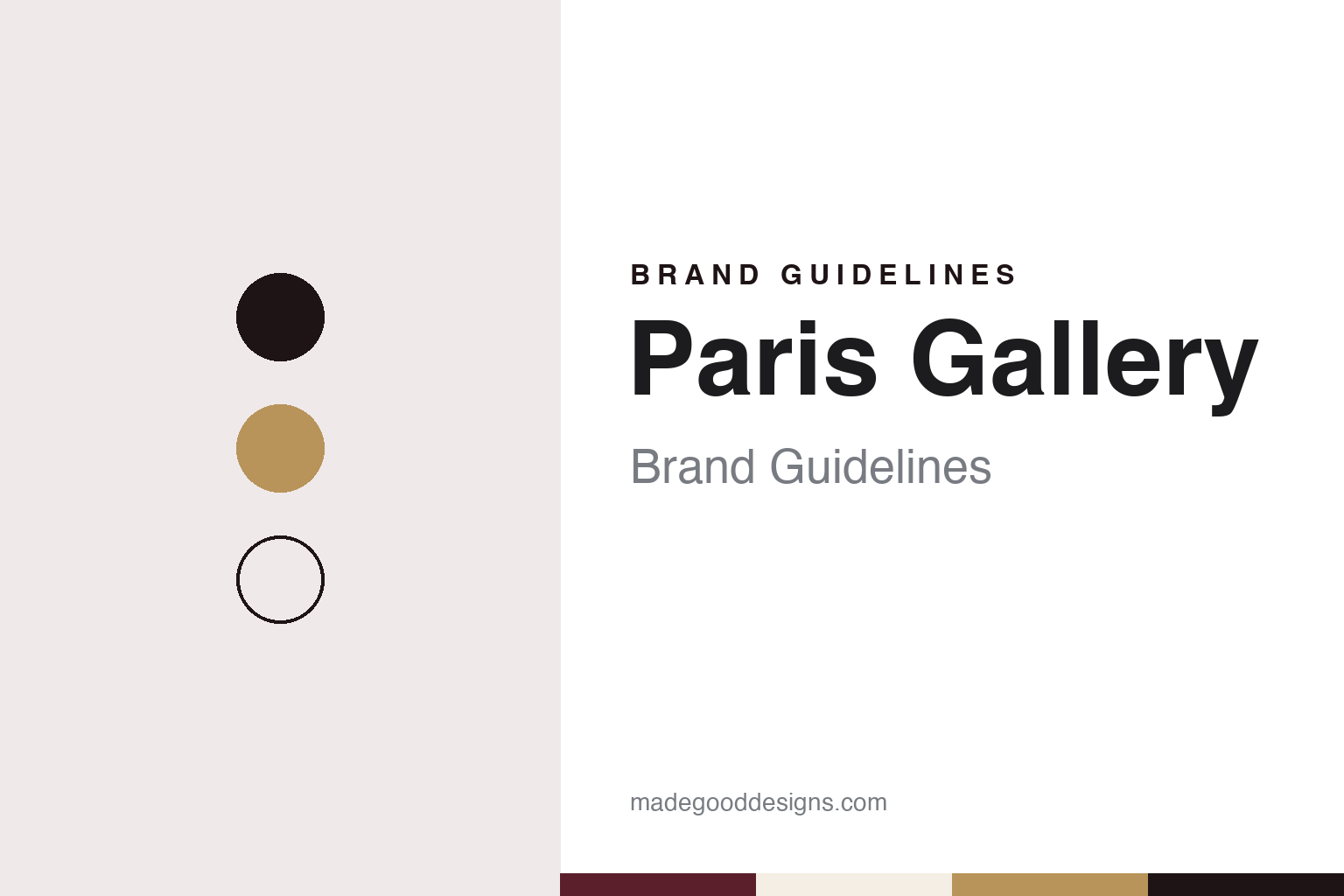
Paris Gallery Brand Guidelines
The Al Fahim family’s Dubai luxury perfumery group.
Aa
Two constants: a bordeaux, ivory and old-gold palette and a high-contrast serif register. Abstract homage — not a Paris Gallery product or mark; no shop sign, logo or pack is reproduced.
Since 1981
A family perfumery business in the Emirates.
Paris Gallery is a luxury retailer from the United Arab Emirates, built around perfume and later widened to watches, eyewear, fashion and cosmetics. The fullest early account comes from The Moodie Davitt Report, a travel-retail trade journal, which wrote on 22 December 2004 that the company was “led by general manager and founder Abdullah Al-Fahim” and that “since 1981” it had opened Paris Gallery perfumeries and what it called “new generation” department stores for luxury goods in Abu Dhabi, Dubai, Riyadh and Jeddah.
By then it was large. The same report said the company ran 32 perfumeries and department stores selling cosmetics, fragrances, watches, jewellery and fashion, and had 3,000 staff in 2003. It gave the company’s total retail space as 180,000 square metres, with plans to double it by 2007. It was also a distributor and agent for luxury houses including Cartier, Chopard, Aigner and Montblanc. Fashion and accessory names on its shelves at the time included Burberry, Salvatore Ferragamo, Etro and Dunhill, the report said. In 2004, The Moodie Davitt Report said, the managements of Saks Fifth Avenue and Harvey Nichols in Riyadh gave Paris Gallery the running of their beauty departments.
The business describes itself as a family firm. In a December 2016 column for Images RetailME, Mohammed Abdul Rahim Al Fahim, chief executive of the Paris Gallery Group of Companies, wrote that his father had wanted to set up “a professionally managed family business,” and that the family first set it up as a limited liability company before building a governance structure around it. “The Paris Gallery concept has evolved over the years,” he wrote. “Back then, we couldn’t fully imagine what our stores would look like.”
Colour
Magazines, records and a loyalty club.
Publicity was part of the business from early on. The Moodie Davitt Report noted in 2004 that the company published two magazines, one in English and one in Arabic, that its stores held product launches, demonstrations and fashion shows, and that Paris Gallery appeared in the Guinness Book of Records for the biggest shopping bag and the biggest magazine.
The range of brands kept growing. In March 2015 Entrepreneur Middle East said the group carried more than 500 international brands across 52 locations, and that its chief executive described a deliberate balance between categories: eyewear, watches, prestige and niche perfume, and cosmetics. Two years later The National put the number at about 800 international brands.
The group also built a loyalty scheme. Entrepreneur Middle East reported that in June 2013 it launched the Luxury Club, a points programme for customers of Paris Gallery and of its sister chain Watch Gallery. The same article said the group was then preparing to open Paris Gallery in Baku, Baghdad and Muscat.
Niche perfume was a recurring theme. In the 2015 interview the chief executive said demand for niche perfumery in the region had kept rising, contrary to what he called the global market trend. He also named Japan as the benchmark for service in his view, and described matching it as both a challenge and an opportunity for the retailer.
Typography
Shop signs, own labels and owners.
Perfumery and beauty-store chains sell other companies’ brands, so their own identity has to live in the shop itself: the sign over the door, the logo on the bag, the colours of the shop floor and the way the counters are laid out. The chains in this group come from Belgium and the Netherlands, the United Kingdom, the Czech Republic, Spain, the United States, France, the Gulf, Portugal and Italy, and each guide describes its signs, logos and colour schemes only as the company itself publishes them.
Store formats vary widely. Some chains grew from a single high-street perfumery; others trade mainly from shopping-centre and mall units, from shop-in-shop counters inside a sister chain, or largely online with a few physical stores. The Perfume Shop, for one, opened boutique stores for niche perfume houses in 2025. Each guide gives store and country counts only as a dated source reports them, and says when that count was made.
Ownership is part of the story. Some chains belong to large retail groups: ICI Paris XL and The Perfume Shop, for example, both sit within A.S. Watson, the Hong Kong health-and-beauty retailer. Others remain family-owned, or have passed between investors, supermarket groups and specialist retailers over the decades. Where a chain was sold, restructured or closed, the guide says what happened and when, and it never implies that a closed chain still trades.
Loyalty cards and own-label ranges are named here only as the companies name them, and corporate pages on founders and owners are treated as the company’s own account. Where an independent, dated source — a newspaper, a trade title or an official register — tells the story differently, both versions are given, and the guide makes clear which rests only on the company’s word.
Aa
A high-contrast serif for a luxury perfume hall. (Specimen set in Cormorant Garamond, a serif STAND-IN; NOT the Paris Gallery logo.)
Paris Gallery
Store counts, plans and a new web name.
The last detailed count comes from March 2017. The National and Images RetailME both reported on 14 March 2017 that the Paris Gallery Group then had 86 stores, which Images RetailME listed as spread across the UAE, Saudi Arabia, Qatar, Bahrain, Oman, Iraq, Azerbaijan and other countries, with more than 3,500 employees from 160 nationalities and about two million square feet of retail space. The chief executive described the group’s distribution arm as having “one of the largest networks in the UAE.” The group announced a five-year plan, for 2017 to 2021, to open 30 more stores, which would have taken it to 116. “Since 2006, the Group has developed a gradual plan to move its brand focus from the local to regional and global status,” the chief executive said at the time.
Today the company’s web address, parisgallery.ae, carries a different name. The site presents itself as Niche Gallery, an online shop for niche and luxury perfume serving the UAE, Saudi Arabia, Kuwait, Qatar, Bahrain and Oman, and says it has operated since 2018. It names fragrance houses such as Maison Crivelli, Memo Paris, Zoologist and Clive Christian among those it sells. Its own description is pointed: “We are not a department store. We are not a marketplace. We are curators.” It lists four values — authenticity, exclusivity, expertise and community — and calls its range of brands a “garden,” a word it also uses as a heading in its menu.
Across these accounts the constant is perfume: a business that began with perfumeries, grew into department stores and a distribution arm, and whose web address now carries an online niche-fragrance shop.
For a design guide, Paris Gallery shows a Gulf retailer that paired a European city in its name with record-sized shopping bags and magazines of its own. Compare Faces, a Dubai-based beauty chain, and Sephora. For this guide we use a deep bordeaux, an ivory and an old gold with a serif, an unofficial interpretation; no product or logo is reproduced.
Explore & save
Keep Paris Gallery’s identity on hand — save it to a board in the Made Good inspiration library.
Paris Gallery identity set
Pin the Paris Gallery bordeaux, ivory and old-gold palette and the high-contrast serif register to your own board.
Source & notes
Frequently Asked Questions
What font can I use to match the Paris Gallery look?
This guide describes Paris Gallery’s type as “A high-contrast serif for a luxury perfume hall”. Its type specimen is set in Cormorant Garamond from Google Fonts as a stand-in; Cormorant Garamond is not Paris Gallery’s own lettering.
What colours are in the Paris Gallery palette?
This guide’s Paris Gallery palette is Bordeaux #5B1F2B, Ink #1E1416, Ivory #F4EEE4, Old gold #B8945A and Paper #FBF8F3. The tones are the guide’s own unofficial interpretation, not official Paris Gallery hex codes.
When was Paris Gallery founded?
Paris Gallery was founded in 1981, in United Arab Emirates.
Who founded Paris Gallery?
Paris Gallery was founded by Abdullah Al-Fahim (per a 2004 report) in 1981.