Perfumes & Companhia Brand Guidelines
The Portuguese perfumery chain from Gaia that is turning into P&C.
Aa
Two constants: a red, pink and orange palette and a geometric sans register. Abstract homage — not a Perfumes & Companhia product or mark; no logo, sign or packaging is reproduced.
From Gaia to a national chain
A shop in a shopping centre, then a run of acquisitions.
Perfumes & Companhia opened its first shop in 1997, in the Arrábida Shopping centre in Vila Nova de Gaia, across the Douro from Porto, the business newspaper ECO reported in May 2026; the company’s own timeline gives the same shop and year and marked its 25th anniversary in 2022. ECO describes it as a family business that is entirely Portuguese, and says it is owned by the Arié group.
In December 2025 ECO, quoting Portugal’s competition authority, the AdC, described the Arié group as belonging to the Arié family, with interests that include the import and distribution of perfume and cosmetics, the Capricciosa pizzerias and the Stefanel clothing brand, as well as logistics, energy and real-estate businesses.
The chain grew largely by taking over smaller perfumeries. Its own history page lists the Quinta-Essência perfumeries, mostly in the Algarve and inland towns, joining in 2001; the Anita perfumeries, four shops in Lisbon, in 2003; and the Perfumarias Mars, in Coimbra, Aveiro and Leiria, in 2006, followed later by Cent&Doze, with three shops in Coimbra and Águeda. The company also says it launched its first loyalty card in 2000, at first only in some shops.
Two larger deals followed. In 2015 the Arié group bought the perfumery chain of the Barreiros Faria family, ECO reported, and kept it as a second banner. In 2020 it bought the Portuguese operation of the French chain Marionnaud and merged those shops into its own, the daily Observador reported in July 2026; the company’s timeline describes them as Marionnaud perfumeries in the Lisbon region that moved under the Perfumes & Companhia name.
Colour
Pink, then red, then P&C.
The identity has changed several times, and the company’s own timeline is the main record of how. It says the first update to the Perfumes & Companhia image made pink the brand colour; that a later redesign produced a logo combining red, pink and orange, with blue and green kept for its Beauty Studio services; and that red later became an emblematic colour of its shops. No official colour values are published with those notes.
The next change is the largest. In May 2026 the general manager, Pedro Aragonez, told ECO that a rebranding under way since April 2026 meant a new signature, an updated logo and the evolution of Perfumes & Companhia into P&C. The same report said the chain then ran 70 Perfumes & Companhia shops and 50 Barreiros Faria shops, and that the plan was for all of them, Barreiros Faria included, to trade under the P&C name within about three months.
The shops themselves are being rebuilt. ECO reported a programme to remodel about 50 shops by 2030, at ten to twelve a year, with eight already in the new concept by May 2026; the same plan paid for a robotised logistics hall in the Albarraque industrial park in Sintra, opened in the second half of 2025, and a new website. The paper counted 30 beauty treatment rooms inside the shops. The company says its first such room opened in 2003 at the Cidade do Porto shopping centre, that its services are grouped under the Beauty Studio name, and that it opened a separate Skin & Companhia concept at Amoreiras in Lisbon.
Around the shops sit the programmes the company names itself: the Like Me loyalty programme and app, extended to all its shops, an online store that it has since relaunched, and more than 20 exclusive brands, the first of them Anthony Logistics for Men. Its timeline also lists consumer awards it has received, including the Escolha do Consumidor award in the perfumery category in each year from 2018 to 2022 and the Prémio Cinco Estrelas in selective perfumery.
Typography
How perfumery chains present themselves.
Perfumery and beauty-store chains sell other companies’ brands, so their own identity has to live in the shop itself: the sign over the door, the logo on the bag, the colours of the shop floor and the way the counters are laid out. The chains in this group come from Belgium and the Netherlands, the United Kingdom, the Czech Republic, Spain, the United States, France, the Gulf, Portugal and Italy, and each guide describes its signs, logos and colour schemes only as the company itself publishes them.
Store formats vary widely. Some chains grew from a single high-street perfumery; others trade mainly from shopping-centre and mall units, from shop-in-shop counters inside a sister chain, or largely online with a few physical stores. The Perfume Shop, for one, opened boutique stores for niche perfume houses in 2025. Each guide gives store and country counts only as a dated source reports them, and says when that count was made.
Ownership is part of the story. Some chains belong to large retail groups: ICI Paris XL and The Perfume Shop, for example, both sit within A.S. Watson, the Hong Kong health-and-beauty retailer. Others remain family-owned, or have passed between investors, supermarket groups and specialist retailers over the decades. Where a chain was sold, restructured or closed, the guide says what happened and when, and it never implies that a closed chain still trades.
Loyalty cards and own-label ranges are named here only as the companies name them, and corporate pages on founders and owners are treated as the company’s own account. Where an independent, dated source — a newspaper, a trade title or an official register — tells the story differently, both versions are given, and the guide makes clear which rests only on the company’s word.
P&C
A clean geometric sans for a name that is shortening to three characters. (Specimen set in Jost, a sans STAND-IN; NOT the Perfumes & Companhia logo.)
Perfumes & Companhia today
Two banners becoming one, and a new neighbour in the group.
By May 2026 the chain had 120 shops across Portugal under its two banners, present in 63 cities, selling more than 300 brands and about 30,000 products, with around 900 staff, ECO reported; it called itself the leader in Portuguese beauty retail, a claim the paper attributed to the company. A July 2026 report in Notícias ao Minuto put the network at 129 shops. The chain opened a new shop on Avenida da Igreja in Lisbon in 2026.
The group then reached for a second chain. In July 2026 Observador reported that the Arié family had bought the Portuguese operation of the Spanish beauty chain Primor, which opened its first Portuguese shop in 2019 and had about 25 there, and that the two brands would stay separate rather than merge as the Marionnaud shops had. On 29 July 2026 Notícias ao Minuto reported that Arié had notified the AdC of the purchase, covering the Primor business in Portugal and the right to use the Primor name there, and that both chains would keep developing independently. The deal was announced in July 2026; its completion had not been reported at the time of writing.
Taken together, the dated reports trace a chain that started with a single shop in Gaia, absorbed regional perfumeries one by one, kept Barreiros Faria under its own name from 2015, and in 2026 set out to bring everything under P&C.
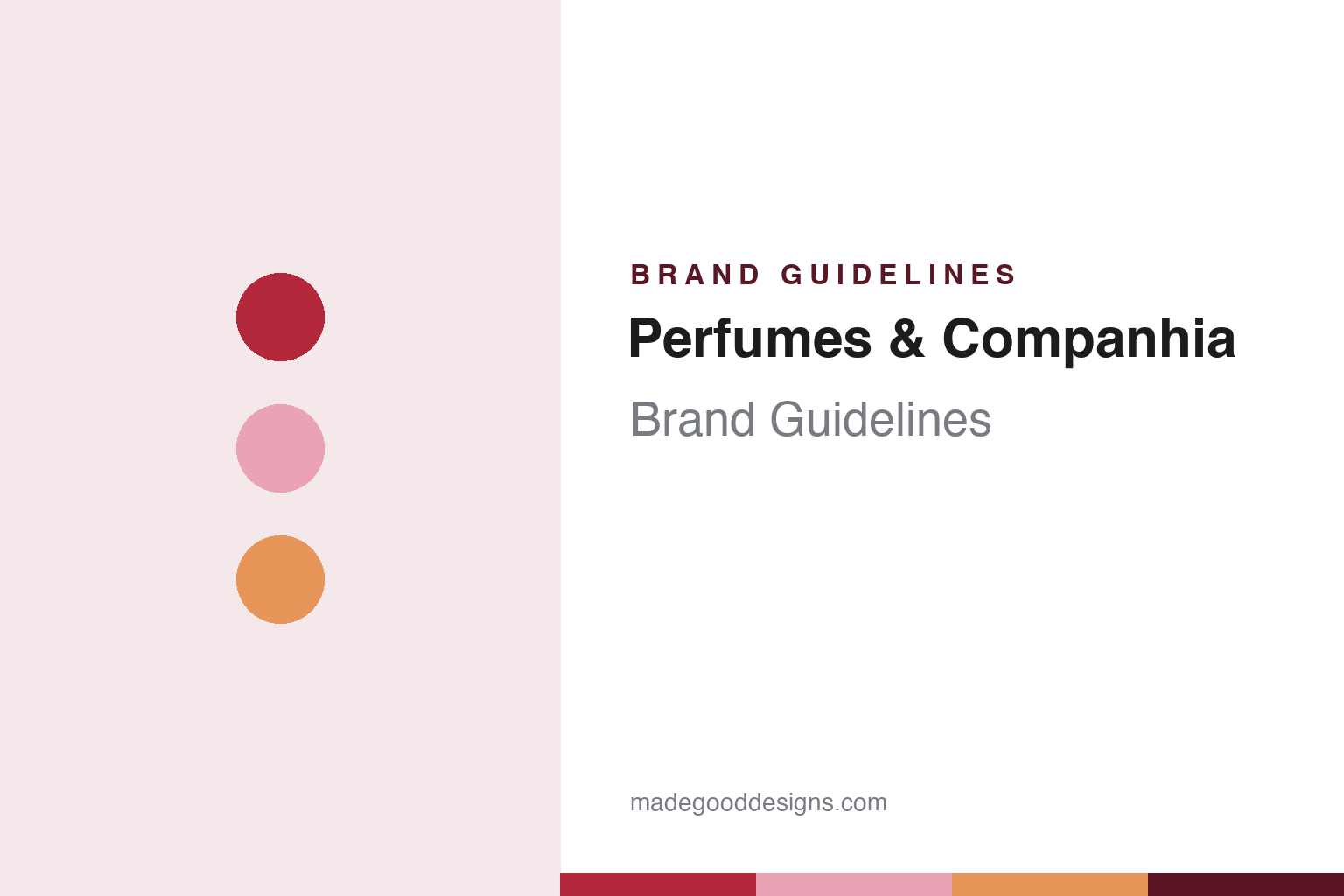
For a design guide, Perfumes & Companhia shows how a chain built from many local perfumery names can fold them into one short mark. Compare Primor, whose Portuguese shops joined the same group in 2026, and Marionnaud, whose Portuguese shops became part of the chain in 2020. For this guide we use a red, a soft pink and an apricot orange with a sans, an unofficial interpretation; no product or logo is reproduced.
Explore & save
Keep Perfumes & Companhia’s identity on hand — save it to a board in the Made Good inspiration library.
Perfumes & Companhia identity set
Pin the red, pink and orange palette and the geometric sans register to your own board.
Source & notes
Frequently Asked Questions
What font can I use to match the Perfumes & Companhia look?
This guide describes Perfumes & Companhia’s type as “A clean geometric sans for a name that is shortening to three characters”. Its type specimen is set in Jost from Google Fonts as a stand-in; Jost is not Perfumes & Companhia’s own lettering.
What colours are in the Perfumes & Companhia palette?
This guide’s Perfumes & Companhia palette is Companhia red #B3283A, Blush pink #E9A3B4, Apricot #E8955A, Deep claret #5A1622 and Shell #FBF4F1. The tones are the guide’s own unofficial interpretation, not official Perfumes & Companhia hex codes.
When was Perfumes & Companhia founded?
Perfumes & Companhia was founded in 1997 (first shop, Arrábida Shopping), in Vila Nova de Gaia, Portugal.
Who owns Perfumes & Companhia?
Perfumes & Companhia is owned by Arié group (Arié family).