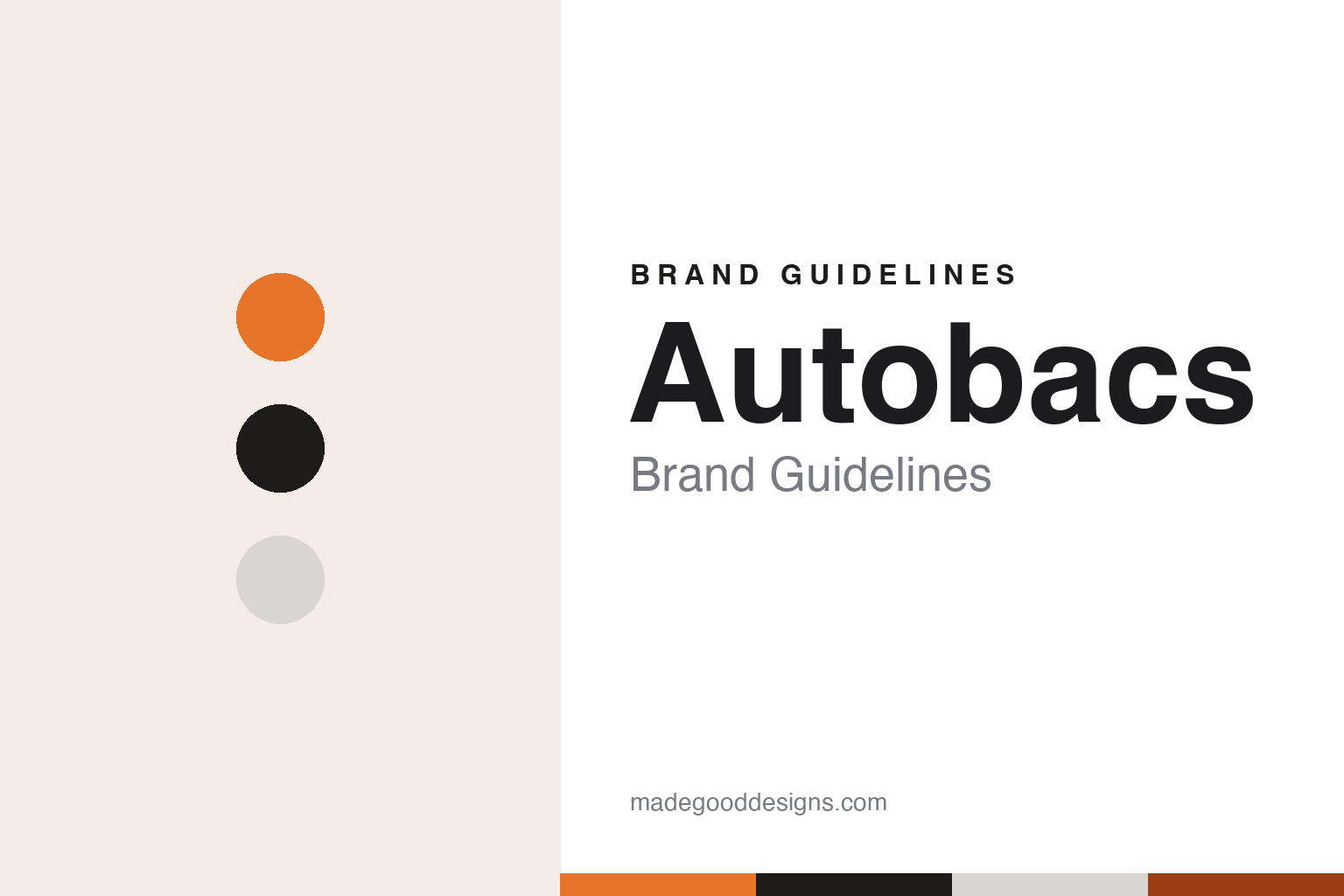
Autobacs Brand Guidelines
The Osaka one-stop car shop named after its product list.
Aa
Two constants: an Autobacs orange, rust and ink palette and a Forecourt sans register. Abstract homage — not an Autobacs product or mark; no sign, logo or store fascia is reproduced.
Suehiro Shokai
A parts wholesaler and an idea from abroad.
Autobacs began as a parts wholesaler. The company’s own history says that in February 1947 Toshio Sumino led the founding of Suehiro Shokai, a sole proprietorship in Osaka’s Fukushima ward set up to wholesale car parts. In August 1948 it became a joint-stock company, Fuji Shokai, which the company counts as its predecessor. In 1958 the wholesale side was spun off as Taiho Sangyo, and in 1960 the business opened the Fuji Drive Shop. In 1969 it co-developed a racing car, the Kaman Apache, for that year’s Japan Grand Prix, the history adds.
The idea that gave the chain its shape came from abroad. In its December 2014 issue the bilingual magazine Hiragana Times reported that Sumino had visited the United States to study retailing there and was struck by one-stop shops that sold every kind of car part, fitted them and carried out repairs on the same site. In Japan at the time, the magazine said, tyres, oil and batteries were sold in separate specialist shops, so drivers had to visit several of them. Sumino opened the first Autobacs in November 1974 in Daito, Osaka Prefecture; the company describes it as Japan’s first one-stop car-accessory shop.
Franchising followed in April 1975, with a first franchise store in Hakodate, and in November 1977 the chain launched own-brand tyres, oil and batteries. The hundredth store opened in 1979, and in March 1980 the company took the name Autobacs Seven. By July 1987, with a first store in Okinawa, it had shops in every one of Japan’s prefectures, the company says.
Colour
A name spelled out, a colour explained.
The name is a compressed product list. Hiragana Times explained it letter by letter: the first two letters stand for the company’s philosophy, A for appeal and U for unique, and the remaining six for what it sells, T for tyres, O for oil, B for batteries, A for accessories, C for car electronics and S for service. The company is Autobacs Seven, but the stores are simply Autobacs; the “Seven” refers to a continuing search for a seventh product line, the magazine said.
The colour has a story too. The same profile said the orange corporate colour, picked to stand out from a distance, stands for a pioneering spirit and for Californian oranges, and was shaped by the American sunshine Sumino remembered from his trip. A company spokesperson told the magazine that stores aim to be easy to shop, with products grouped by use and with consistent in-store signs.
The single store has since become a family of formats. The first Super Autobacs, a large store for a wide catchment, opened in Chiba in March 1997; Autobacs Express, which combines a fuel station with a car-accessory shop, followed in Atsugi in 2002. Later formats include the Smart+1 car-wash and coating shops from 2017, the Autobacs Garage concept shop and, in November 2018, the flagship A PIT AUTOBACS SHINONOME in Tokyo. The group introduced the AQ. own brand in July 2014, the lifestyle brand JACK & MARIE in 2017 and a first GORDON MILLER garage-lifestyle store, in Kuramae, in 2021. Its services widened as well: Autobacs stores began handling shaken, Japan’s statutory vehicle inspection, in 1991, and in 2001 the company showed a sports car of its own design, the Garaiya, its history records.
Typography
How car chains present themselves.
Car-service, tyre and auto-parts chains sell things that are hard to picture: a tyre change, an oil service, a set of wiper blades. So their identities lean on the shop front. A sign has to be read from a moving car, across a forecourt or a retail park, and most of these chains rely on one strong colour, a short wordmark and a fascia that looks the same from town to town. Some explain the choice: Autobacs links its orange to its founder’s visit to the United States, according to a 2014 profile in Hiragana Times.
The formats vary more than the signs. Some chains run drive-in service centres with a row of bays and a small counter; others run large stores where accessories, tyres and car-care goods fill the floor and a workshop sits alongside. In Japan, Autobacs lists a large-format Super Autobacs, a format combined with a fuel station and car-wash shops next to its standard store, and Yellow Hat counts motorcycle and bicycle chains among its group companies.
Ownership shapes the brand as well. Many networks are franchises, with local owners trading under a shared name; Autobacs says it began franchising in 1975, and Yellow Hat signed its first group store in 1982. Other chains belong to tyre makers or parts groups. The guides in this series name those owners and give the dates of each change, from company pages and dated reports, without ranking one chain against another.
Service menus are where the design work becomes practical. Chains name their services the way a driver would ask for them, and Yellow Hat’s service pages, for instance, cover tyres, air-conditioning maintenance and bodywork repair. Most also publish corporate pages on founders, owners and store counts. Read together, those pages show how a sign, a colour and a list of services turn into a brand.
Aa
A bold forecourt sans — a name built from initials. (Specimen set in Archivo, a sans STAND-IN; NOT the Autobacs logo.)
Autobacs Seven
Listed in Tokyo, spread across Asia.
Autobacs Seven listed its shares on the second section of the Osaka Securities Exchange in March 1989 and on the second section of the Tokyo Stock Exchange in August 1993; in September 1993 they moved to the first sections in Osaka and Tokyo. The company also listed in London in March 1995 and left that market in March 2007. After the Tokyo exchange reorganised its segments in April 2022, the shares moved to the Prime Market, the company says. Its head office moved from Osaka to Koto ward in Tokyo in October 2004.
Abroad, the company set up a trading company in Hong Kong in 1986 and opened its first overseas store in Taiwan in May 1991. Singapore followed in 1995, Thailand in 2000 and France in 2001, through a company formed with Renault in 1999, then Malaysia in 2012, Indonesia in 2015 and the Philippines in 2016. The stores opened in the United States from 2003 and in China from 2004 no longer operate, the history notes. As of 1 April 2025 the group counted 1,304 stores, 1,156 in Japan and 148 overseas, including in-shop and combined sites, the company says. It has also moved into car dealerships, signing a dealer contract with BYD’s Japanese arm in December 2022 and making the Honda dealer group Togo Holdings a subsidiary in October 2024.
The name travels through motorsport as well: the Super GT racing series carries it in its title, and the Malaysian motoring site Carz reported in June 2025 on the Sepang round of the 2025 Autobacs Super GT Series.
For a design guide, Autobacs shows how a store name can double as a product list and how one colour can carry a founding story. Compare Yellow Hat, another Japanese car-accessory chain built with partner-run stores, and Halfords, a British car-parts and service chain. For this guide we use orange, rust and ink with a sans, an unofficial interpretation; no product or logo is reproduced.
Explore & save
Keep Autobacs’s identity on hand — save it to a board in the Made Good inspiration library.
Autobacs identity set
Pin the Autobacs orange, rust and ink palette and the Forecourt sans register to your own board.
Source & notes
Frequently Asked Questions
What font can I use to match the Autobacs look?
This guide describes Autobacs’ type as “A bold forecourt sans — a name built from initials”. Its type specimen is set in Archivo from Google Fonts as a stand-in; Archivo is not Autobacs’ own lettering.
What colours are in the Autobacs palette?
This guide’s Autobacs palette is Shop orange #E8742A, Ink #1E1C1A, Forecourt grey #D9D6D0, Deep rust #9A3E12 and Paper #F7F5F1. The tones are the guide’s own unofficial interpretation, not official Autobacs hex codes.
When was Autobacs founded?
Autobacs was founded in 1947 (as Suehiro Shokai), in Osaka, Japan.
Who founded Autobacs?
Autobacs was founded by Toshio Sumino in 1947 (as Suehiro Shokai).