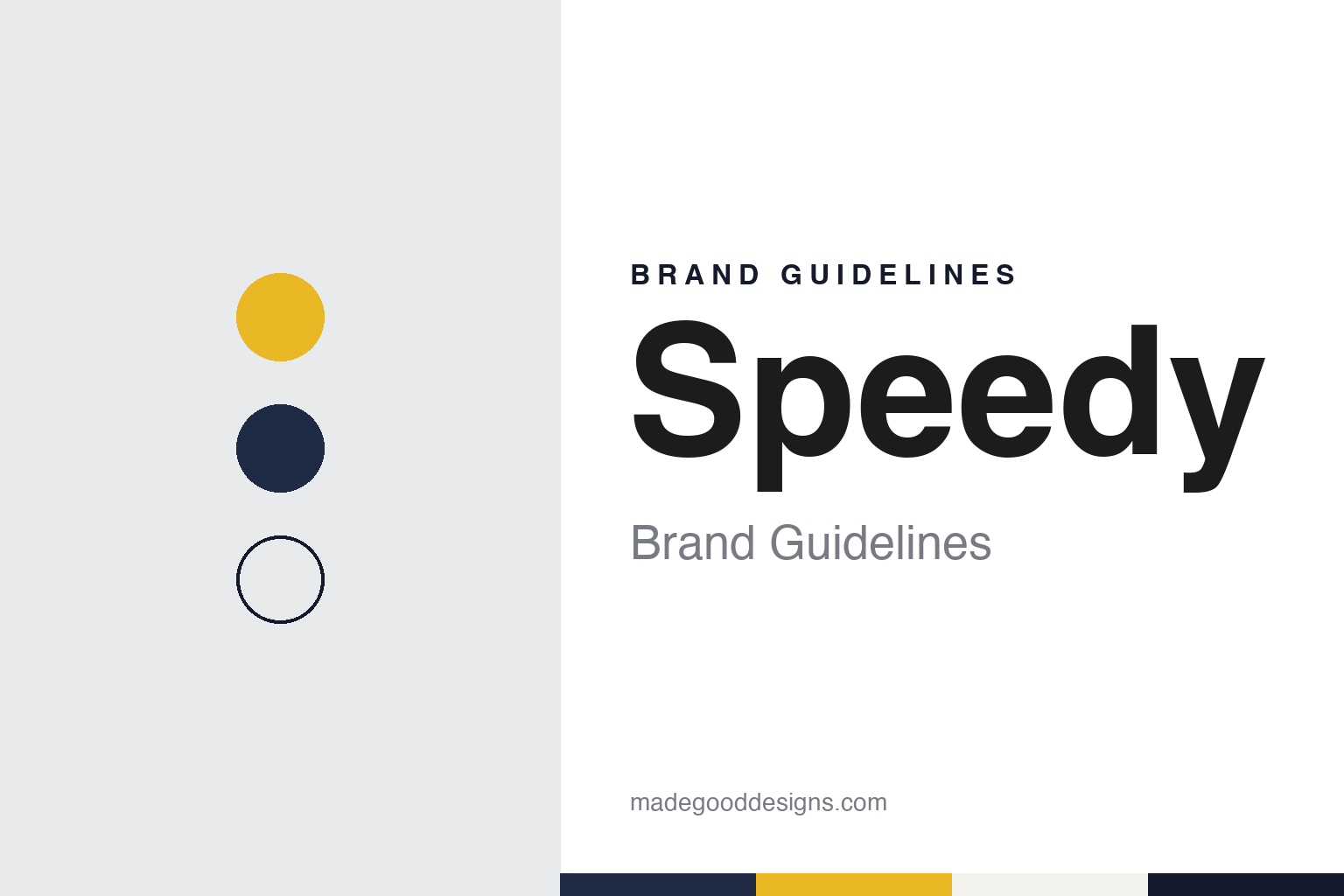
Speedy Brand Guidelines
The French car-service chain that began with exhausts in 1978.
Aa
Two constants: a navy and yellow palette of our own and a bold grotesque register. Abstract homage — not a Speedy sign or mark; no logo, shopfront or vehicle is reproduced.
Exhausts first
A single repair, then a full menu.
Speedy started in France in 1978 as a specialist in exhaust pipes, according to both the company’s own history page and French Wikipedia. When the European business was sold in 1999, L’argus described it as belonging to the Canadian group SMK Speedy International.
The service menu grew in the 1980s. The company says that in 1983 it added oil changes, brakes, shock absorbers and batteries to its exhaust work; French Wikipedia dates the same widening to 1983 and adds that the chain set out its “five commitments” to customers in 1985, the year of its first television advertisement.
Franchising and tyres came next. The company dates the creation of its franchise department and the start of its tyre business to 1991; French Wikipedia gives 1992 for tyres. French Wikipedia also says that in 1991 Speedy bought the Plein Pot network from Shell, taking it past 200 centres, and that it later absorbed centres from the Virage and Axto networks. The company says it opened its own training centre in 1997 and made its first move outside France in 1999.
By the late 1990s the European business was substantial. L’argus reported in November 1999 that Speedy Europe ran 327 centres in France, Belgium, Spain and Switzerland, plus 84 franchised outlets under the Speedy name, and 160 centres in Germany under the Pit Stop name.
Colour
Kwik-Fit, private equity and a buyout.
The Canadian owner sold up in 1999. L’argus reported on 15 November that year that SMK Speedy International had decided to sell all of its European centres and franchise business to the Scottish group Kwik-Fit, subject to a shareholder vote in January; the magazine linked the sale to a plan to refocus on North America. The Journal de l’Automobile, looking back in March 2011, described Kwik-Fit as owned at the time by the carmaker Ford when it bought Speedy.
Ownership then changed with the parent. According to the same 2011 article, Ford sold Kwik-Fit to the investment fund CVC in 2002, and the French fund PAI Partners bought it in 2005. In March 2011 the Japanese trading house Itochu took over Kwik-Fit, which the Journal de l’Automobile described as the parent company of Speedy.
Speedy did not stay with Itochu. French Wikipedia says the new owner wanted to combine Kwik-Fit’s British business with its own tyre distribution and put the French chain up for sale. In 2011 Speedy’s management bought the business in a leveraged management buyout, financed in debt and equity by the Mauritian MCB Group through its private equity fund and its banking arm, the Mauritian news site Defimedia reported in June 2016.
Independence brought a new look. The company says that in 2013 it launched a new Speedy concept and began a programme of centre renovations; in a 2016 interview with the Journal de l’Automobile, the chain’s then president described the preceding five years as a repositioning of the Speedy name built on quality and trust, including a new identity, and said its television campaigns put its commitments forward rather than price.
Typography
Signs, menus and networks.
Car-service, tyre and auto-parts chains sell things that are hard to picture: a tyre change, an oil service, a set of wiper blades. So their identities lean on the shop front. A sign has to be read from a moving car, across a forecourt or a retail park, and most of these chains rely on one strong colour, a short wordmark and a fascia that looks the same from town to town. Some explain the choice: Autobacs links its orange to its founder’s visit to the United States, according to a 2014 profile in Hiragana Times.
The formats vary more than the signs. Some chains run drive-in service centres with a row of bays and a small counter; others run large stores where accessories, tyres and car-care goods fill the floor and a workshop sits alongside. In Japan, Autobacs lists a large-format Super Autobacs, a format combined with a fuel station and car-wash shops next to its standard store, and Yellow Hat counts motorcycle and bicycle chains among its group companies.
Ownership shapes the brand as well. Many networks are franchises, with local owners trading under a shared name; Autobacs says it began franchising in 1975, and Yellow Hat signed its first group store in 1982. Other chains belong to tyre makers or parts groups. The guides in this series name those owners and give the dates of each change, from company pages and dated reports, without ranking one chain against another.
Service menus are where the design work becomes practical. Chains name their services the way a driver would ask for them, and Yellow Hat’s service pages, for instance, cover tyres, air-conditioning maintenance and bodywork repair. Most also publish corporate pages on founders, owners and store counts. Read together, those pages show how a sign, a colour and a list of services turn into a brand.
Aa
A bold grotesque for a roadside sign. (Specimen set in Archivo, a sans STAND-IN; NOT the Speedy logo.)
Speedy
Part of Bridgestone since 2016.
A tyre maker bought the chain in 2016. On 30 May 2016 the Journal de l’Automobile reported that Bridgestone EMEA, the Europe, Middle East and Africa arm of the Japanese tyre maker, was acquiring 100 per cent of Speedy, subject to approval by the competition authorities. Speedy’s president told the magazine the chain then had 480 centres, and said the company liked to say that a French driver was never more than fifteen minutes from one; Defimedia reported the same figure in June 2016 and said half of them were run by franchisees. The company’s own timeline records 2016 as the year Bridgestone bought Speedy France, and its website in 2026 still links to a Bridgestone EMEA policy document.
The menu kept widening under the new owner. The company says it moved to full vehicle servicing in 2018, launched E85 conversion kits in 2020, trained its teams to service electric and hybrid cars in 2022, and in 2023 opened its first service corner in a car park and began servicing two-wheelers. It also runs a fleet business, Speedy Fleet, which it dates to the 2000s.
Growth now comes largely through franchising. The Observatoire de la Franchise reported in March 2025 that Speedy opened 20 new franchised centres in 2024, bringing it to 306 franchises across mainland France, and that it aimed to open 40 more in 2025; it quoted the chain’s president, Eric Terefenko, on extending its presence beyond the large cities. The company itself says it has close to 600 centres and a presence in eight countries outside France. The legal notice on its website names Speedy France SAS as the owner of the site.
For a design guide, Speedy shows how a single-repair name can carry a wider menu without changing its sign. Compare Kwik-Fit, its owner from 1999 to 2011, and Feu Vert, another French car-service chain. For this guide we use a navy and a warm yellow with a sans, an unofficial interpretation; no product or logo is reproduced.
Explore & save
Keep Speedy’s identity on hand — save it to a board in the Made Good inspiration library.
Speedy identity set
Pin the Speedy navy and yellow palette and the bold grotesque register to your own board.
Source & notes
Frequently Asked Questions
What font can I use to match the Speedy look?
This guide describes Speedy’s type as “A bold grotesque for a roadside sign”. Its type specimen is set in Archivo from Google Fonts as a stand-in; Archivo is not Speedy’s own lettering.
What colours are in the Speedy palette?
This guide’s Speedy palette is Workshop navy #1F2A44, Night ink #141A2B, Bay yellow #E9B824, Forecourt grey #8C8F96 and Paper #F3F1EC. The tones are the guide’s own unofficial interpretation, not official Speedy hex codes.
When was Speedy founded?
Speedy was founded in 1978, in France. This guide lists SMK Speedy International, Kwik-Fit, management buyout, Bridgestone (2016) as its owner.
Who owns Speedy?
Speedy is owned by SMK Speedy International, Kwik-Fit, management buyout, Bridgestone (2016).