Vulco Brand Guidelines
The French tyre-dealer network created by Dunlop France in 1996.
Aa
Two constants: a slate and ochre palette of our own and a sturdy grotesque register. Abstract homage — not a Vulco sign or mark; no logo, shopfront or tyre is reproduced.
Dunlop and the dealers
A tyre banner shared by independent centres.
Vulco is a French network of centres for tyres and car maintenance. It was created in 1996 by two shareholders, Dunlop France and Pneuman, according to the franchise directory Observatoire de la Franchise, and the network’s own website says it has existed “for more than 25 years.” The same directory says that from 1998 Vulco offered a breakdown-assistance service for heavy trucks and began to expand in Europe, starting with Spain.
The network is built from independent businesses rather than company-owned branches. In June 2011 the Journal de l’Automobile described Vulco Développement as the parent company to which the network’s members are bound by contract, with the Goodyear Dunlop group as its shareholder. L’argus called Vulco “the Goodyear-Dunlop subsidiary” in 2014, and in 2020 it referred to Goodyear as the network’s parent; in July 2024 J2R Auto described Vulco as “the banner of the Goodyear group.”
Centre counts appear in the trade press year by year. The Journal de l’Automobile gave 240 centres in France in June 2011. In September 2014 L’argus reported that 12 new centres had opened that year by the end of September, half of them financed by existing members, in places including Saint-Cloud, Poitiers, Tours, Caen, Le Havre, Nancy and Nîmes. J2R Auto reported 232 centres in January 2015 and, that April, said they were run by 165 investors. By July 2024 the same title put the network at more than 200 centres.
Vulco also sat inside a wider Goodyear retail family. In 2015 J2R Auto placed it within Goodyear Dunlop Retail Partner, alongside the Quick, HiQ, Premio and Super Service banners, and gave the size of that European family as about 5,000 centres in January and about 4,000 centres in 25 countries in April.
Colour
Tyres first, then the workshop menu.
The service menu on the French website today starts with tyres and moves into maintenance. It lists tyre changes and tyre repairs, oil changes, tyre-pressure sensors, brakes and air-conditioning, with tyres for cars, vans and SUVs in summer, winter and all-season ranges. Among the tyre brands it names are Goodyear, Cooper and Fulda. A separate section addresses professional customers, with pages on joining as a franchisee, on car fleets and truck fleets, and on tyres for heavy goods vehicles.
That professional side has shaped the network for years. In June 2011 the Journal de l’Automobile reported that Vulco Développement had held its annual convention in Seville that May, that purchasing for the network was being centralised from July 2011, and that Vulco had launched a tyre-assistance service for passenger cars covering punctures from the driver’s home and across Europe. The same report mentioned a partnership with the television channel M6 on a series of around thirty short educational films about conduct on the road.
In January 2015 J2R Auto covered the third edition of Vulco&Co, an event at which members met suppliers and heard the year’s plan. The network said then that, for good coverage, it would need about 400 centres for cars and about 200 points for trucks, against 130 truck points at the time. In April 2015 J2R Auto reported that Vulco had taken a stand at the Franchise Expo show at the Porte de Versailles in Paris for the first time, to recruit new members, and that it planned national television and radio campaigns along with more work on its merchant website and social media.
Later reports describe a wider menu. In December 2020 L’argus wrote that Vulco was leaning on niche services such as air-conditioning and the contrôle technique, France’s periodic vehicle inspection, aiming to open about ten centres a year and to sell more tyres under the Goodyear brand. In July 2024 J2R Auto reported a partnership with the glazing network Mondial Pare-Brise, running since the start of that year and active in half the Vulco network: its technicians work inside Vulco centres, and centres without their own glazing service act as local relay points.
Typography
Signs, menus and owners.
Car-service, tyre and auto-parts chains sell things that are hard to picture: a tyre change, an oil service, a set of wiper blades. So their identities lean on the shop front. A sign has to be read from a moving car, across a forecourt or a retail park, and most of these chains rely on one strong colour, a short wordmark and a fascia that looks the same from town to town. Some explain the choice: Autobacs links its orange to its founder’s visit to the United States, according to a 2014 profile in Hiragana Times.
The formats vary more than the signs. Some chains run drive-in service centres with a row of bays and a small counter; others run large stores where accessories, tyres and car-care goods fill the floor and a workshop sits alongside. In Japan, Autobacs lists a large-format Super Autobacs, a format combined with a fuel station and car-wash shops next to its standard store, and Yellow Hat counts motorcycle and bicycle chains among its group companies.
Ownership shapes the brand as well. Many networks are franchises, with local owners trading under a shared name; Autobacs says it began franchising in 1975, and Yellow Hat signed its first group store in 1982. Other chains belong to tyre makers or parts groups. The guides in this series name those owners and give the dates of each change, from company pages and dated reports, without ranking one chain against another.
Service menus are where the design work becomes practical. Chains name their services the way a driver would ask for them, and Yellow Hat’s service pages, for instance, cover tyres, air-conditioning maintenance and bodywork repair. Most also publish corporate pages on founders, owners and store counts. Read together, those pages show how a sign, a colour and a list of services turn into a brand.
Aa
A sturdy grotesque — the register of a roadside tyre centre. (Specimen set in Barlow, a sans STAND-IN; NOT the Vulco logo.)
Vulco
One sign over many independent workshops.
Each Vulco centre is run by its own operator under the shared sign. In December 2020 L’argus reported that a new, harmonised visual identity was being tested at a centre in Courbevoie, in the Hauts-de-Seine, at the same time as new operating software was being rolled out across the network.
The website presents the network in plain terms, as a network of expert car centres for tyres and car maintenance, and builds its pages around a short path to buying tyres online: choose the tyres, choose the services, book an appointment and have them fitted at a centre. Seasonal offers on Goodyear and Cooper tyres and on brake parts sit on the home page, and a centre finder and a customer-service line run through every page.
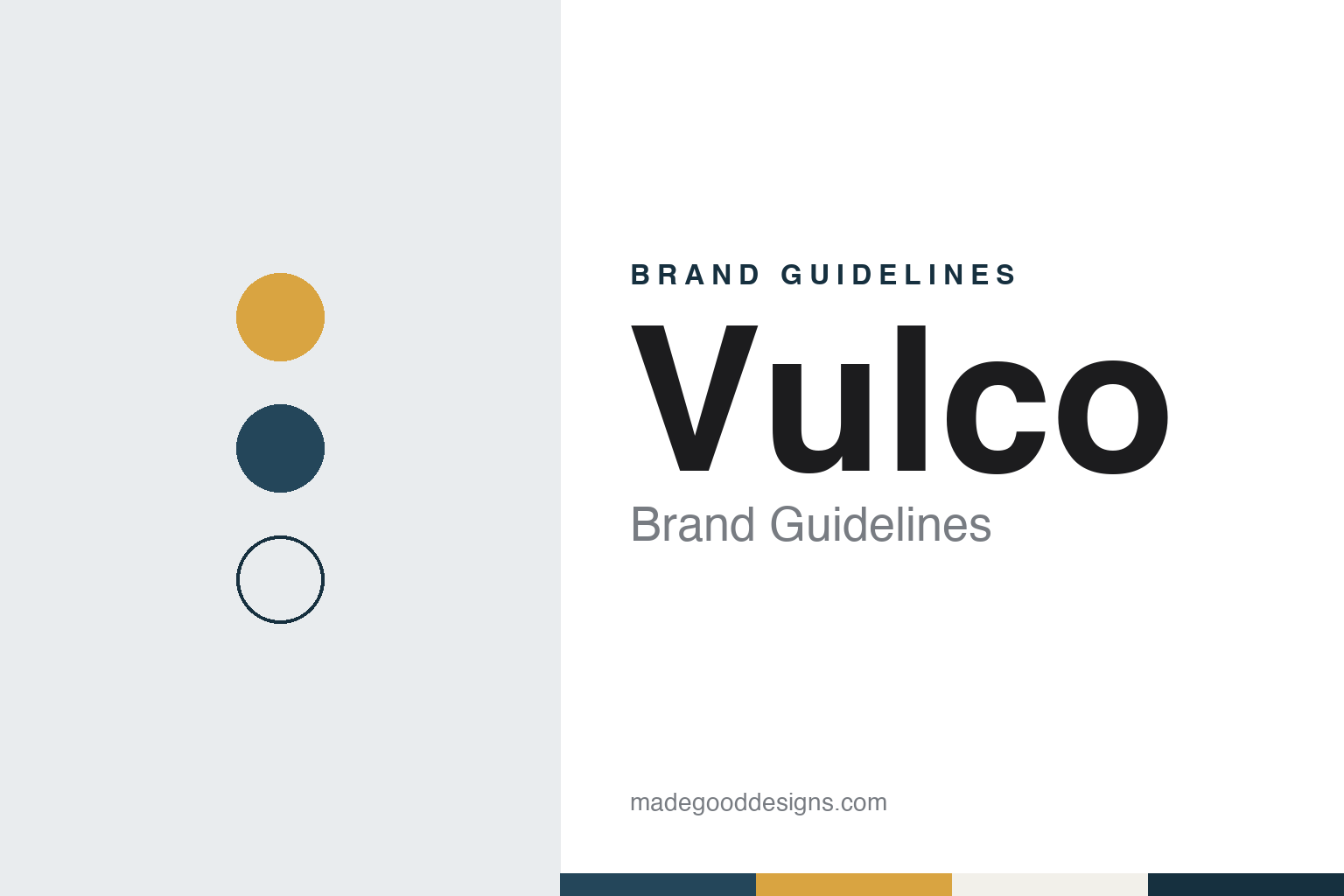
For a design guide, Vulco shows how a tyre maker’s retail banner can give a common face to independent dealers who keep their own businesses. Compare Goodyear, the group behind the network, and Euromaster, another tyre-maker network in France. For this guide we use slate, ochre and a warm paper with a sans, an unofficial interpretation; no product or logo is reproduced.
Explore & save
Keep Vulco’s identity on hand — save it to a board in the Made Good inspiration library.
Vulco identity set
Pin the Vulco slate and ochre palette and the sturdy grotesque register to your own board.
Source & notes
Frequently Asked Questions
What font can I use to match the Vulco look?
This guide describes Vulco’s type as “A sturdy grotesque — the register of a roadside tyre centre”. Its type specimen is set in Barlow from Google Fonts as a stand-in; Barlow is not Vulco’s own lettering.
What colours are in the Vulco palette?
This guide’s Vulco palette is Depot slate #24465A, Night ink #16303F, Ochre stripe #D9A441, Tread grey #8A8F93 and Paper #F2F0EA. The tones are the guide’s own unofficial interpretation, not official Vulco hex codes.
When was Vulco founded?
Vulco was founded in 1996, in France.