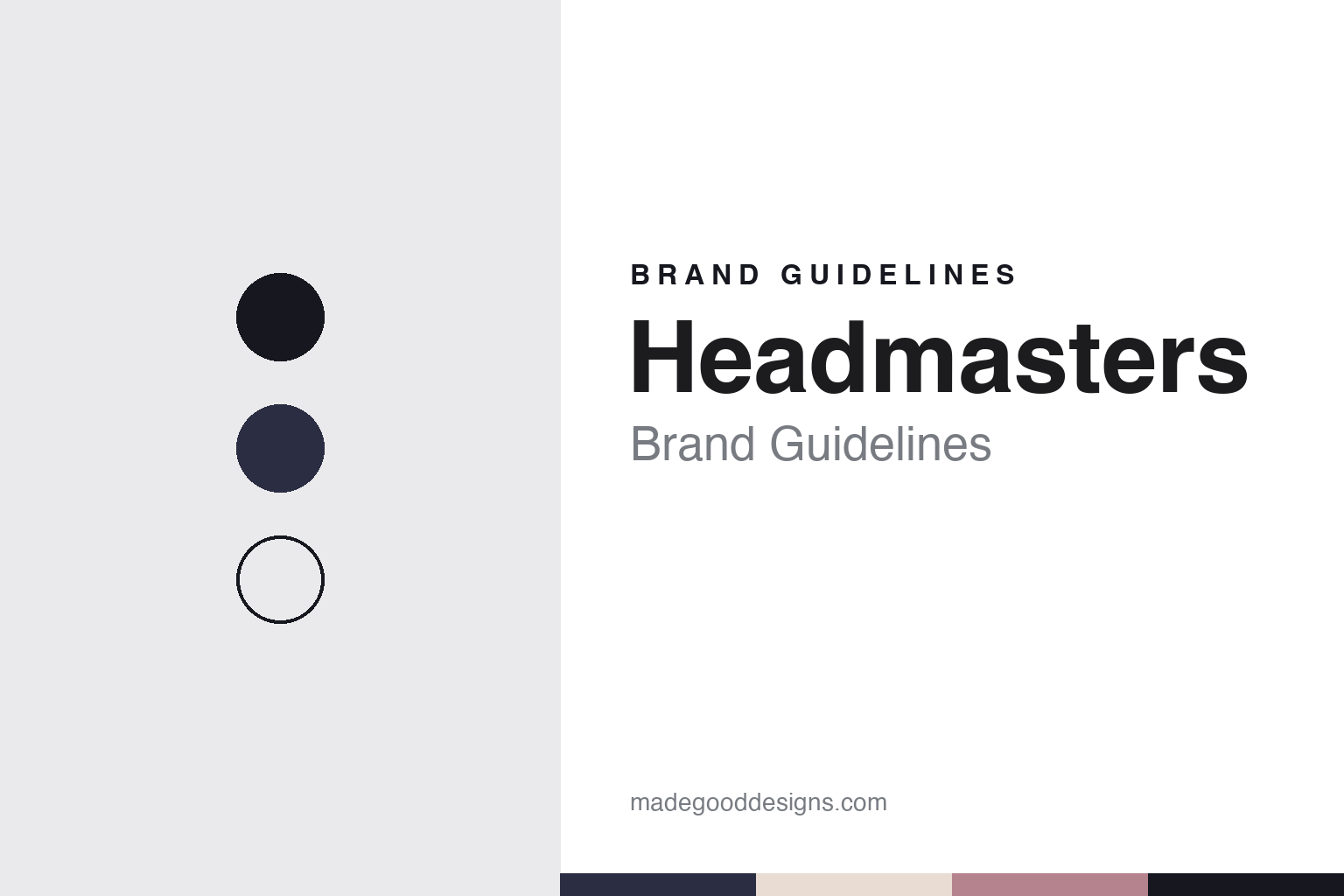
Headmasters Brand Guidelines
The Wimbledon Village salon group founded in 1982.
Aa
Two constants: a slate, rose and blush palette and a high-street sans register. Abstract homage — not a Headmasters asset or mark; no salon sign, logo or photograph is reproduced.
Wimbledon Village
One salon in south-west London, 1982.
Headmasters began with a single salon in Wimbledon Village, in south-west London, in 1982. In April 2022 the trade title Hairdressers Journal reported that the group’s chairman, John Sanders, had co-founded the business that year with Christine Sanders, opening the salon in the village that is still treated as its flagship. The company’s own about page gives the same year and the same place: “The first Headmasters salon opened in Wimbledon Village in 1982.”
Five years earlier, in May 2017, the local magazine Lady Wimbledon marked the group’s 35th anniversary. It quoted John Sanders as chairman and described a team of about 1,000 staff working across the salons. The company also dates some of its individual branches: its news pages say the Weybridge salon in Surrey opened in 1985 and has been celebrating its 40th year.
From one salon the business became a chain of high-street salons concentrated in London and the surrounding counties. Salon counts change with the date and the source, so each one is given here with its source. In May 2018 Hairdressers Journal called Headmasters a “sixty-strong independent high street salon group.” In February 2019 the same magazine wrote of “over 60 salons in over three decades.” In April 2022, in the group’s 40th year, it reported 55 salons across London and the Southeast. The company’s own about page, which carries no date, now gives 54 salons and two academies, and describes the business as one of the UK’s biggest salon groups.
The management team has been reported in the trade press. In May 2021 Hairdressers Journal listed Trevor Sanders as finance director and interim chief executive in the senior management team, alongside the chief operating officer, the chief information officer, the head of PR and marketing, and the creative and communications director.
Colour
Franchising, education and a creative director.
Headmasters runs on two models side by side: salons operated by the group and salons owned by franchisees under the Headmasters name. The company’s about page invites hairdressers to “own your own Headmasters salon,” and the trade press has followed the franchise side for several years. In May 2021 Hairdressers Journal reported that the group had twenty-seven franchise salons, a total that included a newly franchised salon in Chiswick taken over by a former salon manager who had first joined the company as an apprentice.
The most prominent franchise is in Mayfair. In February 2019 Hairdressers Journal reported that Andrew Barton, the group’s creative director, had become the franchise owner of Headmasters Mayfair, which the magazine described as the group’s flagship salon in central London. The same report summed up the franchise programme as one that lets hairdressers own their own Headmasters salon with the support of the wider group, and it gave the group’s core principles as premium hairdressing, service and professional development for every stylist.
Barton’s appointment had been announced in May 2018. Hairdressers Journal reported then that he would lead the existing artistic team and act as brand spokesperson, and the group’s commercial director said he would head up the company’s education programmes. By 2021 the magazine listed him as creative and communications director.
Education is a large part of how the group presents itself. Its about page describes two dedicated academies where stylists receive ongoing training, and the company’s pages refer to an education section for staff and trainees. In its 40th year the group turned its own people into the brand’s imagery: the #weatheadmasters campaign of April 2022, Hairdressers Journal reported, featured twelve members of salon staff in the annual brand image campaign, and the photographs and video were also used to support recruitment. Barton told the magazine that Headmasters “is what it is because of its people.”
Typography
Salon chains and franchise groups.
Hair-salon chains present themselves less through products than through the sign above the door. The names in this guide come from the United States, France, Germany, England, Australia and Japan, and each company publishes its own salon signs, logos and colour schemes; the palettes here are our own reading, not official colours.
The formats vary widely. At one end are walk-in salons built around quick cuts with no appointment, often in strip centres, shopping malls or inside larger stores; at the other are high-street and department-store salons that sell an appointment with a named stylist. Some companies run several banners at once, each aimed at a different customer, so the corporate name and the name on the shopfront are not always the same.
Ownership is just as varied. Some chains are franchise groups, where a franchisor licenses its name to independent salon owners; others are run by their founders’ families or by larger salon groups that combine company-owned and franchised salons. Several have changed hands more than once, and this guide gives those changes as dated facts. For each company it notes when and where the business was founded, who owns it today, how many salons a dated source counts and which banners it trades under, along with any restructuring, closure or change of owner.
Many chains also describe their own training academies, seasonal collections and own-label product ranges, using the names the companies give them, and keep corporate pages on their founders and owners. This guide sets out what each company says about itself, what independent sources record, and the points where the two differ.
Aa
A clean high-street sans for a salon fascia. (Specimen set in Archivo, a sans STAND-IN; NOT the Headmasters logo.)
Headmasters
An independent group built on salons and staff.
Hairdressers Journal called Headmasters an independent high-street salon group in 2018, and in 2022 it still named the co-founder John Sanders as chairman. The group’s growth, as the magazine has reported it, has come through new salons and franchisees taking on Headmasters branches.
That shapes how the brand reads in public. Its visible assets are the salons themselves, the people who work in them and the annual image campaigns built around those people, rather than a product range sold in other shops. The salons named in the sources sit in London and the south-east: the Wimbledon Village original, Weybridge in Surrey, Chiswick in west London and the franchised salon in Mayfair.
The company’s own figures should be read as its own claims. Its about page describes Headmasters as one of the UK’s biggest salon groups and gives its current count as 54 salons and two academies; the trade press has given counts between 55 and about 60 at different dates since 2018. The founding facts are the same in the company’s pages, in Lady Wimbledon and in Hairdressers Journal: one salon, Wimbledon Village, 1982.
For a design guide, Headmasters shows how a salon group can make its own staff the centre of its identity, using annual image campaigns to present the people in its salons as the brand. Compare Toni&Guy, another London-born salon name built on franchising and education, and Saks Hair, an English franchise group that began in the north-east. For this guide we use slate, rose and a pale blush with a sans, an unofficial interpretation; no product or logo is reproduced.
Explore & save
Keep Headmasters’s identity on hand — save it to a board in the Made Good inspiration library.
Headmasters identity set
Pin the Headmasters slate, rose and blush palette and the high-street sans register to your own board.
Source & notes
Frequently Asked Questions
What font can I use to match the Headmasters look?
This guide describes Headmasters’ type as “A clean high-street sans for a salon fascia”. Its type specimen is set in Archivo from Google Fonts as a stand-in; Archivo is not Headmasters’ own lettering.
What colours are in the Headmasters palette?
This guide’s Headmasters palette is Village slate #2B2D42, Night ink #16171F, Rose clay #B5838D, Blush stone #E9DCD3 and Paper #F8F6F4. The tones are the guide’s own unofficial interpretation, not official Headmasters hex codes.
When was Headmasters founded?
Headmasters was founded in 1982, in Wimbledon Village, London. Headmasters is known for High-street salons, franchising, academies.
Who founded Headmasters?
Headmasters was founded by John and Christine Sanders in 1982.