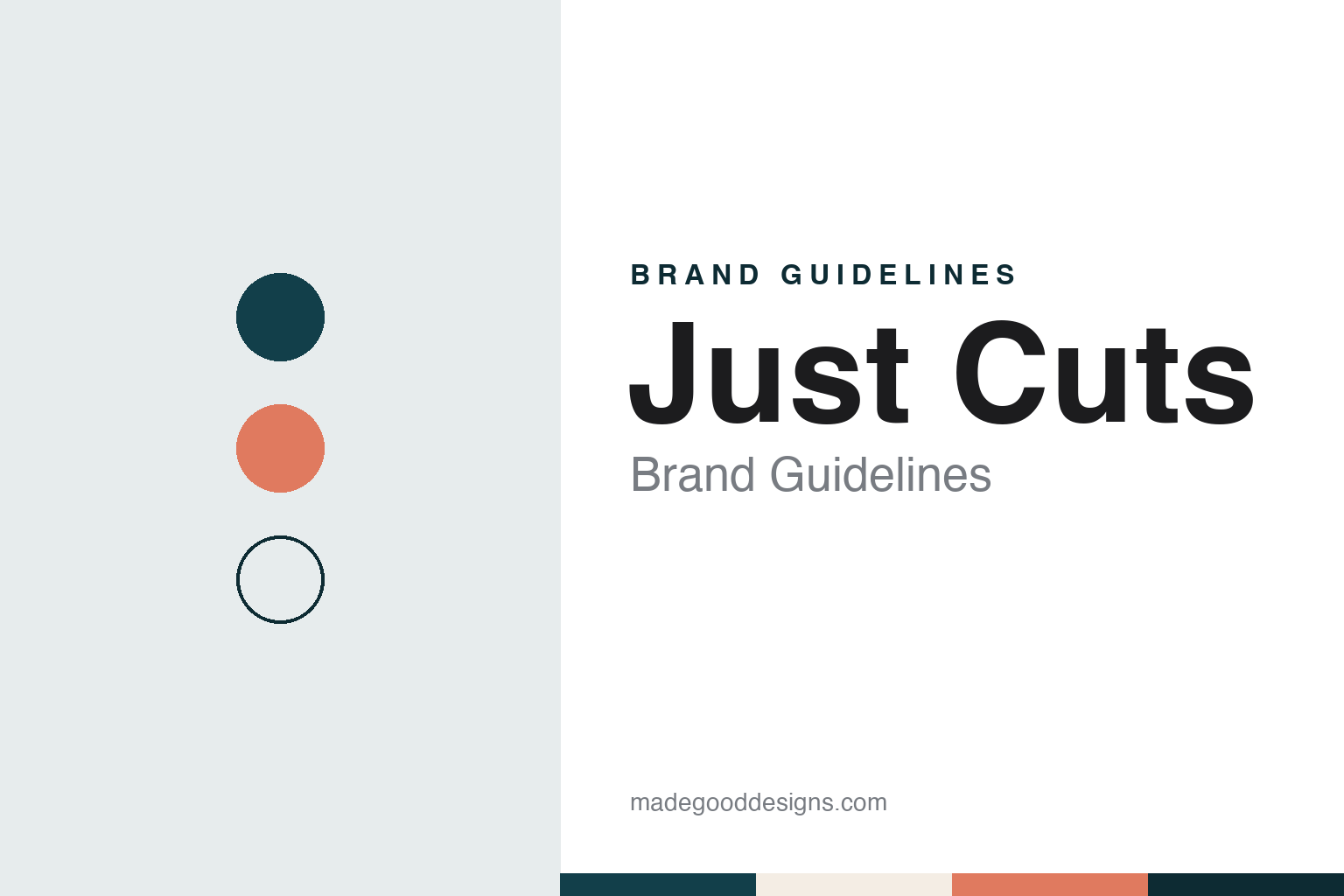
Just Cuts Brand Guidelines
The Sydney walk-in salon franchise built on no appointments.
Aa
Two constants: a teal, sand and coral palette and a plain grotesque register. Abstract homage — not a Just Cuts asset; no salon sign, logo or product is reproduced.
A Sydney hairdresser
A cut-only salon that became a franchise.
Just Cuts is an Australian chain of walk-in hair salons, run as a franchise. It was built by Denis McFadden, a Sydney hairdresser, and its story is told in slightly different ways depending on the source. Franchise Canada, the magazine of the Canadian Franchise Association, traced its origins in January 2024 to 1983 and Hurstville, a Sydney suburb. McFadden, it said, was moving his full-service salon to another spot on the same strip but still had six months left on his old lease, so he put a sign in the window offering simple haircuts and staffed the old shop with stylists who did only that. A queue formed almost at once, the magazine reported, and he decided to keep both the salon and the idea.
The Australian trade site Franchise Business, writing in June 2020, put the starting point earlier, saying McFadden spotted the need for a no-frills hairdressing option in 1980 and then developed the no-appointment, price-conscious model. Both sources agree on the next step: franchising began in 1990. The company itself dates the brand to that year. In a media release of September 2017 it said the first franchised salon opened at Engadine, in New South Wales, in 1990, and that the business had started out of a garage in the Sutherland Shire. Franchise Canada adds that the first franchisee was a former apprentice of McFadden’s.
The model that grew from those beginnings is narrow by design. The company says its salons specialise in cutting hair for men, women and children, and that they do not offer colour or chemical services. In Franchise Canada’s account, add-ons such as blow-drying and straightening are available, but the core of the offer remains a haircut without an appointment. Just Cuts says it was founded on the idea that people want a quality cut from a qualified stylist at an affordable price, and it describes its place as sitting between the barber and the high-end salon.
Colour
No appointments, one name for the cut.
Much of the Just Cuts identity lies in the words it uses. The company calls its haircut a Style Cut, with a trademark sign, and refers to customers as Clients and to its hairdressers as Stylists, both capitalised in its own copy. It says every Style Cut is backed by a seven-day guarantee: a customer who is unhappy can return with the receipt to any salon within a week. It also says its prices are fixed and shown upfront, with no hidden extras.
The walk-in system is the other constant. Just Cuts does not take appointments. Instead, its app lets customers check in ahead of a visit and receive a text when it is time to come to the salon, the company says. Franchise Canada reported in 2024 that franchise owners use a companion system to see, from a phone, how many clients are queuing and which stylists are checked in, and that the system includes a benchmarking tool comparing each salon with the rest of the group.
The salons themselves follow a set pattern. The company describes a modern, open-plan layout with a dedicated retail space for its own products, each design customised within a single brand framework. Speaking to Franchise Canada, chief executive Amber Manning said that in Australia a handful of shop fitters travel the country to keep the look and feel of the salons consistent, and that the company manufactures its own products.
Those products carry a separate name. Just Cuts says it launched its haircare and styling range, JUSTICE, in 2013, after customers asked for products to use at home; the range appears on its sites as JUSTICE Haircare and JUSTICE Professional, and the company opened a warehouse and distribution centre for it at Caringbah, New South Wales, in May 2017. The brand has also attached its name to public events. Both the company and Franchise Canada say Just Cuts was the official hairdresser of the Sydney 2000 Olympics, and the company says it set a Guinness World Record in 2013 for the most haircuts in eight hours at a fundraising event.
Typography
Signs, colour and the salon front.
Hair-salon chains present themselves less through products than through the sign above the door. The names in this guide come from the United States, France, Germany, England, Australia and Japan, and each company publishes its own salon signs, logos and colour schemes; the palettes here are our own reading, not official colours.
The formats vary widely. At one end are walk-in salons built around quick cuts with no appointment, often in strip centres, shopping malls or inside larger stores; at the other are high-street and department-store salons that sell an appointment with a named stylist. Some companies run several banners at once, each aimed at a different customer, so the corporate name and the name on the shopfront are not always the same.
Ownership is just as varied. Some chains are franchise groups, where a franchisor licenses its name to independent salon owners; others are run by their founders’ families or by larger salon groups that combine company-owned and franchised salons. Several have changed hands more than once, and this guide gives those changes as dated facts. For each company it notes when and where the business was founded, who owns it today, how many salons a dated source counts and which banners it trades under, along with any restructuring, closure or change of owner.
Many chains also describe their own training academies, seasonal collections and own-label product ranges, using the names the companies give them, and keep corporate pages on their founders and owners. This guide sets out what each company says about itself, what independent sources record, and the points where the two differ.
Aa
A plain, friendly grotesque for a walk-in salon. (Specimen set in Archivo, a sans STAND-IN; NOT the Just Cuts logo.)
Just Cuts
From Engadine to four countries.
The network spread first across Australia and then overseas. Franchise Canada reported that the first salon outside Australia opened in New Zealand in 1996. In its September 2017 release the company marked its 200th salon, at Mandurah in Western Australia, and said it had bought back the New Zealand master franchise and brought both countries under its head office team in Sydney; it then described itself as Australian owned. Franchise Business counted more than 200 outlets across Australia, New Zealand and the UK in June 2020, and reported that more than half of the franchisees ran more than one salon.
By January 2024, Franchise Canada put the total at 227 locations in four countries: 189 in Australia, 32 in New Zealand, five in the UK and one in Taiwan, run by 125 franchisees, about 55 per cent of whom owned more than one salon. The same article described plans to open in Canada, with Manning saying the main market was families who want a quality salon visit without a separate trip to the barber. The company now runs franchising sites for Australia and New Zealand, the UK and Canada.
The people at the top have changed over time. McFadden led the business as chief executive and founder in 2017, according to the company, which says he was inducted into the Franchising Hall of Fame in 2013; Franchise Business reported in 2020 that he sat on the Franchise Council of Australia’s Hall of Fame and that Manning, by then chief executive, had been named in the top ten of the 2019 Top 30 Franchise Executives report. In October 2026 the company announced that Andrew Kidd had become Group CEO on 10 August 2026, after more than 30 years in franchising across Australia, New Zealand and the United States.
The company’s own numbers give a sense of scale, as its claims: it spoke of 100,000 clients a week across 200 salons in 2017, and of a network of 3,500 stylists on its current site. Manning repeated the figure of more than 100,000 haircuts a week to Franchise Canada in 2024.
For a design guide, Just Cuts shows how a franchise can turn a simple offer — a walk-in cut under one trademarked name — into a consistent salon front across several countries. Compare Great Clips, another walk-in salon franchise, and QB House, the Japanese haircut-only chain. For this guide we use a deep teal, sand and a warm coral with a plain sans, an unofficial interpretation; no product or logo is reproduced.
Explore & save
Keep Just Cuts’s identity on hand — save it to a board in the Made Good inspiration library.
Just Cuts identity set
Pin the Just Cuts teal, sand and coral palette and the plain grotesque register to your own board.
Source & notes
Frequently Asked Questions
What font can I use to match the Just Cuts look?
This guide describes Just Cuts’ type as “A plain, friendly grotesque for a walk-in salon”. Its type specimen is set in Archivo from Google Fonts as a stand-in; Archivo is not Just Cuts’ own lettering.
What colours are in the Just Cuts palette?
This guide’s Just Cuts palette is Harbour teal #123F4A, Deep ink #0D2B33, Sand #F4EDE4, Coral #E07A5F and Paper #FBF8F4. The tones are the guide’s own unofficial interpretation, not official Just Cuts hex codes.
Who founded Just Cuts?
Just Cuts was founded by Denis McFadden. Just Cuts is known for Walk-in Style Cuts, JUSTICE haircare.