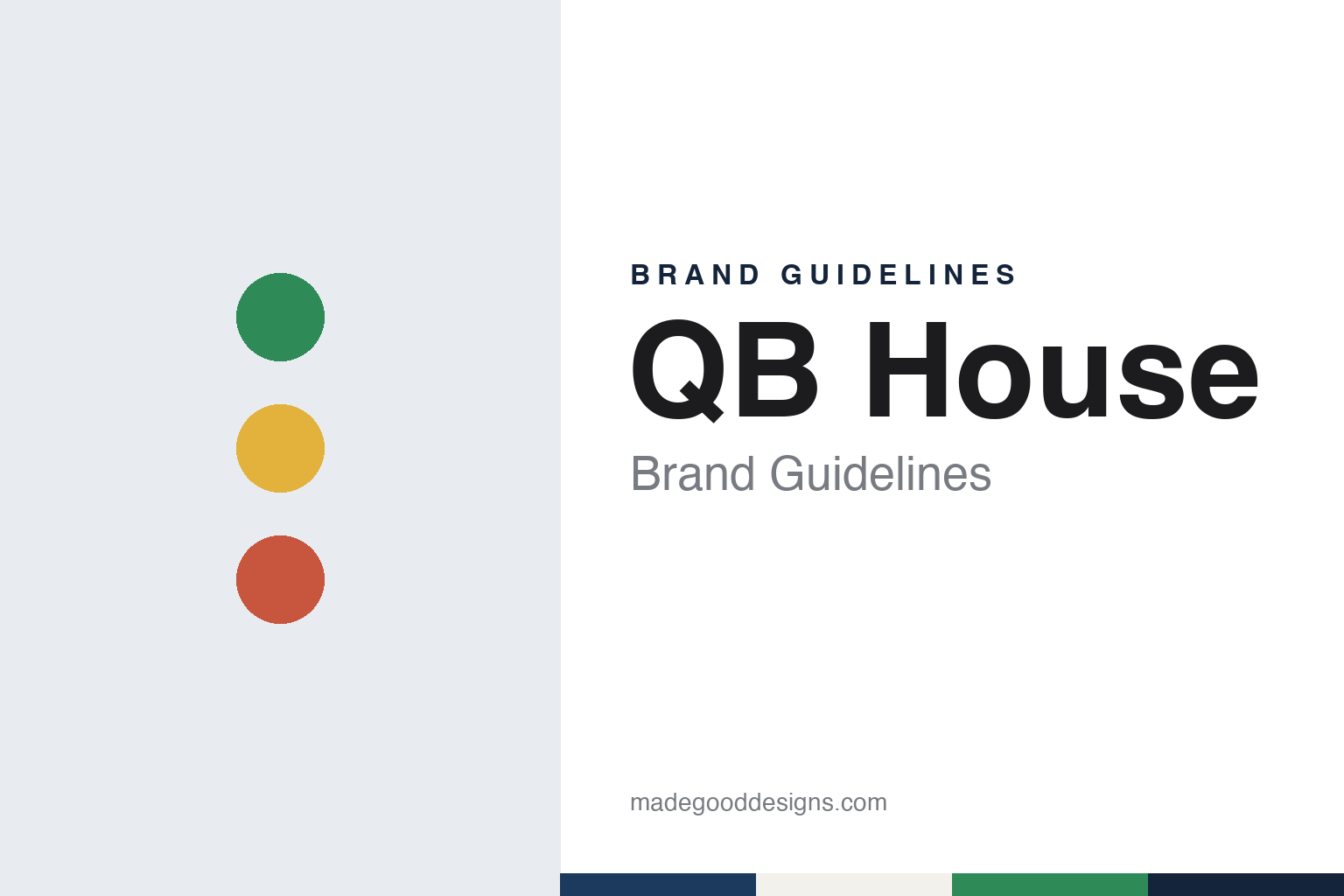
QB House Brand Guidelines
Tokyo’s ten-minute haircut, sold one cut at a time.
Aa
Two constants: a station blue with green and amber palette and a geometric sans register. Abstract homage — not a QB House asset; no shop sign, lamp or logo is reproduced.
Ten minutes in Kanda
One service, taken out of the barbershop.
QB House is a Japanese chain of haircut-only shops. Its operating company, QB Net, was set up in Tokyo in December 1995, and the first shop opened in the Kanda Mitoshiro district of Chiyoda on 1 November 1996, according to the company’s own history and a 2017 case report published by the organisers of Japan’s Porter Prize. Japanese Wikipedia names the founder as Kuniyoshi Konishi. It says the “Net” in the company name came from his view that an internet era was coming and that the shops would grow like a network; it also notes that the first shop has since closed.
The idea was to lift one service out of the traditional barbershop and sell it on its own. The Porter Prize report describes the concept as “ten-minute grooming”: a haircut only, with no shampoo, shave or massage, aimed mainly at busy office workers. It explains that Japanese barbers had long sold those services together as a set, with hours, closing days and menus largely aligned across the trade through local associations, and that QB House created a new habit — having a haircut in a spare moment at lunchtime or on the way home, in a shop inside or beside a station. The report also notes a different approach to the cut itself: trimming only what has grown, to shorten the consultation and bring customers back more often.
The letters in the name stand for “quick barber” and “quick beauty,” Japanese Wikipedia says. It adds that, under Japanese law, a shop staffed by licensed barbers is registered as a barber’s and one staffed by beauticians as a beauty salon, and that QB House runs shops of both kinds with no difference in appearance or service. The Porter Prize report sets out the rules behind that split, including a 2015 change that formally allowed perms at barbers’ shops and cuts at beauty salons.
Recognition came early. The company says it received the 1998 New Business Grand Prize, awarded in February 1999, for creating a new genre of haircut-only shop and growing it as a chain, as well as a 1998 Asian Innovation Award.
Colour
A shop built around the queue.
The QB House shop is designed around speed. Instead of washing, staff use an air washer, a vacuum hose that lifts cut hair away after the cut; the Porter Prize report says the company developed it in-house. Payment and queueing are handled together by a ticket machine, so stylists spend as little time as possible on anything except cutting. Outside each shop stands a signal lamp of three stacked colours, which Japanese Wikipedia says shows green for no wait, yellow for roughly five to ten minutes and red for fifteen minutes or more. The same information appears in the company’s app.
Because there is no shampoo, the shops need little plumbing, and that shapes where they go. The Porter Prize report gives an average of about 3.5 seats per shop in 2017 and describes how QB House reused small, unused spaces inside stations, such as former station-master rooms, night-duty rooms and storerooms. Japanese Wikipedia describes standardised fittings it calls “system units” and standardised staff movements that keep the floor area per customer small.
The format was taken a step further abroad. The QB Shell, a self-contained capsule shop for overseas markets, won a Good Design Award in 2006, according to the company and Japanese Wikipedia. Japanese Wikipedia says that in Hong Kong some shell shops hold a single seat inside an enclosed, prefabricated unit, a form not permitted in Japan. When the chain received the JETRO chairman’s prize at the second Japan Service Awards in 2018, the judges cited the compact QB Shell, which let it open in many kinds of vacant space, and a cutting theory and training curriculum that kept the service consistent outside Japan.
The identity has since been reworked. The company says it renewed the visual identity of QB House and refreshed its shop design in December 2020, and relaunched the brand website in July 2021, its first redesign in nine years. Alongside the main chain it has tried other formats: FaSS, opened at Nakameguro in July 2011 for younger customers, and QB PREMIUM, which opened at Hong Kong International Airport in May 2018 and in Japan at Otemachi station in March 2020. Its own stylist schools, under the name Logiscut, opened in Tokyo in 2012 and have since spread to other cities in Japan, Hong Kong and Taiwan, the company says.
Typography
Signs, colour and the salon front.
Hair-salon chains present themselves less through products than through the sign above the door. The names in this guide come from the United States, France, Germany, England, Australia and Japan, and each company publishes its own salon signs, logos and colour schemes; the palettes here are our own reading, not official colours.
The formats vary widely. At one end are walk-in salons built around quick cuts with no appointment, often in strip centres, shopping malls or inside larger stores; at the other are high-street and department-store salons that sell an appointment with a named stylist. Some companies run several banners at once, each aimed at a different customer, so the corporate name and the name on the shopfront are not always the same.
Ownership is just as varied. Some chains are franchise groups, where a franchisor licenses its name to independent salon owners; others are run by their founders’ families or by larger salon groups that combine company-owned and franchised salons. Several have changed hands more than once, and this guide gives those changes as dated facts. For each company it notes when and where the business was founded, who owns it today, how many salons a dated source counts and which banners it trades under, along with any restructuring, closure or change of owner.
Many chains also describe their own training academies, seasonal collections and own-label product ranges, using the names the companies give them, and keep corporate pages on their founders and owners. This guide sets out what each company says about itself, what independent sources record, and the points where the two differ.
Aa
A clean geometric sans for a fast, functional shop. (Specimen set in Outfit, a sans STAND-IN; NOT the QB House logo.)
QB House
From one shop to a listed group.
The chain went abroad within a few years. The company set up a Singapore subsidiary in December 2002, a Hong Kong company in February 2005, a Taiwan company in 2012, QB House USA in 2016 and a Canadian company in 2023, followed by companies in Vietnam and Malaysia in November 2024, according to its history. Japanese Wikipedia says the Vietnam entry, announced in January 2025, made it the sixth overseas country.
Ownership changed several times before the listing. Japanese Wikipedia says ORIX acquired 73.9 per cent of the shares from the founder and others in August 2006, and sold a 78 per cent stake to JAFCO in December 2010; the company dates the move to a JAFCO-managed fund to 2010. In October 2014 the business passed to a fund run by Integral, the company says. In July 2016 it adopted a holding-company structure as QB Net Holdings, with a new operating company taking over the haircut business, and on 23 March 2018 the holding company listed on the First Section of the Tokyo Stock Exchange. It moved to the exchange’s Prime market in April 2022 and has its head office in Shibuya, Tokyo.
Store counts come from dated sources. The Porter Prize report counted 542 shops in Japan and 117 overseas at the end of June 2017. The Japan Service Awards citation in 2018 gave 118 overseas shops and more than 3 million overseas visits a year. Japanese Wikipedia gives 563 shops in Japan and 128 overseas, 691 in all, at the end of June 2024. The company says domestic visits passed 300 million in total in March 2024.
The Porter Prize, awarded in 2017, credited the company with keeping its lead after rivals copied the format, by training its own stylists and improving its processes in-house, and noted that the overseas business had grown.
For a design guide, QB House shows how a service can be designed as a system — a lamp outside, a ticket machine at the door and a vacuum in place of a basin — and how that system becomes the brand. Compare Supercuts, an American walk-in chain, and Just Cuts, the Australian walk-in salon franchise. For this guide we use a station blue with a signal green and amber and a geometric sans, an unofficial interpretation; no product or logo is reproduced.
Explore & save
Keep QB House’s identity on hand — save it to a board in the Made Good inspiration library.
QB House identity set
Pin the QB House station blue, green and amber palette and the geometric sans register to your own board.
Source & notes
Frequently Asked Questions
What font can I use to match the QB House look?
This guide describes QB House’s type as “A clean geometric sans for a fast, functional shop”. Its type specimen is set in Outfit from Google Fonts as a stand-in; Outfit is not QB House’s own lettering.
What colours are in the QB House palette?
This guide’s QB House palette is Station blue #1C3A5E, Night ink #14243A, Go green #2E8B57, Wait amber #E3B23C and Paper #F7F6F2. The tones are the guide’s own unofficial interpretation, not official QB House hex codes.
When was QB House founded?
QB House was founded in Company 1995; first shop 1996, in Tokyo, Japan.
Who founded QB House?
QB House was founded by Kuniyoshi Konishi in Company 1995; first shop 1996.