Village Cinemas Brand Guidelines
The 1954 Melbourne drive-in chain behind Gold Class.
Aa
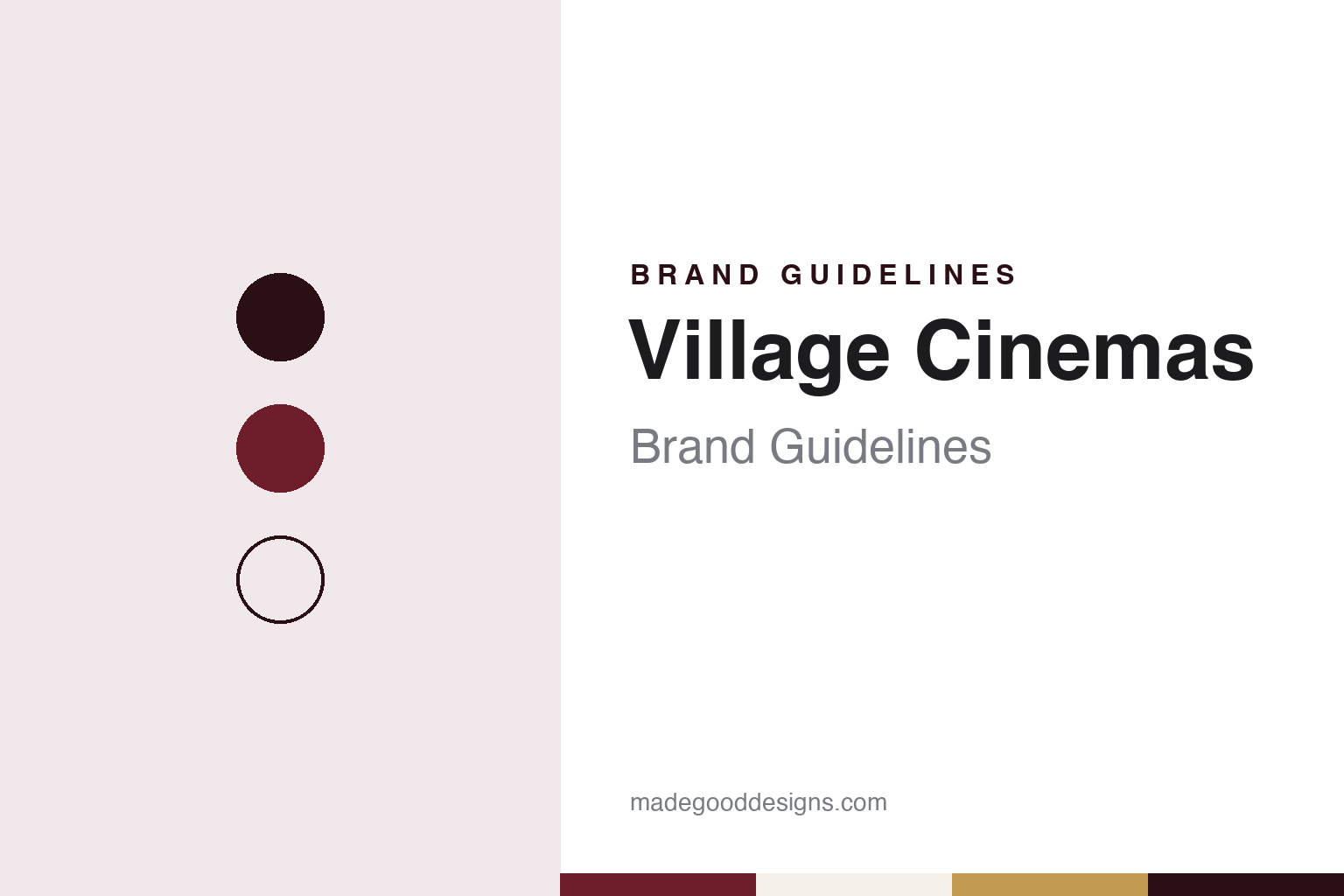
Two constants: a deep claret, gold and warm ivory palette and a high-contrast serif register. Abstract homage — not a Village Cinemas asset or mark; no logo, sign or poster is reproduced.
A drive-in at Croydon
Roc Kirby’s Village Drive-In, 1954.
Village Cinemas is the business that started Village Roadshow. English Wikipedia dates it to 1954, when Roc Kirby opened a drive-in theatre at Croydon, in Melbourne’s outer east, as one of Australia’s early drive-ins. The site stood beside a shopping strip called Croydon Village, which gave the company its name. Kirby already ran indoor cinemas as Kirby Theatres, and the original Village Drive-In had room for 454 cars, English Wikipedia says.
The circuit spread quickly. Village Drive-In Pty Limited opened drive-ins in Melbourne suburbs including Rowville and Essendon, in regional Victoria and in Launceston, Tasmania, and by the start of the 1960s it ran 27 drive-ins across Victoria and Tasmania, according to English Wikipedia. During the 1960s it began adding “hard-top” indoor cinemas for city audiences less reliant on cars.
The company soon reached beyond exhibition. English Wikipedia says it moved into film distribution in the late 1960s with Roadshow and into film production in the early 1970s, and the group took the name Village Roadshow Limited in 1988. Kirby’s sons, Robert and John, and Graham Burke, who joined in 1960 sweeping floors at one of its theatres, went on to lead the larger group.
Drive-ins faded as home video spread. The original Croydon drive-in closed in 1990, but the Coburg Drive-In, in Melbourne’s north, remains part of the Village circuit, English Wikipedia says.
Colour
Multiplexes, Gold Class and joint ventures.
Village’s second era was the multiplex. In 1988, English Wikipedia says, Village Roadshow sold two-thirds of Village Cinemas and formed an equal joint venture with Warner Bros. and Greater Union, the Australian Multiplex Joint Venture, to build multiplexes across Australia. Its first, Village Greater Union 8 at Westfield Airport West in Melbourne, opened in 1989.
The format most associated with the chain arrived in 1997. The Village Cinemas at Crown, in central Melbourne, opened on 8 May 1997 with 14 screens, four of them Gold Class luxury lounges, and at first ran around the clock, according to the Cinema Treasures database; English Wikipedia, which dates the opening to February 1997, says it returned to normal hours in 2001. Marking the format’s 20th anniversary in December 2017, The Movie Boards wrote that Gold Class was devised by Village Roadshow and drew on the first-class cabins of airlines. English Wikipedia describes Gold Class as offering butlered refreshments, an à la carte menu and reclining seats, and says Cinema Europa screens for arthouse and foreign-language films followed at the Jam Factory in October 1998. Larger Vmax auditoriums sit alongside them at several sites, English Wikipedia says. It adds that by July 1999 Gold Class had spread to Village sites at Southland, Century City Walk, Sunshine and the Jam Factory, and to Birch Carroll & Coyle cinemas in Brisbane. In October 2008 Village Roadshow took the format to the United States, opening a stand-alone Gold Class cinema at South Barrington, near Chicago; in September 2010 it sold its majority stake in that chain to iPic Entertainment, which renamed it iPic Theaters.
In the 1990s the Village name travelled. English Wikipedia says Village Roadshow entered Singapore in 1992 with Golden Harvest to form Golden Village, and by 1996 was building cinemas in some 20 markets, from the UK, where it was a partner in Warner Village Cinemas, to Argentina and Greece. From 2001 it sold most of those businesses, and in October 2017 it sold its half of Golden Village to Orange Sky Golden Harvest. The name survives abroad under licence: Antenna Group has run the Village-branded cinemas in Greece since 2022, English Wikipedia says.
Typography
How cinema chains present themselves.
This group of guides looks at cinema chains in France, Central and Eastern Europe, Germany, Finland, South Korea, Singapore, Malaysia, the United Kingdom and Australia, and at how each presents itself: the name over the entrance, the signs, logos and colour schemes the companies publish, and the way that name carries over to tickets, websites and apps. The palettes shown here are our own interpretations, not official colour values.
Formats are part of that presentation. Some operators label their auditoriums with the premium and large-format systems they install, such as IMAX, 4DX, ScreenX or Dolby Atmos sound, and with their own names for reclining seats or VIP rooms, as Cinema City’s national websites do. City-centre multiplexes carry house labels too: UGC has grouped its large multiplexes under the Ciné Cité name since 1995.
Ownership varies. Some chains belong to larger cinema groups, as Cinema City has belonged to Cineworld since 2014; others sit inside film and media companies, as with UGC, which also produces and distributes films and series and in which Canal+ says it took a 34% stake in November 2025. Restructurings and sales are part of the record, and corporate pages on founders and owners are where each company tells its own version.
Loyalty cards and subscription passes have become part of the brand as well. UGC launched its UGC Illimité card in France in 2000, and other operators followed with passes and clubs under their own names. This guide sets out what can be checked about each chain: who founded it, who owns it now and how it names its cinemas and cards, and it marks clearly what rests only on the company’s own word.
Aa
A high-contrast serif for lounge menus and posters. (Specimen set in Playfair Display, a serif STAND-IN; NOT the Village Cinemas logo.)
Village Cinemas
Half of Australian Theatres.
At home, Village Cinemas has been half of a larger business for more than two decades. In 2003, English Wikipedia says, Warner Bros. sold its third of the multiplex venture back to its partners, and Village Roadshow and Amalgamated Holdings, the owner of Greater Union, took equal shares in a new joint venture, Australian Theatres. Amalgamated Holdings became Event Hospitality and Entertainment in 2015 and is now EVT, the owner of Event Cinemas, according to English Wikipedia. In Australia the Village Cinemas name is used only in Victoria and Tasmania, English Wikipedia says; the four Tasmanian Village cinemas joined Australian Theatres in February 2013, after the media company WIN left an earlier joint venture.
The parent company changed hands in 2020. Village Roadshow’s shareholders approved two takeover schemes from BGH Capital, a Melbourne private-equity firm set up in 2017, and the federal court approved the first of them, blooloop reported on 16 December 2020; the takeover was expected to complete by 29 December. Village Roadshow then left the Australian Securities Exchange and in 2023 became Village Roadshow Pty Limited, English Wikipedia says. Its other businesses include theme parks such as Sea World and Warner Bros. Movie World, film distribution and Village Roadshow Studios. Village Roadshow Entertainment Group, the Hollywood film financier, is a separate company in which Village Roadshow held a 20 per cent stake in 2020, blooloop reported.
For a design guide, Village Cinemas shows a home-grown name, taken from a suburban shopping strip, carried from a 1950s drive-in to multiplexes and a Gold Class lounge tier. Compare Event Cinemas, its partner in Australian Theatres, and Golden Village, the Singapore chain Village Roadshow co-founded. For this guide we use a deep claret, gold and warm ivory palette with a high-contrast serif, an unofficial interpretation; no product or logo is reproduced.
Explore & save
Keep Village Cinemas’s identity on hand — save it to a board in the Made Good inspiration library.
Village Cinemas identity set
Pin the Village Cinemas deep claret, gold and warm ivory palette and the high-contrast serif register to your own board.
Source & notes
Frequently Asked Questions
What font can I use to match the Village Cinemas look?
This guide describes Village Cinemas’ type as “A high-contrast serif for lounge menus and posters”. Its type specimen is set in Playfair Display from Google Fonts as a stand-in; Playfair Display is not Village Cinemas’ own lettering.
What colours are in the Village Cinemas palette?
This guide’s Village Cinemas palette is Deep claret #6E1E2A, Velvet dark #2A0F14, Warm ivory #F5F0E8, Lounge gold #C29A52 and Paper #F8F7F5. The tones are the guide’s own unofficial interpretation, not official Village Cinemas hex codes.
When was Village Cinemas founded?
Village Cinemas was founded in 1954, in Croydon, Melbourne, Australia.
Who founded Village Cinemas?
Village Cinemas was founded by Roc Kirby in 1954. Village Cinemas is known for Gold Class, Vmax, Coburg Drive-In.