dELiA*s Brand Guidelines
The 1990s teen catalog of mixed-case type and pulled faces.
Aa
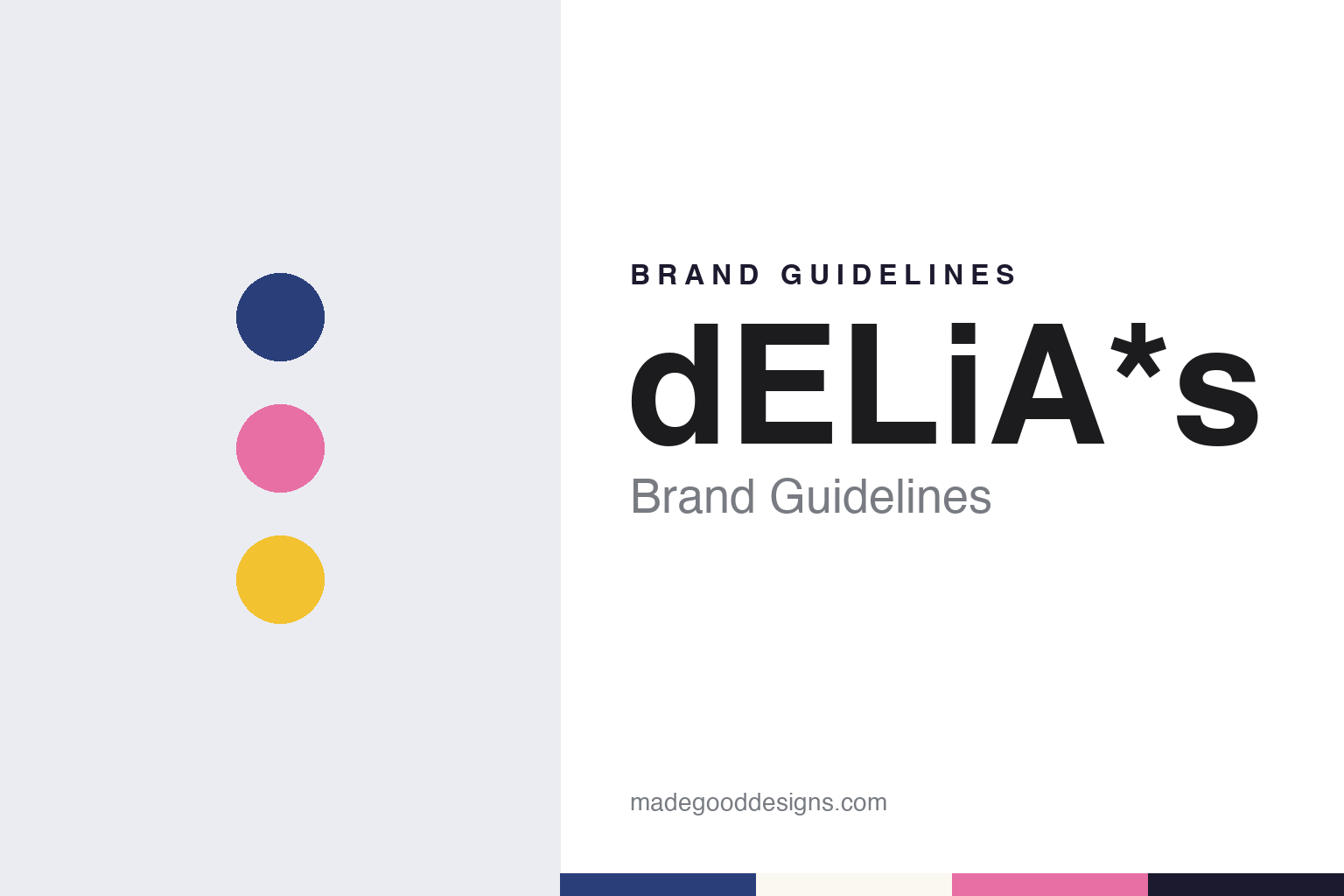
Two constants: a dELiA*s blue, yellow and pink palette and a Playful sans register. Abstract homage — not a dELiA*s product or mark; no garment, logo or catalog page is reproduced.
The magalog
Two Yale roommates and a New York apartment.
dELiA*s began in New York in 1993. Its founders were Stephen Kahn and Christopher Edgar, former roommates at Yale. Mental Floss, writing in 2017, says Kahn had worked at the brokerage PaineWebber and that Edgar left a comparative-literature doctorate at Columbia University to join him. The International Directory of Company Histories dates the launch to September 1993 and places it in Kahn’s New York apartment, funded with Kahn’s own savings and money from family and friends.
The product was a catalog, but not a conventional one. The company history calls it a “magalog”, a hybrid of mail-order catalog and fashion magazine that mixed editorial pages with clothes from more than fifty outside labels and newer designers. The earliest issues reached readers in 1994, handed out by student representatives on college campuses — in March, according to the company history, and in the autumn, according to Mental Floss. The founders had aimed at college women; Mental Floss quotes Kahn as saying a far larger response came instead from high-school girls once small magazine advertisements ran.
From early 1995 the company switched to direct mail, renting mailing lists and placing small advertisements for free catalogs in the back pages of teen magazines, the company history says. That shift fixed the audience the name came to stand for: girls and young women from about ten to their early twenties. dELiA*s became a listed company in late 1996.
Colour
Mixed-case type and expressive faces.
The look of dELiA*s came from its catalog pages. Mental Floss credits creative director Charlene Benson, previously art director of Mademoiselle, who for a year produced the catalog at night alongside her magazine job. Benson described choosing pictures in which the models were pulling faces, and building looser, more chaotic layouts than she could use at a fashion magazine.
The type was part of that. The name itself mixes capitals and lower case — dELiA*s, with an asterisk before the final letter — and Benson told Mental Floss that the team “really liked that mixed up and down type,” adding that the teen magazine Sassy had tried something similar before. Catalog copy ran in the same alternating style. Where the name came from is, in Benson’s account, unknown; a photo producer told Mental Floss that a fictional “Delia” stood for a girl who dressed for herself and for her friends.
Photography followed the same line. Models in the catalog rarely smile in the conventional way, Mental Floss notes; they laugh, grimace or clown for the camera, shot by photographers including Kevin Hatt and later Mei Tao. Clothes were styled loosely rather than as matched outfits.
The catalog widened into a family of titles. The company history records the purchase of the soccer catalog and store business TSI Soccer and of the girls’ website gURL.com in December 1997; a home-furnishings catalog called Contents from late 1997; a dELiA*s website with online ordering from 1998; and Droog, a catalog for boys and young men launched in 1998, which Mental Floss, citing Catalog Age, says closed in 2000. In 1999 dELiA*s floated its internet business, iTurf, which held gURL and the online shops.
Typography
Youth chains in North America.
Youth and mall fashion chains in the United States and Canada mostly present themselves through their stores: the shop sign above a mall unit, the shopping bag and the labels on the rails. Few of them publish a formal identity manual, so what can be described is what the companies show in their stores, on their websites and in their announcements, and what the business press has reported about them.
The formats vary. Some chains began as a single surf or skate shop and moved into enclosed malls; PacSun traces itself to a Newport Beach surf shop of 1980 and opened a mall store the following year, and Zumiez started in 1978 as a shop in Seattle’s Northgate Mall. Others built their business on catalogues and later online shops, and several now trade across the United States, Canada and further abroad.
Ownership is just as varied. Some chains are still run by founders or their families, some are listed on stock exchanges, and others are owned by private-equity firms or brand-licensing groups, often after a Chapter 11 or other restructuring. Those changes are part of each brand’s story, and the guides here give them as dated facts, with the store estate described as it stood at the date of the source.
On the rails, these retailers mix outside labels with their own brands and with licensed ranges, from surf and skate names to sports and entertainment partnerships, and they name those collections in their own announcements. Each guide in this series sets out who founded the chain, who owns it now, how it has traded and what it sells, and separates what independent dated sources report from what the company says about itself.
Aa
A playful sans — after a name written in mixed capitals and lower case. (Specimen set in Rubik, a sans STAND-IN; NOT the dELiA*s logo.)
dELiA*s
From catalog to mall stores to licence.
Stores came after the catalog. The company history records an outlet store in Reading, Pennsylvania, in late 1997; the purchase of two New York and New Jersey clothing chains, Screeem! and Jean Country, in 1998; and the opening of a full-price dELiA*s store in a White Plains, New York, mall in February 1999, followed by a second in Wayne, New Jersey, that June.
Ownership then changed. English Wikipedia says the youth-marketing company Alloy acquired dELiA*s in 2003 and spun it off again in 2005. In 2013, BuzzFeed News reported, dELiA*s sold its Alloy business to Steve Russo.
The retailer did not survive the mid-2010s. In December 2014 dELiA*s filed for Chapter 11 bankruptcy protection in New York and moved to liquidate; BuzzFeed News reported in September 2015 that the chain had been down to fewer than one hundred stores before the filing, and English Wikipedia says the liquidation covered 95 stores. The store chain closed in the course of that liquidation.
The name continued separately. Russo bought the dELiA*s brand and its intellectual property in early 2015 and relaunched it as an online-only shop in August 2015, BuzzFeed News reported; English Wikipedia says that relaunch was unsuccessful. In November 2018 the San Francisco online retailer Dolls Kill launched dELiA*s by Dolls Kill under a licensing agreement, Vox and Elle reported, with collections modelled on the 1990s catalog — rainbow stripes, mesh tops, flower-embellished jeans and platform shoes, in Vox’s description — sold online and at pop-up shops in Los Angeles and San Francisco. Vox noted that the product photography imitated the old catalog too, with models posing under a slightly warped wide-angle lens. In 2026 the Dolls Kill website still carries a dELiA*s by Dolls Kill collection.
For a design guide, dELiA*s shows how a mail-order catalog built an identity from type and attitude rather than from a fixed logo system: mixed-case lettering, a stray asterisk, loose layouts and models caught mid-laugh. Compare the Wet Seal brand guidelines, another mall fashion chain of the same generation, and the Justice brand guidelines, a girls’ chain whose name also outlived its stores. For this guide we use a deep blue, sky blue, butterfly yellow and bubblegum pink with a rounded sans, an unofficial interpretation; no product or logo is reproduced.
Explore & save
Keep dELiA*s’s identity on hand — save it to a board in the Made Good inspiration library.
dELiA*s identity set
Pin the dELiA*s blue, yellow and pink palette and the Playful sans register to your own board.
Source & notes
Frequently Asked Questions
What font can I use to match the dELiA*s look?
This guide describes dELiA*s’ type as “A playful sans — after a name written in mixed capitals and lower case”. Its type specimen is set in Rubik from Google Fonts as a stand-in; Rubik is not dELiA*s’ own lettering.
What colours are in the dELiA*s palette?
This guide’s dELiA*s palette is Deep blue #2A3F7A, Sky blue #7FBCE6, Butterfly yellow #F2C230, Bubblegum pink #E86FA4 and Paper #FBF8F2. The tones are the guide’s own unofficial interpretation, not official dELiA*s hex codes.
When was dELiA*s founded?
dELiA*s was founded in September 1993, in New York, United States.
Who founded dELiA*s?
dELiA*s was founded by Stephen Kahn and Christopher Edgar in September 1993.