Justice Brand Guidelines
From Limited Too sister chain to a Walmart-only tween label.
Aa
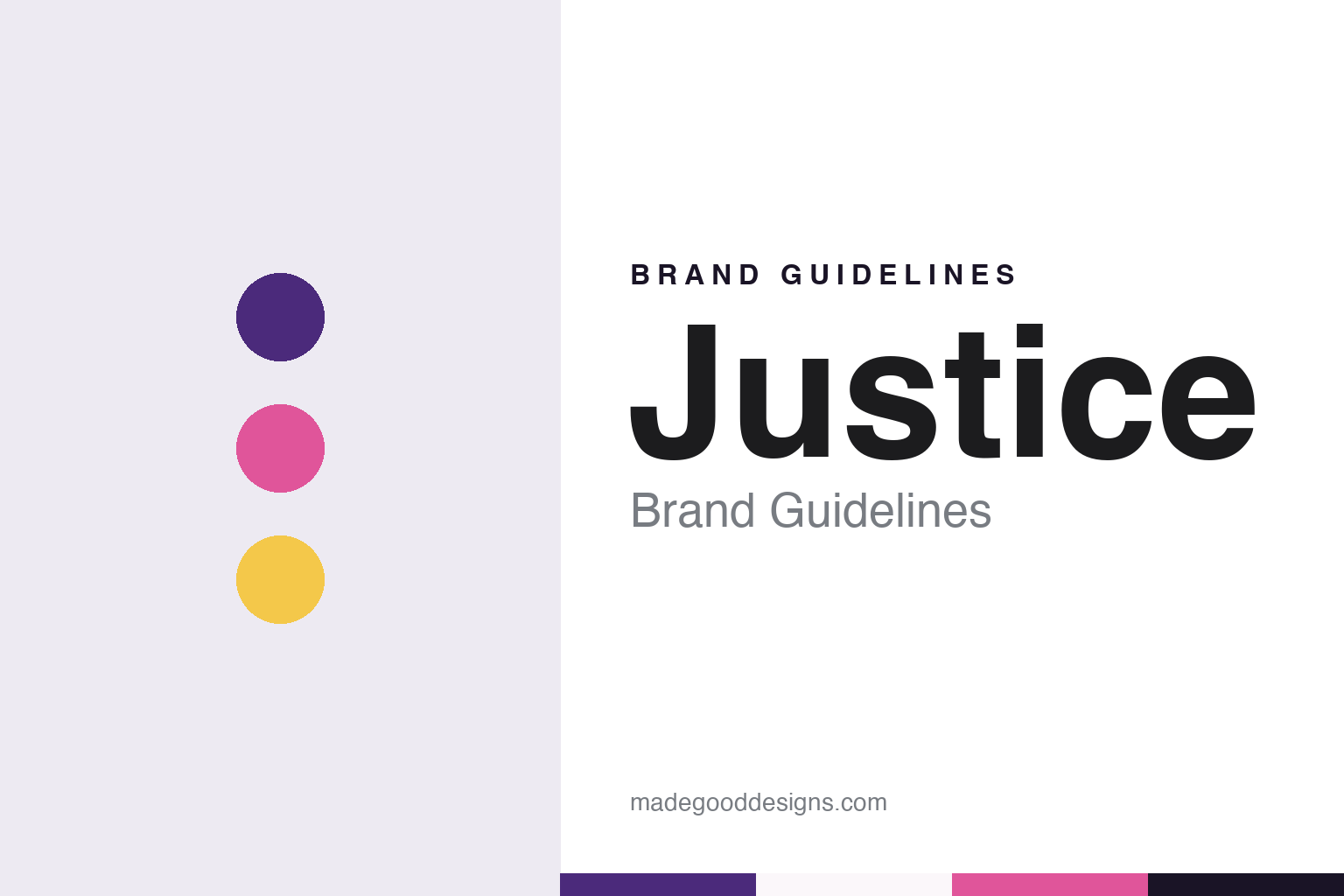
Two constants: a Justice grape, pink and yellow palette and a Rounded sans register. Abstract homage — not a Justice product or mark; no garment, logo or shopfront is reproduced.
Limited Too
A girls’ offshoot of The Limited.
Justice grew out of Limited Too, a children’s line that the Columbus, Ohio, retailer The Limited created in 1987. Ohio State University’s Historic Costume and Textiles Collection, in an exhibition on Columbus fashion, says Limited Too began inside The Limited’s own stores as a version of its styles for young girls. English Wikipedia says a new management team refocused it on preteen girls in 1996, and in 1999 Limited Too was spun off as an independent company, Too, Inc.
Before Justice, Too, Inc. had tried an older customer. From 2001 to 2003, English Wikipedia says, it ran Mishmash, a chain aimed at young women of about fifteen to twenty, selling apparel, accessories and gifts. When that chain folded, the company opened the earliest Justice: Just for Girls stores in January 2004, many of them in former Mishmash shops. The Ohio State exhibition describes Justice as a lower-priced sister brand to Limited Too.
In July 2006 Too, Inc. renamed itself Tween Brands, and its shares began trading on the New York Stock Exchange under the new name. The two chains then became one. The Ohio State exhibition says Limited Too had 582 stores in the United States in 2008, plus 52 franchised stores in the Middle East, when the name was dropped: about 560 shops were converted to Justice and the rest closed, a changeover English Wikipedia places between 2008 and 2010.
Colour
Girls’ sizes, licences and own ranges.
Justice sells to girls of roughly six to twelve. English Wikipedia lists apparel, underwear, sleepwear, swimwear, accessories and personal-care products, in girls’ sizes 6 to 20 and in plus sizes, together with licensed merchandise from television franchises including iCarly, Victorious, Wizards of Waverly Place and Liv and Maddie.
The company added ranges under names of its own. A boys’ line, Brothers, started online in 2010 and was carried in selected Justice stores by 2012, according to the Ohio State exhibition; English Wikipedia says the owner announced in February 2015 that Brothers would be discontinued. Later additions included Justice Active, an athleisure range, and in 2018 Ultra Squad, an original series of graphic novels and toys, English Wikipedia says.
Ownership passed through retail groups. On 25 June 2009 the women’s-wear chain Dress Barn announced a friendly purchase of Tween Brands, and Retail Dive, looking back in November 2020, dated the acquisition of the Justice chain to 2009. On 1 January 2011 Dress Barn completed a reorganisation under a new holding company, Ascena Retail Group, which went on to own Justice alongside labels such as Ann Taylor, Loft and Lane Bryant. Retail Dive reported that Justice had 826 stores by autumn 2019. By then the group was already shrinking: before its bankruptcy, Retail Dive reported in October 2020, Ascena had sold a majority stake in its Maurices chain and liquidated Dressbarn and all 544 of its stores.
Typography
Youth chains in North America.
Youth and mall fashion chains in the United States and Canada mostly present themselves through their stores: the shop sign above a mall unit, the shopping bag and the labels on the rails. Few of them publish a formal identity manual, so what can be described is what the companies show in their stores, on their websites and in their announcements, and what the business press has reported about them.
The formats vary. Some chains began as a single surf or skate shop and moved into enclosed malls; PacSun traces itself to a Newport Beach surf shop of 1980 and opened a mall store the following year, and Zumiez started in 1978 as a shop in Seattle’s Northgate Mall. Others built their business on catalogues and later online shops, and several now trade across the United States, Canada and further abroad.
Ownership is just as varied. Some chains are still run by founders or their families, some are listed on stock exchanges, and others are owned by private-equity firms or brand-licensing groups, often after a Chapter 11 or other restructuring. Those changes are part of each brand’s story, and the guides here give them as dated facts, with the store estate described as it stood at the date of the source.
On the rails, these retailers mix outside labels with their own brands and with licensed ranges, from surf and skate names to sports and entertainment partnerships, and they name those collections in their own announcements. Each guide in this series sets out who founded the chain, who owns it now, how it has traded and what it sells, and separates what independent dated sources report from what the company says about itself.
Aa
A rounded sans — for a short, one-word name aimed at girls. (Specimen set in Fredoka, a sans STAND-IN; NOT the Justice logo.)
Justice
From mall chain to a brand inside another retailer.
The store chain closed between 2020 and early 2021. Ascena filed for Chapter 11 protection in July 2020, English Wikipedia says. In October 2020 Retail Dive reported that the group planned to close more than 1,000 locations in its bankruptcy, most of them Justice stores, and that it had agreed terms with an opening bidder for the Justice intellectual property and online business ahead of an auction overseen by the US Bankruptcy Court for the Eastern District of Virginia. In the same restructuring Ascena agreed to sell its Catherines label to FullBeauty after an earlier auction, Retail Dive reported.
On 11 November 2020 Ascena announced that Bluestar Alliance, a New York brand-management company, had bought the Justice brand. Retail Dive reported the same day that Justice was winding down all of its physical stores, a process Ascena expected to complete in early 2021.
Under Bluestar, Justice became a label sold through another retailer. In July 2021 Walmart announced that it would be the exclusive fashion retailer for Justice, carrying it in 2,400 US stores and on Walmart.com, Retail Dive and FashionUnited reported; Bluestar’s president told Retail Dive that Justice had previously been sold in about 1,000 of its own stores. The opening Walmart collection, as the announcement described it, ran to more than 140 items across clothing, jewellery and accessories, bedding and bath, backpacks, stationery, skateboards and tech accessories, with athleisure separates, graphic tees, tie-dye sweatshirts and oversized hoodies among them; the announcement added that shoes and pet accessories would follow that September. English Wikipedia says Walmart Canada began carrying the line in August 2021. In 2026 Bluestar Alliance’s website lists Justice in its brand portfolio.
For a design guide, Justice shows how a girls’ identity moves from a mall shopfront to a section inside another retailer: a short one-word name, a children’s product range and licensed characters carrying a brand that no longer has stores of its own. Its history offers three distinct settings to study: Limited Too shops that began inside a women’s chain, the Justice stores that replaced them between 2008 and 2010, and from 2021 a section inside Walmart, which, FashionUnited reported, had added more than 1,000 national fashion brands over the previous few years. Compare the Claire’s brand guidelines for another mall chain selling to girls, and the dELiA*s brand guidelines for a teen label whose name also outlived its shops through a licence. For this guide we use a grape purple, bright pink and sunny yellow with a rounded sans, an unofficial interpretation; no product or logo is reproduced.
Explore & save
Keep Justice’s identity on hand — save it to a board in the Made Good inspiration library.
Justice identity set
Pin the Justice grape, pink and yellow palette and the Rounded sans register to your own board.
Source & notes
Frequently Asked Questions
What font can I use to match the Justice look?
This guide describes Justice’s type as “A rounded sans — for a short, one-word name aimed at girls”. Its type specimen is set in Fredoka from Google Fonts as a stand-in; Fredoka is not Justice’s own lettering.
What colours are in the Justice palette?
This guide’s Justice palette is Grape #4B2A7B, Ink #1A1426, Bright pink #E0559A, Sunny yellow #F4C84A and Paper #FBF7FA. The tones are the guide’s own unofficial interpretation, not official Justice hex codes.
When did Justice open?
Justice opened in January 2004 (by Too, Inc.), in United States.
Who owns Justice?
Justice is owned by Tween Brands; Dress Barn / Ascena from 2009; Bluestar Alliance from 2020.