BC Liquor Stores Brand Guidelines
British Columbia’s government liquor chain since 1921.
Aa
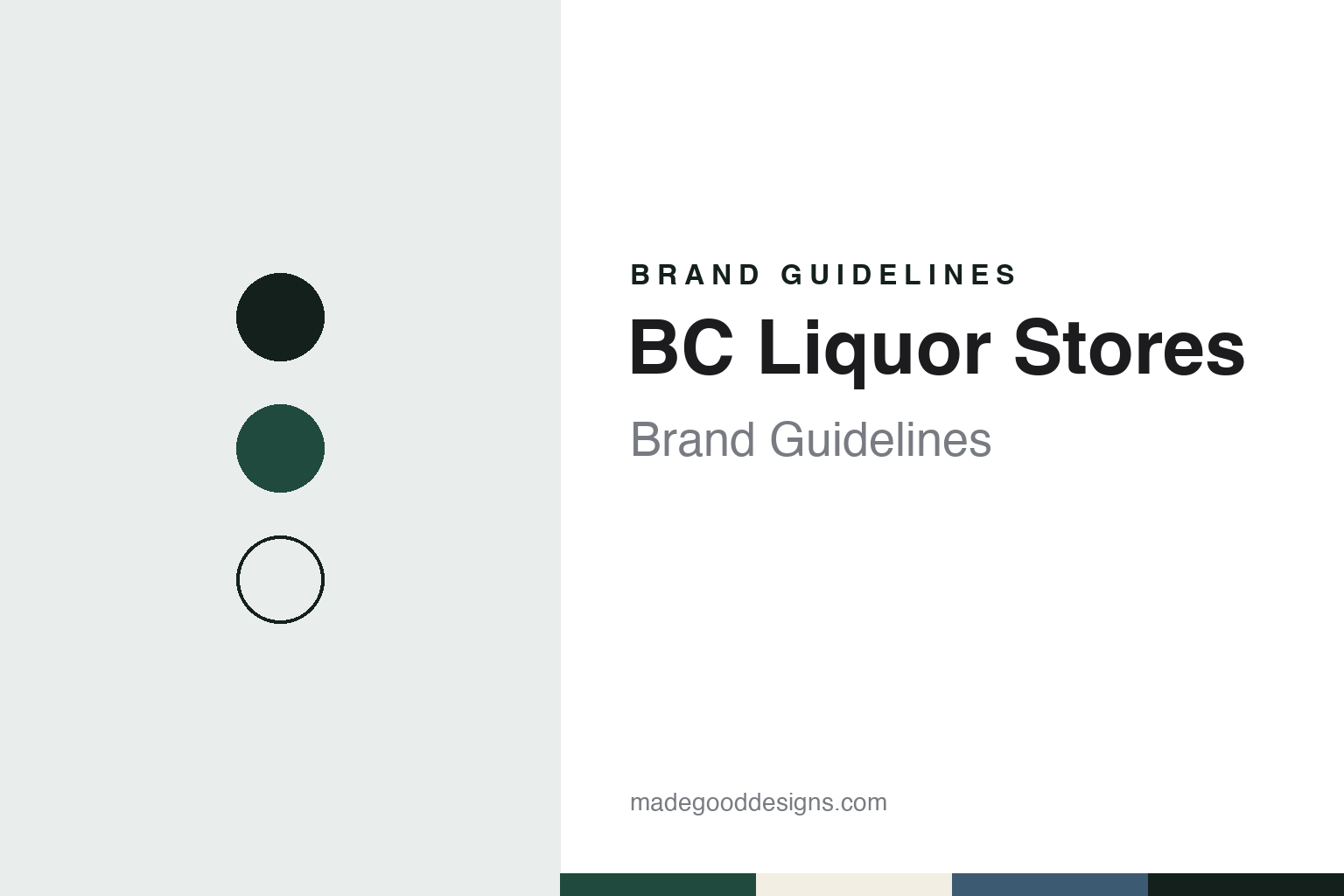
Two constants: a pine green, slate and cream palette and a civic sans register. Abstract homage — not a BC Liquor Stores sign or mark; no logo or label is reproduced.
June 1921
A plebiscite, an act and seventeen stores in a week.
British Columbia’s government liquor stores date from 1921. English Wikipedia says the province held a plebiscite on 20 October 1920 in which voters chose government-controlled sales over prohibition, and that the Government Liquor Act was passed in March 1921. The first government stores opened on 15 June 1921, the same day the Prohibition Act was repealed. Seventeen opened in the first week, and by March 1922 there was at least one store in 32 of the province’s 39 electoral districts, the encyclopedia says. It also notes that British Columbia was, as of 1920, the only Canadian province to have voted for government-controlled liquor sales, and that buying by the glass was not possible in the province between 1921 and 1924.
The stores were run by a three-member Liquor Control Board, set up in 1921 and the forerunner of today’s BC Liquor Distribution Branch (LDB), according to English Wikipedia. It adds that an amendment to the act in 1925 allowed beer parlours. Provincial law of the period also barred Indigenous people from buying liquor, under an 1887 act that English Wikipedia says was repealed in 1968.
Private competition came much later. English Wikipedia says the province has allowed private retail liquor stores since 1988, with a moratorium on new private licences that ran until 2002. Today British Columbia has what the LDB’s 2025/26 annual service plan report calls a “mixed public-private retail” model: the Liquor and Cannabis Regulation Branch licenses private stores, restaurants, pubs and makers, while the LDB, under the Liquor Distribution Act, holds the sole right to buy beverage alcohol for the province and acts as its wholesaler.
Colour
BC Liquor Stores, BCLIQUOR, BCL.
The chain’s name has shifted with its owner’s branding. Older coverage calls it BC Liquor Stores, the name English Wikipedia still uses and the one in the chain’s web address. The LDB’s own 2025/26 report calls the shops BCLIQUOR stores, shortened to BCL, and a 2026 provincial government release uses the same name.
The liquor brand also set the pattern for a sister chain. As British Columbia prepared for legal non-medical cannabis, the LDB announced in April 2018 that its public cannabis shops would trade as BC Cannabis Stores, a name and brand that “align with the BC Liquor Stores brand” and that had been “developed in-house,” Daily Hive and Cannabis Retailer reported. English Wikipedia says the first of those stores opened in Kamloops on 17 October 2018.
Inside the stores, the LDB describes a system built around signs and shelf labels. In March 2025 it said BCL stores were adding red maple-leaf shelf labels next to the price labels of products from Canadian manufacturers. The same statement named the stores’ “Locally Yours” sections for BC VQA wine, “Bottled in BC” sections and BC Craft Beer sections, the chain’s magazine, Taste, and staff it calls BC VQA advocates. It also said the stores were taking selected U.S.-made liquor off their shelves in response to U.S. tariffs; the LDB’s 2025/26 report says the ban on U.S.-made liquor was maintained through that year.
The LDB says customers and staff raise money for community partners and charities through a platform it calls Multiply the Good, and its report says Ipsos named BCL one of British Columbia’s top ten “Most Loved Brands.” The same report describes qualitative research with customers that it says is informing refinements to the BCL brand, standardised merchandising in stores, and a Mystery Shopper programme in which a third party checks each store against service standards.
Typography
Signs, shelves and owners.
Liquor, beer and wine store chains sell much the same goods, so they rely heavily on what sits around the bottles: the shop sign, the logo, the colours on the fascia and the bags, and the layout inside. The chains in this guide come from Australia, Finland, Canada, France and the Netherlands, and they show how differently that job can be done, from a founder’s portrait on the sign to a set of initials or a plain public-service name.
Store formats vary as much as the signs. At one end are large warehouse-style stores that draw shoppers from a wide area; in 2005 the wine writer Chris Shanahan described Dan Murphy’s stores in Australia as “prairie-like” spaces. At the other are neighbourhood shops beside supermarkets, smaller premium “cellar” stores and, in Australia, drive-through outlets, which BWS said in 2021 numbered 220 in its own fleet.
Ownership shapes the identity too. Some chains in this guide are state or provincial retailers owned by the public sector; others belong, or have belonged, to supermarket groups, as Dan Murphy’s and BWS did under Woolworths before the 2021 listing of Endeavour Group; others again trade as franchises under a shared name. Own-label ranges, tastings, delivery services and loyalty schemes, such as Dan Murphy’s My Dan’s, are part of the brand, and each company names them in its own way.
Most of these chains publish their own histories, on corporate or careers pages that name founders, first shops and owners. This guide uses those pages as the companies’ own accounts, sets them beside independent press and registers where it can, and describes colours and lettering in words; the palettes shown here are an unofficial interpretation, not the companies’ own.
Aa
A plain civic sans for a public retailer. (Specimen set in Archivo, a sans STAND-IN; NOT the BC Liquor Stores or BCLIQUOR logo.)
BC Liquor Stores
A public chain inside a mixed market.
The scale is set out in the LDB’s 2025/26 report. The branch, accountable to the Minister of Agriculture and Food since 17 July 2025, when it moved from the Ministry of Public Safety and Solicitor General, operates 198 BCLIQUOR stores and 39 BC Cannabis Stores and employs about 5,500 full- and part-time staff. Its liquor moves through distribution centres in Delta and Kamloops, with cannabis handled from Richmond; English Wikipedia places the head office in Burnaby.
The same report records that job action by the B.C. General Employees’ Union in fall 2025 closed the LDB’s distribution centres and retail stores for several weeks, followed by what it calls an orderly restart. In 2026 the provincial government announced a three-year trial, running until June 2029, under which bars, pubs and restaurants may buy alcohol from BCLIQUOR stores and private liquor stores; the LDB remains the central wholesaler, the government release said. The 2025/26 report also lists changes letting eligible B.C. makers deliver packaged refreshment beverages directly, work on direct-to-consumer liquor sales between provinces, and continued support for B.C. wineries after a freeze in 2024. English Wikipedia says the provincial government decided on 5 December 2017 that the LDB would also be the sole distributor of non-medical cannabis.
For a design guide, BC Liquor Stores shows how a public retailer carries one naming system across store signs, shelf labels and a sister chain. Compare LCBO, Ontario’s provincial retailer, and SAQ in Quebec. For this guide we use a deep pine green, a slate blue and a warm cream with a sans, an unofficial interpretation; no product or logo is reproduced.
Explore & save
Keep BC Liquor Stores’s identity on hand — save it to a board in the Made Good inspiration library.
BC Liquor Stores identity set
Pin the BC Liquor Stores pine green, slate and cream palette and the civic sans register to your own board.
Source & notes
Frequently Asked Questions
What font can I use to match the BC Liquor Stores look?
This guide describes BC Liquor Stores’ type as “A plain civic sans for a public retailer”. Its type specimen is set in Archivo from Google Fonts as a stand-in; Archivo is not BC Liquor Stores’ own lettering.
What colours are in the BC Liquor Stores palette?
This guide’s BC Liquor Stores palette is Pine green #1F4A3D, Ink #14201C, Harbour slate #3D5A73, Warm cream #F3EEE3 and Paper #F8F7F3. The tones are the guide’s own unofficial interpretation, not official BC Liquor Stores hex codes.
When was BC Liquor Stores founded?
BC Liquor Stores was founded in 1921 (first stores 15 June), in British Columbia, Canada.