SAQ Brand Guidelines
Quebec’s provincial alcohol retailer, from a 1921 commission to a warehouse Dépôt.
Aa
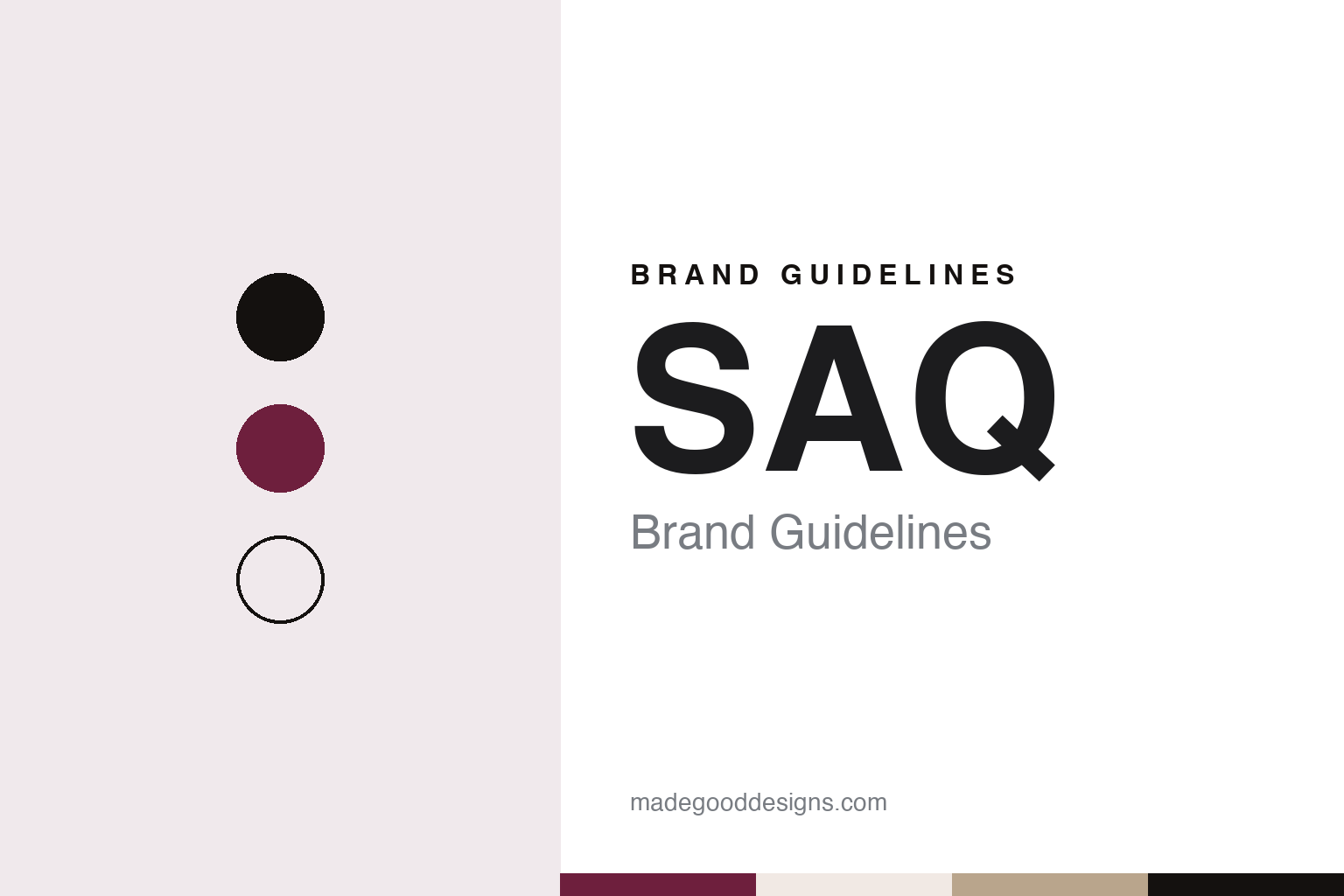
Two constants: a wine red, ink and stone palette and a Civic sans register. Abstract homage — not an SAQ product or mark; no logo, sign or label is reproduced.
Commission des liqueurs
A 1921 commission, a 1961 Régie and a 1971 société.
The Société des alcools du Québec, known everywhere by its initials SAQ, is the Quebec government’s alcohol retailer. English Wikipedia describes it as a provincial state-owned enterprise whose sole shareholder is Quebec’s Minister of Finance, operating under the Act respecting the Société des alcools du Québec, with its head office in Montreal.
Its story begins in 1921. French Wikipedia says the province passed its Alcoholic Beverages Act on 1 March 1921 and created the Commission des liqueurs de Québec (the Quebec Liquor Commission) to manage the trade in wines and spirits and to issue permits to hotels and restaurants that wanted to serve alcohol. By 1 May 1921 the commission counted 53 stores, and in 1922 it opened its own bottling plant, French Wikipedia says.
Those early shops looked nothing like today’s. French Wikipedia describes bottles kept out of sight, a price list posted on the wall, and a grilled counter where customers placed their order with an employee; spirits could be bought only one bottle at a time, a limit that lasted until 1941, and every bottle sold was wrapped in opaque paper.
In 1961 the commission became the Régie des alcools du Québec. That year, French Wikipedia says, the Régie opened the first branch in which customers could see the products, at Place-Ville-Marie in Montreal, and from 1970 branches became self-service, so shoppers could pick up the bottles themselves. A commission of inquiry set up in 1968, known as the Thinel commission, recommended splitting the Régie in two. In 1971 the commercial side became the Société des alcools du Québec, while permits passed to a separate body, now the Régie des alcools, des courses et des jeux.
Colour
Express, Classique, Sélection and Dépôt.
The SAQ’s present shape dates from a commercial change in 1994–1995. French Wikipedia says that is when the network was divided into three banners — SAQ Express, SAQ Classique and SAQ Sélection — and opening hours were extended. English Wikipedia sets out their roles: the Classique branch is the varied-selection store found in towns with a single SAQ; Express carries top-selling products in large urban centres with longer hours; and Sélection offers a wider range with professional advice.
More formats followed. In 1999, French Wikipedia says, a store concept called SAQ Signature, for high-end spirits and fine wines, replaced a branch named SAQ Whisky & Cie; the last Signature store closed in 2019. The first SAQ Dépôt, a warehouse-style branch selling products in bulk and in wholesale packs, opened in 2000, and the online store SAQ.com launched in 2001. From 2003, Sélection branches and the larger Classique branches gained a Terroirs d’ici section for products made in Quebec. In 2015 the corporation launched SAQ Inspire, a loyalty programme in which members collect points on purchases and receive offers based on their tastes, French Wikipedia says.
Beyond its own branches, the SAQ sells through agencies run inside local businesses. In March 2025 Radio-Canada reported that it would open 34 new agencies in the Bas-Saint-Laurent, Gaspésie and Chaudière-Appalaches regions. The same report said the SAQ lists between 3,500 and 4,000 products on its website, while a branch can carry up to a few thousand, depending on its size.
The emblem is compact. English Wikipedia describes the SAQ symbol as combining three ideas: a white letter Q standing for Quebec, a red wine glass and the image of a store front. The short initials, rather than the full corporate name, are what appear across the banners: SAQ Express, SAQ Sélection, SAQ Dépôt and SAQ.com.
Typography
Shop formats and public retailers.
Liquor, beer and wine store chains sell much the same goods, so they rely heavily on what sits around the bottles: the shop sign, the logo, the colours on the fascia and the bags, and the layout inside. The chains in this guide come from Australia, Finland, Canada, France and the Netherlands, and they show how differently that job can be done, from a founder’s portrait on the sign to a set of initials or a plain public-service name.
Store formats vary as much as the signs. At one end are large warehouse-style stores that draw shoppers from a wide area; in 2005 the wine writer Chris Shanahan described Dan Murphy’s stores in Australia as “prairie-like” spaces. At the other are neighbourhood shops beside supermarkets, smaller premium “cellar” stores and, in Australia, drive-through outlets, which BWS said in 2021 numbered 220 in its own fleet.
Ownership shapes the identity too. Some chains in this guide are state or provincial retailers owned by the public sector; others belong, or have belonged, to supermarket groups, as Dan Murphy’s and BWS did under Woolworths before the 2021 listing of Endeavour Group; others again trade as franchises under a shared name. Own-label ranges, tastings, delivery services and loyalty schemes, such as Dan Murphy’s My Dan’s, are part of the brand, and each company names them in its own way.
Most of these chains publish their own histories, on corporate or careers pages that name founders, first shops and owners. This guide uses those pages as the companies’ own accounts, sets them beside independent press and registers where it can, and describes colours and lettering in words; the palettes shown here are an unofficial interpretation, not the companies’ own.
Aa
A clean civic sans for a public retailer with many banners. (Specimen set in Work Sans, a sans STAND-IN; NOT the SAQ logo.)
SAQ
Fewer branches, smaller formats.
The SAQ’s legal position is narrower than a complete monopoly. French Wikipedia, quoting the corporation, says it holds exclusive first distribution in Quebec of all alcoholic beverages except, essentially, light cider and beer bottled in Quebec; grocery stores and dépanneurs sell beer, cider and some wines. In January 2017, French Wikipedia says, Quebec craft wines gained the right to be sold in grocery stores without passing through the SAQ.
The head office has moved as well. French Wikipedia says the heritage building Au-Pied-du-Courant, which had housed the head office, was sold in 2017, and that the corporation’s offices were centralised on rue Tellier in Montreal, with the move completed in 2018.
The network is now being resized. In March 2025 Radio-Canada reported that the SAQ would close eight branches in 2025–2026, among them Stanstead, Baie-d’Urfé and Ville-Émard, because traffic at those stores no longer supported them. The same report described a new format, the micro-agence: a counter of about thirty products inside grocers and dépanneurs that already hold a licence to sell alcohol, to be piloted at six Montreal locations from May 2025, alongside a delivery pilot. In October 2025 La Presse Canadienne, in a report carried by Noovo, said the SAQ had added eight such outlets since the spring and had paused its plan for about a hundred urban mini-agencies to consult further, while saying it still intended to go ahead with the concept.
For a design guide, the SAQ shows how one public retailer can run many shop formats under three letters, from a city Express to a warehouse Dépôt and a counter inside a corner shop. Compare LCBO, Ontario’s provincial retailer, and Alko, Finland’s alcohol retailer. For this guide we use a deep wine red, ink and a warm stone with a sans, an unofficial interpretation; no product or logo is reproduced.
Explore & save
Keep SAQ’s identity on hand — save it to a board in the Made Good inspiration library.
SAQ identity set
Pin the SAQ wine red, ink and stone palette and the Civic sans register to your own board.
Source & notes
Frequently Asked Questions
What font can I use to match the SAQ look?
This guide describes SAQ’s type as “A clean civic sans for a public retailer with many banners”. Its type specimen is set in Work Sans from Google Fonts as a stand-in; Work Sans is not SAQ’s own lettering.
What colours are in the SAQ palette?
This guide’s SAQ palette is Wine red #6E1F3D, Ink #14110F, Blush stone #F1E9E4, Cork #B9A58C and Paper #FAF7F5. The tones are the guide’s own unofficial interpretation, not official SAQ hex codes.
When was SAQ founded?
SAQ was founded in 1921 (as Commission des liqueurs de Québec), in Quebec, Canada.
Who owns SAQ?
SAQ today: Provincial state-owned enterprise, Montreal. This guide dates SAQ to 1921 (as Commission des liqueurs de Québec), in Quebec, Canada.