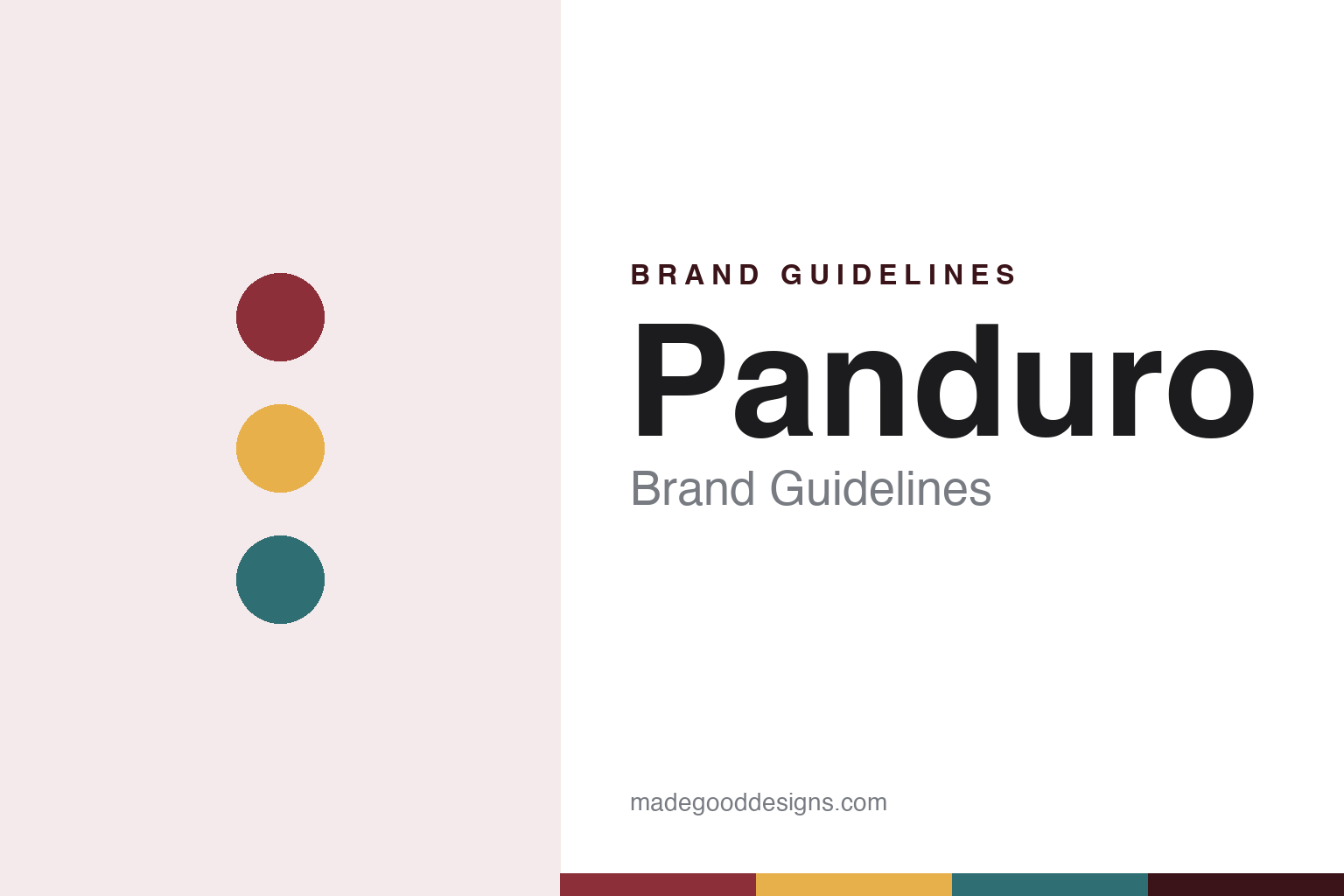
Panduro Brand Guidelines
The Danish-born hobby chain run from Malmö since 1962.
Aa
Two constants: a red, mustard and teal palette and a rounded sans register. Abstract homage — not a Panduro product or mark; no logo, kit or shop sign is reproduced.
From souvenirs to kits
A Danish family business that crossed the Øresund.
Panduro began in Denmark in the years after the Second World War. The company says Carlo Panduro, whom it describes as of Spanish descent, started by making his own souvenirs and jewellery, and that his son Jörgen soon joined the family business and began selling hobby materials to the public sector. Swedish Wikipedia, citing the Malmö newspaper Sydsvenskan, describes Carlo Panduro as a smith who made souvenirs and jewellery in his spare time, opened his own shop and then began selling materials to customers who wanted to make things themselves.
The founding year is given two ways. Lekolar, the group that bought the company in 2022, said in an August 2022 press release that Panduro was founded in 1954 by Carlo Panduro in Denmark; Swedish Wikipedia gives 1955. Panduro itself says the first Panduro shop opened in the mid-1950s on Nørrevold in Copenhagen.
In 1962 the business crossed the Øresund. The company says its first Swedish shop opened in Malmö that year, and Swedish Wikipedia dates the opening to August 1962, adding that the Swedish company had been registered in 1960 and that Jörgen Panduro moved to Sweden in 1962. Malmö has been the head office ever since; Lekolar’s 2022 release describes Panduro as headquartered there since 1962.
For its first decades Panduro was as much a catalogue as a shop. The company says its thick product catalogue quickly became well known and remained its main sales channel until the 1980s, when it began a serious move into retail. By 2022 it belonged to the three brothers Thomas, Jesper and Peter Panduro, according to Lekolar.
Colour
Kits, instructions and an in-house design team.
Panduro sells materials for making things by hand rather than finished goods. On its Swedish website the company lists areas such as interior decoration, paper crafts, baking, textile decoration, needlework, children’s crafts and art, and says its range runs to about 19,500 articles, about a quarter of which are renewed every year. Lekolar’s 2022 release gave a figure of approximately 18,000 items, so the number moves with the range.
The company puts weight on its own product development. It says this takes place at the head office in Malmö, where it puts together material kits with detailed instructions, and that many products are designed by Panduro’s in-house design and product-development team, while others are developed with outside designers and with what it calls its creative ambassadors from across the Nordic countries. Swedish Wikipedia adds that Panduro produces instruction videos for part of its range.
The group has grown by buying other retailers. Panduro says it acquired Pipoos, its counterpart in the Netherlands, in 2011, and that there are 36 Pipoos stores in the Netherlands and Belgium, counting the online shop. In 2016 it acquired Kreatima, a Stockholm shop for artists’ materials, which the company says now has stores in Stockholm, Gothenburg, Copenhagen and Oslo as well as an online shop; it gives the Kreatima range as about 8,500 articles. Swedish Wikipedia dates the first Kreatima shop in Norway to October 2022. Lekolar’s 2022 release named the group’s brands as Panduro, Pando by Panduro, Kreatima and Pipoos, sold online and through the company’s own stores in Sweden, Denmark, Norway, the Netherlands and Belgium.
Panduro today describes a network of 103 stores in six countries. The company also runs a customer club and promotes in-store parties on its website, and publishes do-it-yourself films on current products and themes.
Typography
Shops, catalogues and kits.
Craft, fabric and hobby store chains sell materials rather than finished things, and that shapes how they present themselves. From Scandinavia and Germany to France, the Netherlands, Japan, Australia and North America, these retailers describe their shops, ranges and services on their own websites, and those pages are the main record of how each one wants to be seen: the shop sign over the door, the colours of the website, the names of its catalogues and own ranges.
Store formats vary widely. Some chains run large hobby stores with paper, paint, beads and party goods under one roof; others are fabric halls built around bolts of cloth and haberdashery counters; some began as mail-order catalogues and still publish them. Panduro, for example, says its printed catalogue was its main sales channel until the 1980s, while idee. Creativmarkt says it publishes a free yarn catalogue twice a year with its sister brand Wolle Rödel.
Some of these companies also present themselves as teachers. They publish free instructions, project videos and blogs; TAP Holding, which owns idee. Creativmarkt, says it advises customers in workshops as well as in its shops, and Panduro promotes parties held in its stores. Own-label ranges and kits, often developed by in-house design teams, sit alongside branded materials from outside suppliers, and the companies name those ranges in their own way.
Ownership is part of the story too. Some chains in this guide are family businesses or were until recently, and some now belong to larger groups: Panduro has been part of the Swedish Lekolar group since 2022, and idee. Creativmarkt belongs to the Jacoby family’s TAP Holding. Corporate pages on founders and owners give each company’s own account; this guide sets those beside independent, dated sources wherever they exist.
Aa
A rounded, friendly sans for a kit-and-catalogue retailer. (Specimen set in Rubik, a sans STAND-IN; NOT the Panduro logo.)
Panduro
From family ownership to the Lekolar group.
Family ownership ended in 2022. On 11 August 2022 Lekolar, a Swedish supplier of learning environments for schools and pre-schools based in Osby, announced that it had agreed to buy Panduro from Thomas, Jesper and Peter Panduro, saying the deal would take it into the consumer market. Lekolar said it had been owned by the investment company Nalka Invest since 2017.
The deal went through competition review. Denmark’s competition authority, the Konkurrence- og Forbrugerstyrelsen, approved Lekolar Group AB’s acquisition of sole control of Panduro Förvaltning AB under its simplified procedure on 22 September 2022. Its decision describes Lekolar as a portfolio company of Nalka Invest, part of the Interogo Group, selling teaching and creative materials to schools and kindergartens, and notes that Panduro sold hobby materials to consumers from 14 physical stores in Denmark and through its website. On 1 November 2022 Lekolar announced that it had completed the acquisition.
Lekolar said Panduro would carry on as an independent business within the group under its chief executive at the time, Rickard Kemfors, with its head office and product development staying in Malmö. The company’s own history now closes with the same event: in autumn 2022, it says, Lekolar bought Panduro from the three brothers.
For a design guide, Panduro shows how a catalogue business turned into a store chain without losing its kit-and-instructions habit: products are planned in-house, packed with instructions and sold under several names in different countries. Compare Pipoos, the Dutch chain Panduro bought in 2011, and Søstrene Grene, another Danish-founded retailer of craft and home goods. For this guide we use a bead red, a mustard and a teal on craft paper with a sans, an unofficial interpretation; no product or logo is reproduced.
Explore & save
Keep Panduro’s identity on hand — save it to a board in the Made Good inspiration library.
Panduro identity set
Pin the Panduro red, mustard and teal palette and the rounded sans register to your own board.
Source & notes
Frequently Asked Questions
What font can I use to match the Panduro look?
This guide describes Panduro’s type as “A rounded, friendly sans for a kit-and-catalogue retailer”. Its type specimen is set in Rubik from Google Fonts as a stand-in; Rubik is not Panduro’s own lettering.
What colours are in the Panduro palette?
This guide shows Panduro’s palette as Bead red #8C2F39, Kit-box mustard #E8B04B, Fjord teal #2F6F73, Deep plum #3A1418 and Craft paper #F6F0E6. It notes the values are approximate rather than official Panduro codes.
When was Panduro founded?
Panduro was founded in 1954 or 1955 (sources differ), in Denmark.
Who founded Panduro?
Panduro was founded by Carlo Panduro in 1954 or 1955 (sources differ).
Who owns Panduro?
Panduro today: Panduro Hobby AB, Malmö; part of Lekolar since 2022.