Mood Fabrics Brand Guidelines
The Garment District fabric house behind “Thank you, Mood.”
Aa
Two constants: an ink, grey and deep teal palette and a display serif register. Abstract homage — not a Mood Fabrics product or mark; no fabric, logo or shop sign is reproduced.
From wholesale to retail
A Garment District fabric house that opened its doors.
Mood Fabrics is a fabric retailer that began in New York’s Garment District. The company’s own history says it was founded as Mood Designer Fabrics in 1991 by Jack Sauma, who grew up in Lebanon and Sweden, studied design in the 1970s and, the company says, made his first sale as a designer to the Swedish chain H&M. He moved to New York in 1976 with Janet Sauma, the company says, worked as a contractor sewing clothing for designers including Michael Kors, Geoffrey Beene and Pierre Cardin, and launched clothing lines of his own, among them Isaiah and Joyce Jordan, before he began selling fabric from his collection to wholesale customers.
That fabric trade became the business. In its early years, the company says, Mood was strictly a wholesaler and turned home sewers away; in 1993 Janet Sauma opened it to retail customers, including home sewers, costume designers and sewing enthusiasts. In 2001 it moved to a larger site in the Garment District, which it gives as 40,000 square feet across three floors; the company says the New York flagship alone now welcomes more than 1,200 customers a day. The company calls itself a family business; it says the founder’s sons, Philip and Eric Sauma, run its day-to-day operations, and What Now Atlanta described Eric Sauma as co-CEO in January 2026.
Colour
Thank you, Mood.
Mood’s public profile owes much to television. The company says a small production crew approached the Saumas in 2002 to film the pilot of a new reality show at the store. That show was Project Runway, which premiered on Bravo on 1 December 2004, according to Wikipedia. The company says the series popularised the catchphrases “Make it work!” and “Thank you, Mood,” and drew thousands of fans to the store each year, and it credits the show’s mentor Tim Gunn with coining “Thank you, Mood!” The directory of Ponce City Market in Atlanta, where Mood now has a showroom, describes the company as “known as the official fabric supplier for Project Runway.”
The second store followed in 2007, when the company opened Mood Fabrics LA and launched online shopping at MoodFabrics.com. The Los Angeles store, it says, served the same designers and sewers as New York but with a stronger focus on the Hollywood film and costume industry. A Miami store followed in 2022, and in November 2025 Mood opened what it calls its fourth flagship store, in Houston, with 9,000 square feet; What Now Atlanta reported that the company celebrated the Houston grand opening near the end of 2025.
Beyond bolts on shelves, the website lists services that extend the brand: free sewing patterns under the Mood Sewing Patterns name, a free swatch programme, custom fabric printing, wholesale fabrics, a fabric dictionary and a rewards scheme. It invites customers to share what they make under the tag #MADEWITHMOOD. Its shop is divided into fashion fabrics, home fabrics, trims, buttons and notions, and the company describes its stock as designer fabrics.
Typography
Design and documentation.
Craft, fabric and hobby store chains sell materials rather than finished things, and that shapes how they present themselves. From Scandinavia and Germany to France, the Netherlands, Japan, Australia and North America, these retailers describe their shops, ranges and services on their own websites, and those pages are the main record of how each one wants to be seen: the shop sign over the door, the colours of the website, the names of its catalogues and own ranges.
Store formats vary widely. Some chains run large hobby stores with paper, paint, beads and party goods under one roof; others are fabric halls built around bolts of cloth and haberdashery counters; some began as mail-order catalogues and still publish them. Panduro, for example, says its printed catalogue was its main sales channel until the 1980s, while idee. Creativmarkt says it publishes a free yarn catalogue twice a year with its sister brand Wolle Rödel.
Some of these companies also present themselves as teachers. They publish free instructions, project videos and blogs; TAP Holding, which owns idee. Creativmarkt, says it advises customers in workshops as well as in its shops, and Panduro promotes parties held in its stores. Own-label ranges and kits, often developed by in-house design teams, sit alongside branded materials from outside suppliers, and the companies name those ranges in their own way.
Ownership is part of the story too. Some chains in this guide are family businesses or were until recently, and some now belong to larger groups: Panduro has been part of the Swedish Lekolar group since 2022, and idee. Creativmarkt belongs to the Jacoby family’s TAP Holding. Corporate pages on founders and owners give each company’s own account; this guide sets those beside independent, dated sources wherever they exist.
Aa
A high-contrast display serif for a fashion-trade name. (Specimen set in DM Serif Display, a serif STAND-IN; NOT the Mood Fabrics logo.)
Showrooms
Touch the sample, order online.
In 2026 Mood began to test a smaller format, at a time when, as What Now Atlanta put it, neighbourhood fabric stores were becoming less common. In January 2026 What Now Atlanta reported that the company, which it called a largely online retailer with stores in New York City, Los Angeles, Miami and Houston, had taken a lease at Ponce City Market in Atlanta for its first store in Georgia. Instead of full bolts, the roughly 1,500-square-foot space was planned as a showroom with more than 8,000 fabric samples, from which customers would order through an online range the paper put at 80,000 products. Eric Sauma told the paper that people want to feel fabric and match colour, and linked the timing to the closure of JOANN, which the paper noted had shut all its locations the previous year. He also described plans for sewing meetups, workshops and seminars, with the aim of turning sewing, usually done alone, into something shared, and for a Chicago location on the same model. If the first showrooms succeeded, he told the paper, the company would like to scale the format nationwide.
The company says the Atlanta showroom opened in April 2026, with samples of more than 8,000 fabrics and trims, notions, events, sewing nights, classes and workshops, and that a Chicago showroom followed in September 2026. Its website now lists four stores, in New York City, Los Angeles, Miami and Houston, and the two showrooms in Atlanta and Chicago, and says retail locations in the US and abroad are being considered. The Ponce City Market directory describes the Atlanta space as a showroom with thousands of fabric samples, sewing notions and a hands-on shopping experience, designed as a community hub for workshops and gatherings.
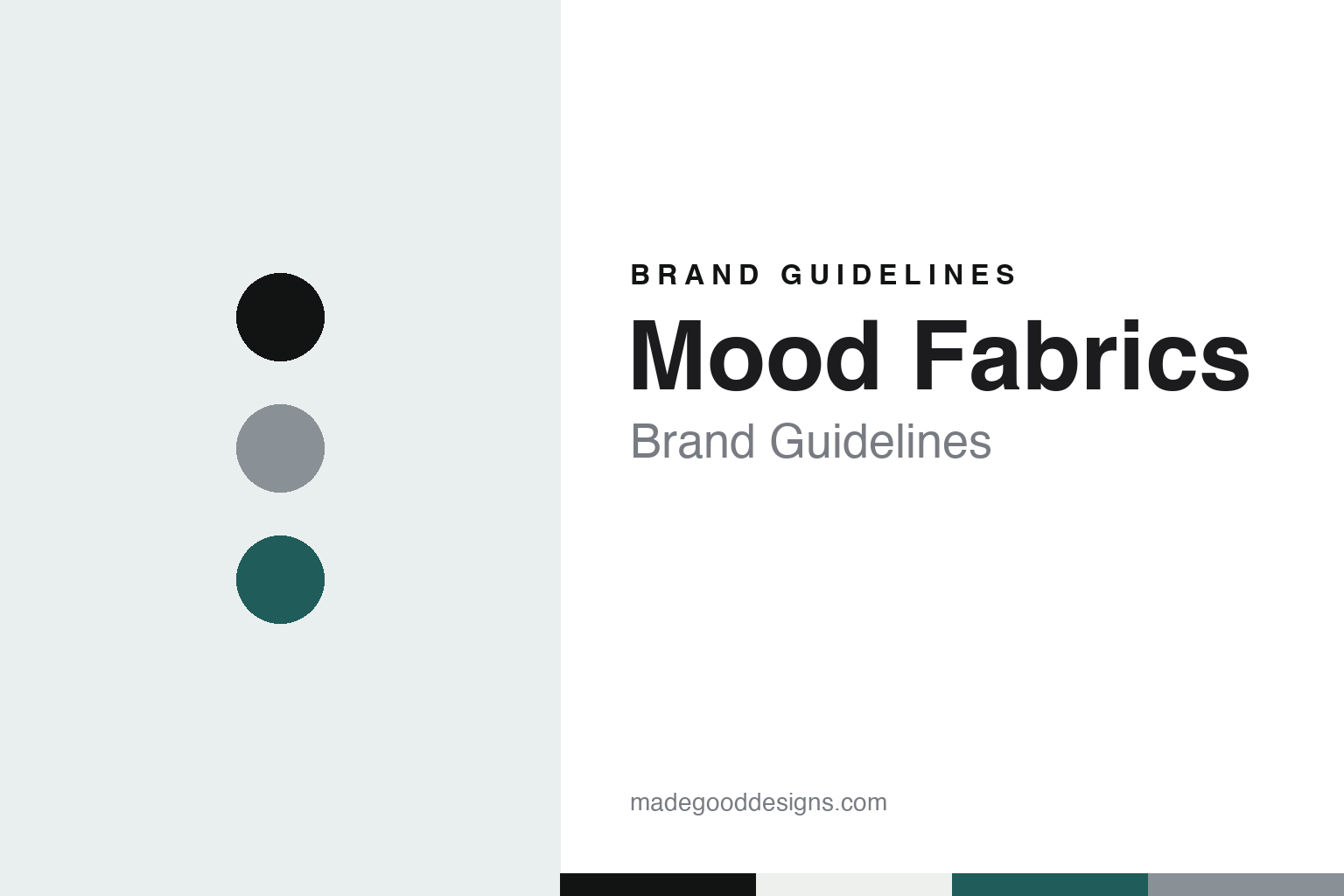
For a design guide, Mood Fabrics shows how a wholesale fabric house turned a television catchphrase into a retail brand. Compare JOANN, the American fabric and craft chain, and Fabricland, the Canadian fabric retailer. For this guide we use an ink black, a cool grey and a deep teal with a serif, an unofficial interpretation; no product or logo is reproduced.
Explore & save
Keep Mood Fabrics’s identity on hand — save it to a board in the Made Good inspiration library.
Mood Fabrics identity set
Pin the Mood Fabrics ink, grey and deep teal palette and the display serif register to your own board.
Source & notes
Frequently Asked Questions
What font can I use to match the Mood Fabrics look?
This guide describes Mood Fabrics’ type as “A high-contrast display serif for a fashion-trade name”. Its type specimen is set in DM Serif Display from Google Fonts as a stand-in; DM Serif Display is not Mood Fabrics’ own lettering.
What colours are in the Mood Fabrics palette?
This guide’s Mood Fabrics palette is Ink #121414, Selvedge grey #8A9196, Deep teal #1F5C5A, Muslin #EEF0EE and Paper #F8F8F6. The tones are the guide’s own unofficial interpretation, not official Mood Fabrics hex codes.
When was Mood Fabrics founded?
Mood Fabrics was founded in 1991 (as Mood Designer Fabrics), in New York, USA.
Who founded Mood Fabrics?
Mood Fabrics was founded by Jack Sauma in 1991 (as Mood Designer Fabrics).