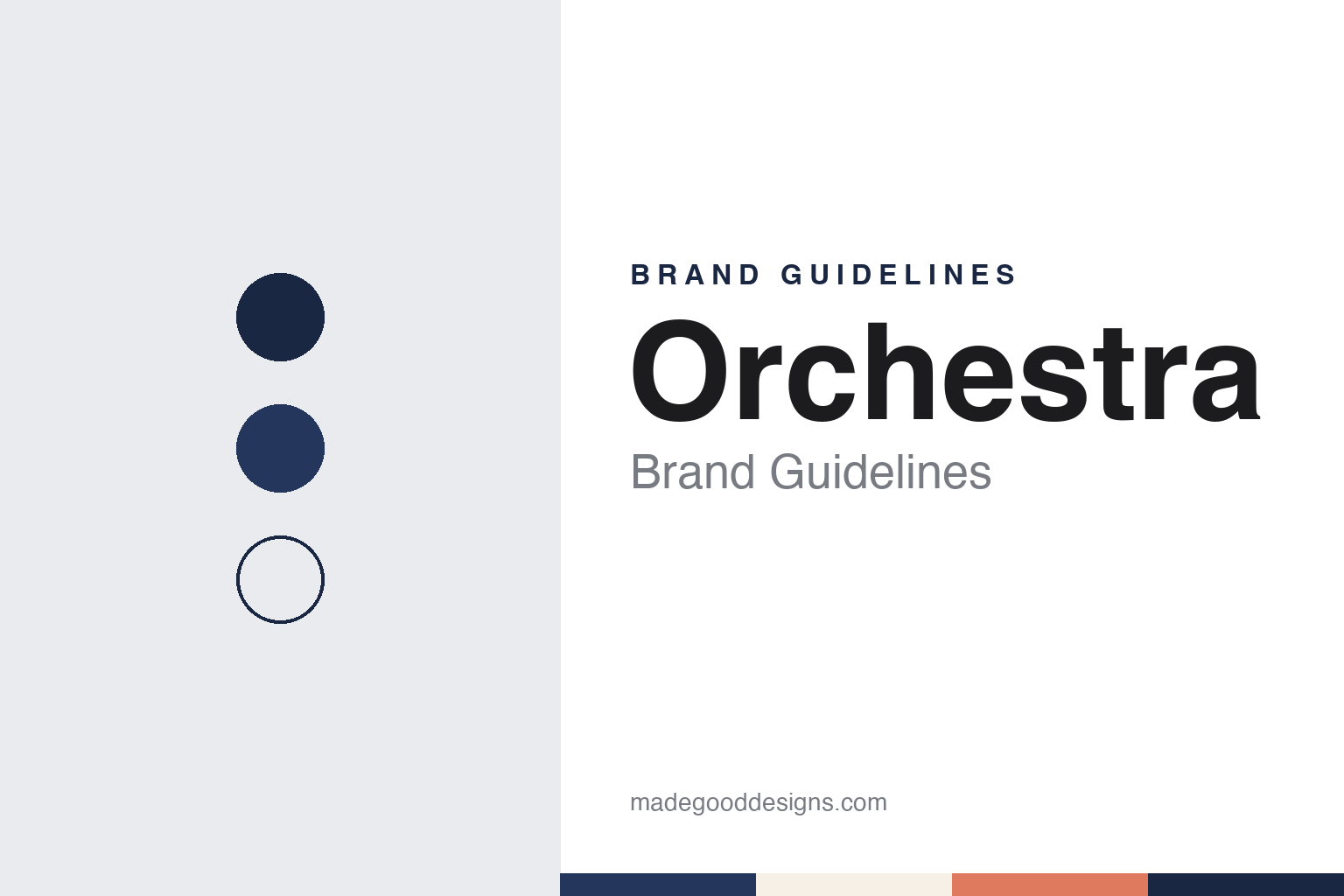
Orchestra Brand Guidelines
The Montpellier children’s chain that bought Prémaman and came back through its founder.
Aa
Two constants: a navy, cream and coral palette and a rounded sans register. Abstract homage — not an Orchestra product or mark; no garment, logo or shop sign is reproduced.
A Montpellier start
A children’s clothing chain built on franchise shops.
Orchestra began in 1995 as a children’s clothing chain based around Montpellier, in the south of France. The regional business weekly Le Journal des Entreprises described it in February 2026 as a designer, maker and retailer of textiles for children and of nursery goods, “born in 1995,” and named Pierre Mestre as its founder. French franchise directories, including the Observatoire de la Franchise, name him together with Chantal Mestre as the two people who started the chain. Its registered office is at Saint-Aunès, just east of Montpellier, according to the AFP report carried by FashionUnited in April 2020.
The chain grew through franchise and affiliate shops as well as its own branches. The Observatoire de la Franchise’s page on the network describes three formats: shops of around 500 square metres given over to children’s clothes, larger shops of 1,000 to 1,500 square metres that add maternity wear and nursery goods, and stores of up to 5,000 square metres that bring everything for babies and children under one roof. The same page describes clothing for children from birth to fourteen.
Loyalty has been central to the brand since its early years. Orchestra sells a paid membership, the Club, which in the company’s own description gives members discounts across its collections throughout the year. The Observatoire de la Franchise reported in December 2016 that more than a million people had joined the programme, and FashionUnited put the figure at 1.5 million members in February 2026, describing the Club as the base of the chain’s sales.
Nursery goods became a second pillar. In a statement filed with the French market regulator’s information service in June 2012, the company said it had launched a nursery banner, Babycare by Orchestra, in France, Switzerland and Spain, and had opened what it called the largest nursery store in France, in Montpellier, that April. Le Monde Informatique reported in February 2014 that Orchestra had bought the Swiss business Babycare in 2012.
Colour
Prémaman joins the group.
The decisive purchase came in 2012. On 27 June that year Orchestra announced that it was buying the whole of Prémaman, a Belgian family company specialising in nursery and maternity goods. In that statement the company described Prémaman as founded in 1953, with more than 280 shops in 38 countries, 134 of them in Belgium, run through a mix of its own branches, franchisees and affiliated agents, and said it would be consolidated from July 2012. Le Monde Informatique reported in February 2014 that, after buying Prémaman, the group moved both businesses onto a single management system.
From then on the listed company traded as Orchestra-Prémaman, and Prémaman continued as a name inside its shops: the Observatoire de la Franchise page describes Prémaman as a brand Orchestra sells exclusively. The two names together set out the range the shops cover, from children’s clothing to maternity wear and nursery equipment.
The group then looked to the United States. The Observatoire de la Franchise reported in December 2016 that Orchestra-Prémaman and Destination Maternity, an American maternity-clothing retailer, were preparing to merge, with the combined group to be based in Montpellier. The plan did not go ahead. Fox Business, carrying a MarketWatch report on 28 July 2017, said the agreement first announced on 20 December 2016 had been terminated, with the companies citing the difficulty of satisfying regulators in France and the United States.
Difficulties followed at home. A court opened a safeguard procedure, a court-supervised reorganisation that freezes earlier debts, for Orchestra-Prémaman on 24 September 2019, the company said in a June 2020 statement. In February 2020 it announced job cuts in France and abroad, and its plan at the time included closing 125 of its 534 points of sale, FashionUnited reported on 30 April 2020, citing AFP. On 29 April 2020 the commercial court in Montpellier converted the safeguard into a receivership, or redressement judiciaire.
Typography
Shop signs, formats and owners.
Baby and nursery store chains in the UK, France, Germany, Italy, the United States and Australia sell to families at the same moment in life, but each presents itself in its own way. The shop sign and logo are the first point of contact, and the same name is carried onto catalogues and websites; Mothercare’s history page, for example, shows its catalogues from 1962 onwards beside shopfronts from Kingston in 1961 to Plymouth in 2018. Colour schemes are each company’s own choice.
Store formats run from large nursery superstores to high-street shops and shop-in-shop counters inside other retailers. Mothercare describes a range from small shop-in-shop units to mid-sized high-street stores and larger out-of-town or shopping-mall stores, while PRG Retail Group describes Prénatal’s Italian network as a mix of shops and megastores, including a two-floor store near Milan shared with the Toys Center banner.
Franchising is one route abroad. Mothercare says it began franchising in 1984 and awards one partner per territory, so the same name can appear over stores run by different companies in different countries. Own-label ranges sit beside branded nursery goods, and the companies name and describe those ranges themselves on their websites and in their catalogues.
Corporate pages tell the rest of the story: founders, owners and changes of ownership. Mothercare and Prénatal have both passed through mergers, private-equity ownership or sale, and Mothercare’s British shops closed after its UK arm entered administration in 2019. For a design reader, these pages are a direct record of how a name, a sign and a palette have travelled through those changes.
Aa
A rounded sans for a children’s shop sign. (Specimen set in Nunito, a rounded sans STAND-IN; NOT the Orchestra logo.)
NewOrch
Taken back by its founder in 2020.
The court weighed more than one plan. FashionUnited reported in April 2020 that Othaim Investment Company, part of the Saudi family group Al-Othaim, which had taken a small minority stake in Orchestra in 2016, intended to bid for the business. On 19 June 2020 the commercial court in Montpellier chose NewOrch, a new company led by Pierre Mestre, as the buyer of Orchestra-Prémaman’s assets. In the company’s account of the judgment, NewOrch was owned 41 per cent by a group of suppliers, franchisees and managers, 38 per cent by the Mestre family and 19 per cent by the Gotlib family, with 2 per cent offered to employees without charge. The plan kept the group in France, Greece, Cyprus, Spain, Belgium, Luxembourg, Switzerland and Morocco, with 430 points of sale, 257 of them in France, and the shares of the old listed company stayed suspended on Euronext Paris.
The business that followed is smaller and more centralised. Le Journal des Entreprises reported on 19 February 2026 that Orchestra had about 4,600 staff and 450 shops, that it had finished repaying the financing of the takeover in September 2024, and that Christophe Pla, appointed managing director in September 2022, now runs NewOrch, the parent company, which Pierre Mestre chairs. The paper said the group had reorganised into three business units, for textiles, for nursery goods and new markets, and for digital and marketing; that digital sales made up a quarter of the total; that about 250 shops in France were due for renovation in new store concepts; and that it opened two shops in Belgium in 2025. It also said Orchestra reached around 25 further countries through export partners.
FashionUnited, in its own February 2026 report, said the group had strengthened its own-label ranges and that its shareholders were thinking about a future owner able to keep the brand anchored in Montpellier. It noted difficulties at Maison Combelle, a furniture subsidiary.
For a design guide, Orchestra shows a children’s brand held together by a membership card and a shop format that grows from a clothing boutique to a nursery superstore. Compare Okaïdi, another French children’s clothing chain, and Natalys, a French baby and maternity chain. For this guide we use a navy, a muslin cream and a coral with a rounded sans, an unofficial interpretation; no product or logo is reproduced.
Explore & save
Keep Orchestra’s identity on hand — save it to a board in the Made Good inspiration library.
Orchestra identity set
Pin the Orchestra navy, cream and coral palette and the rounded sans register to your own board.
Source & notes
Frequently Asked Questions
What font can I use to match the Orchestra look?
This guide describes Orchestra’s type as “A rounded sans for a children’s shop sign”. Its type specimen is set in Nunito from Google Fonts as a stand-in; Nunito is not Orchestra’s own lettering.
What colours are in the Orchestra palette?
This guide’s Orchestra palette is Playroom navy #24365C, Night ink #1A2742, Muslin cream #F6F0E6, Coral smock #E07A5F and Pale sky #BFD6E3. The tones are the guide’s own unofficial interpretation, not official Orchestra hex codes.
When was Orchestra founded?
Orchestra was founded in 1995, in Montpellier, France. Orchestra is known for Children’s clothing, maternity, nursery megastores, the Club card.
Who founded Orchestra?
Orchestra was founded by Pierre and Chantal Mestre in 1995.