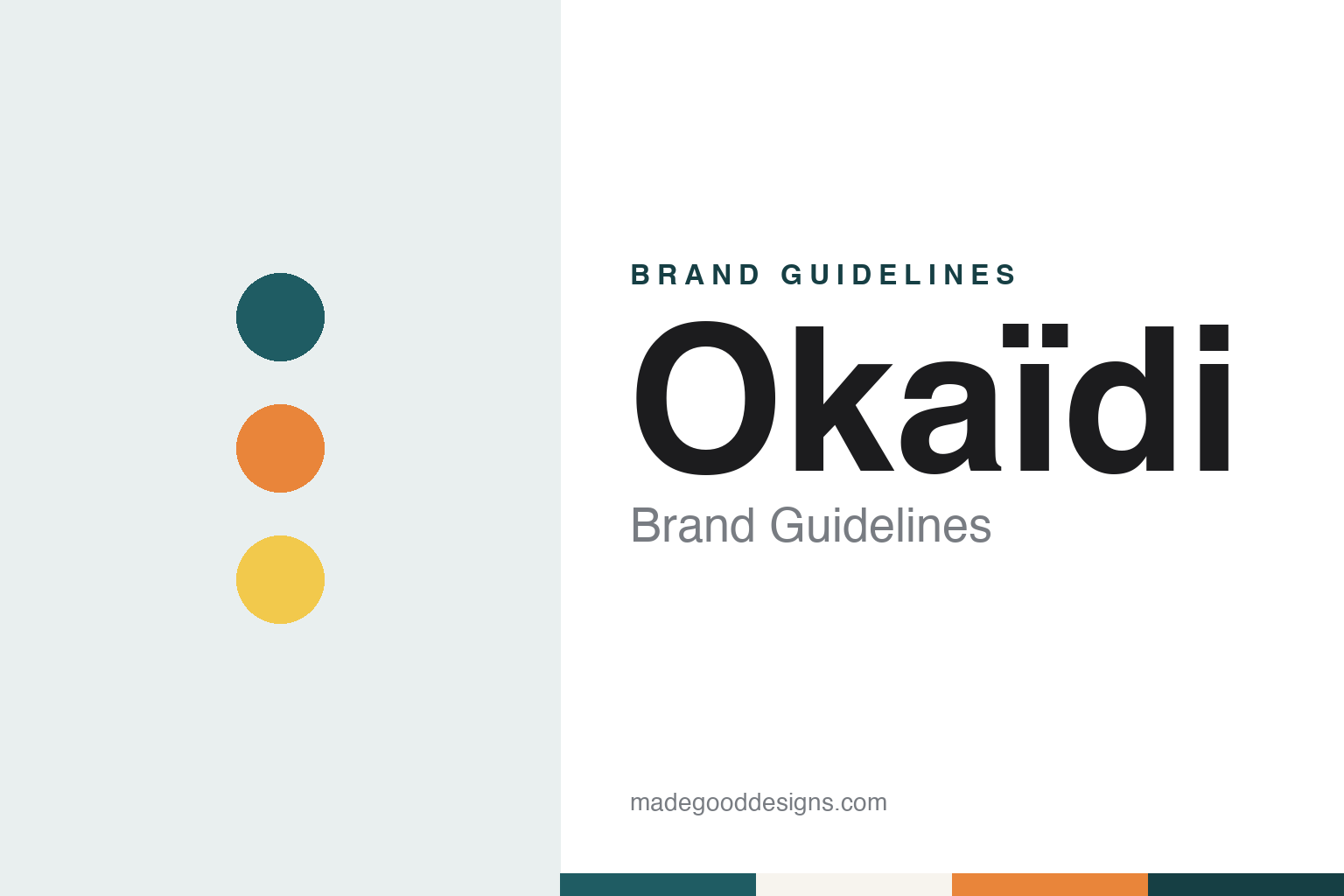
Okaïdi Brand Guidelines
A Roubaix childrenswear label built on colour.
Aa
Two constants: a teal, tangerine and yellow palette and a rounded sans register. Abstract homage — not an Okaïdi product or mark; no garment, logo or shop fascia is reproduced.
Camaïeu Enfant
A children’s business carved out of a Roubaix fashion group.
Okaïdi is a French childrenswear brand and chain of shops based in Roubaix, in the Lille area of northern France. French Wikipedia describes it as covering children from birth to 14 and says it was formerly called Camaïeu Enfant: the children’s arm of the Camaïeu fashion group.
Its story starts with a takeover. On 25 April 1994, French Wikipedia says, Jean Duforest, a co-founder of the Camaïeu group, and his partner Jean-Luc Souflet took over Camaïeu’s children’s business, with 30 shops and 100 staff. Sources give different dates for the Okaïdi name itself. Le Journal des Entreprises wrote in March 2023 that Okaïdi and its baby label had been offering families childrenswear “since 1996,” and Republik Retail gave 1996 as the brand’s creation date in July 2026; French Wikipedia says the brand was officially launched in August 2000, with 100 shops and 440 staff.
A second label followed. French Wikipedia dates Obaïbi to June 2002, as a concept for children up to five, narrowed in 2007 to clothing for babies up to three. Today the group behind both brands is IDKids, which L’Express Franchise describes as founded in Roubaix. Republik Retail described Obaïbi in 2026 as the group’s brand for 0 to 3 year olds and Oxybul as its brand for early-learning toys and games, alongside Okaïdi for older children.
For about two decades the group also owned a premium childrenswear brand. Republik Retail reported in April 2026 that IDKids had held Jacadi Paris since 2005; that brand was sold in 2026, as described below.
Colour
Colour, cotton and resale.
The clothes are the brand’s main signature. Le Journal des Entreprises described Okaïdi in March 2023 as offering families childrenswear that is accessible, colourful and, increasingly, made with lower environmental impact, and the Polish trade site Mediarun characterised its style in 2026 as urban casual, “full of graphics, intense colours and functional cuts.”
The same 2023 report set out what Okaïdi said about its materials and sourcing. The company called its programme “Eko”, a label used both inside the business and with customers to show progress in reducing the carbon footprint of the products in its shops. Okaïdi said the majority of its collections were made in Asia, close to where the raw materials come from, in factories audited on human and environmental grounds. Those are the company’s statements as reported, not independent findings.
The report also described the brand’s work with the European Centre for Innovative Textiles at Tourcoing, near Roubaix, which the company said had led since 2020 to a T-shirt knit containing at least 60 percent recycled cotton. In its shops, the newspaper said, a service called IDtroc promoted the resale of second-hand children’s clothing among customers, and donation points collected worn-out items to be recycled into textile fibre with a German partner.
The brand names themselves carry a recognisable pattern: Okaïdi, Obaïbi and Oxybul all begin with an O, and the first two are written with a diaeresis on the i. Across the group the labels divide children by age: Obaïbi for babies up to three, Okaïdi for children aged three to 14, according to the group’s descriptions reported in 2026, and Oxybul for play and early learning.
Typography
Design and documentation.
France’s mass-market fashion and childrenswear chains grew up mostly in retail parks and shopping centres rather than on high streets. Kiabi opened its first store at Roncq, outside Lille, in 1978, and Gémo was created by the Éram group in 1991 to sell shoes and clothing for the whole family in stores on the edges of towns. For these chains the shop fascia, the logo on the bag and the label inside the garment are often the same name, because most of what they sell is their own.
Own-label ranges carry much of the identity. The International Directory of Company Histories traces Kiabi’s house brands back to its first store, with Winch and Decade, and later children’s labels; Le Journal des Entreprises reported in 2021 that own-label products made up 85 to 90 per cent of Gémo’s offer. Catalogues, websites, apps and seasonal campaigns present those ranges, and logos are redrawn from time to time: Kiabi unveiled a new single-letter K in December 2025, CB News reported.
Many of the chains belong to family-owned groups, and their corporate pages say so plainly. Kiabi sits in the Mulliez family’s retail group alongside Auchan and Decathlon; Gémo belongs to Éram, based at Saint-Pierre-Montlimart in Maine-et-Loire; French Wikipedia describes Groupe Beaumanoir as a family group founded in 1981 by Roland Beaumanoir. Founders, owners and changes of control are part of each brand’s story, and receiverships and sales have reshaped several of these names in recent years.
This guide sets out what can be checked about each brand: who founded it, who owns it, how its stores, labels and logos have changed, and what has happened to it. Company statements are marked as such, and counts of stores and countries are given with the date of the source.
Aa
A rounded sans for a colourful children’s label. (Specimen set in Nunito, a sans STAND-IN; NOT the Okaïdi logo.)
Okaïdi
A court-supervised restructuring in 2026.
In January 2026 IDKids asked the commercial court for protection for its French businesses, saying the mid-range was caught in an “hourglass effect” between low-cost and ultra-fast fashion on one side and the premium segment on the other, Republik Retail reported. On 3 February 2026 the commercial court of Lille Métropole opened a redressement judiciaire (a court-supervised reorganisation) for the entities IDKids, Okaïdi and the logistics arm IDLog, according to Republik Retail and L’Express Franchise. Jacadi stayed outside the procedure.
Assets and markets were then sold or closed. On 28 April 2026, Republik Retail reported, France’s competition authority, the Autorité de la concurrence, cleared without conditions the takeover of Jacadi by the Deveaux group, owner of Armand Thiery, finding no overlap because Jacadi sells children’s and baby clothing and Deveaux adult ready-to-wear. In Poland, Mediarun reported, a Warsaw district court declared the local subsidiary bankrupt on 22 April 2026, closing its 25 shops and its online shop after 16 years in the country.
On 28 July 2026 the Lille Métropole court approved the group’s continuation plan, ending the procedure, according to L’Express Franchise, Republik Retail and RetailDetail. L’Express Franchise reported that the plan closed about 60 Okaïdi shops in France, cut 290 jobs and took the brand out of Germany, Poland and Portugal, and put the French network after the closures at about 335 shops. The company itself gave 766 shops in 50 countries, 272 of them in France, and about 4,500 staff, around 2,000 of them in France, Republik Retail reported in July 2026.
As of July 2026, then, Okaïdi was still trading under IDKids, in Roubaix, after a six-month reorganisation that left it with fewer shops and fewer countries.
For a design guide, Okaïdi shows how a children’s label carries one naming pattern and a colourful palette across a baby line, a toy brand and shops in many countries. Compare Vertbaudet, another French childrenswear name, and Camaïeu, the group from which Okaïdi’s business was taken over in 1994. For this guide we use teal, tangerine and yellow with a sans, an unofficial interpretation; no product or logo is reproduced.
Explore & save
Keep Okaïdi’s identity on hand — save it to a board in the Made Good inspiration library.
Okaïdi identity set
Pin the Okaïdi teal, tangerine and yellow palette and the rounded sans register to your own board.
Source & notes
Frequently Asked Questions
What font can I use to match the Okaïdi look?
This guide describes Okaïdi’s type as “A rounded sans for a colourful children’s label”. Its type specimen is set in Nunito from Google Fonts as a stand-in; Nunito is not Okaïdi’s own lettering.
What colours are in the Okaïdi palette?
This guide’s Okaïdi palette is Deep teal #1F5C63, Ink green #163F44, Tangerine #E9853A, Sunny yellow #F2C94C and Chalk #F7F4EE. The tones are the guide’s own unofficial interpretation, not official Okaïdi hex codes.
When was Okaïdi founded?
Okaïdi was founded in 1994 takeover; brand dated 1996 or 2000, in Roubaix, France.
Who founded Okaïdi?
Okaïdi was founded by Jean Duforest and Jean-Luc Souflet in 1994 takeover; brand dated 1996 or 2000.


