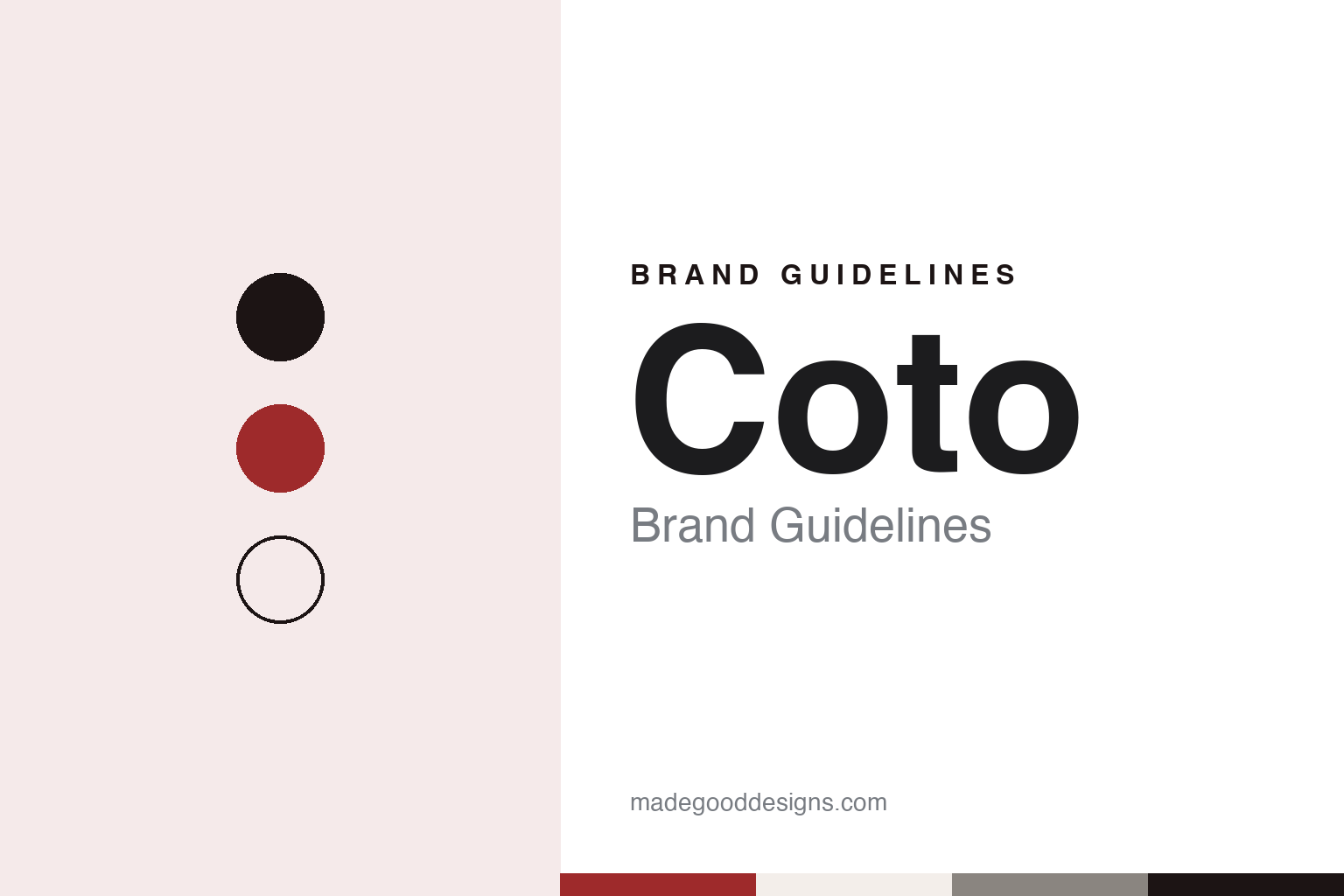
Coto Brand Guidelines
A 1970 Boedo butcher shop turned supermarket chain.
Aa
Two constants: a butcher red, tile white and market grey palette and a Condensed sans register. Abstract homage — not a Coto product or mark; no sign, logo or store front is reproduced.
The butcher’s counter
A chain built on meat.
Coto began with meat. Its founder, Alfredo Coto, learned the trade from his father, Joaquín Coto, a Galician immigrant who had a butcher’s stall at the Mercado de Retiro in Buenos Aires, iProfesional reported in September 2026. As a boy he went with his father to the Liniers cattle market, La Nación reported in a 2005 profile, and before opening a shop the family was already buying cattle and delivering meat to small businesses.
In 1970, with his wife Gloria, he opened his first butcher shop, in the Buenos Aires neighbourhood of Boedo, La Nación reported; iProfesional says a loan from his father-in-law paid for it. Spanish Wikipedia dates the founding of the company, Coto C.I.C.S.A. — the initials stand for Centro Integral de Comercialización Sociedad Anónima — to 10 September 1970 and names its founders as Alfredo Coto and Gloria García. In a 2024 report, La Nación described the business as born that year as a chain of integrated butcher shops, selling directly from producer to consumer.
The butcher chain grew for almost two decades before Coto sold groceries at scale. By 1987, La Nación reported in 2005, it had 34 shops open to the public, a meat plant of its own and more than 350 employees.
That structure set the pattern for what followed. iProfesional describes the chain’s growth as resting on control of the whole value chain, from the cattle to the shelf, and says that after 1987 the company opened branches and hypermarkets across the city and its suburbs until it was competing with the large foreign chains then entering the Argentine market.
Colour
From Mar de Ajó to the city.
The first supermarket opened in 1987 at Mar de Ajó, a beach town on the Atlantic coast of Buenos Aires province, according to La Nación, iProfesional and Spanish Wikipedia. From there the chain spread through the city of Buenos Aires and its suburbs. Spanish Wikipedia says Coto rented stores of the Supercoop chain of the El Hogar Obrero cooperative and bought stores from other chains, among them Acassuso, Sumo and the Chilean-owned Metro and Unimarc, renaming them all Coto. Its first hypermarket opened in Nueva Pompeya, and it built a distribution centre at Esteban Echeverría.
The company stayed in its founders’ hands. In its 2005 profile, La Nación said that while most of Argentina’s local supermarket chains had passed into foreign ownership over the previous decade, Coto had turned down offers, including one from Wal-Mart in the late 1990s. That year, the paper reported, it had more than 100 stores and 18,500 employees, and three meat plants of its own that supplied the supermarkets and exported part of their output. Alfredo Coto was then president of the Asociación de Supermercados Unidos, a trade body he had led out of the Cámara Argentina de Supermercados in 2003, and treasurer of the Asociación de Empresarios Argentinos, the paper said; the company’s offices were then in the La Paternal district.
The same profile recorded a widening of the chain. Coto, the paper said, had grown by serving price-conscious shoppers and was then opening its first stores inside gated communities north of the city, launching an online service, Coto Digital, and moving into the provinces, with a hypermarket beside the Alto Rosario shopping centre built with the property group IRSA.
Spanish Wikipedia records later openings: a hypermarket at Munro on 24 October 2008, on a former El Hogar Obrero site, and a hypermarket with office towers in Barracas on 8 August 2016. It lists stores in Rosario, Paraná, Santa Fe, Neuquén and Mendoza, as well as the coast.
Typography
Supermarkets of the Southern Cone.
Colombia, Peru and Argentina have large retail chains that grew from a single shop into national networks, and most of them present themselves first through their formats. A company’s own pages usually set out its hypermarkets, supermarkets, discount stores, department stores, home-improvement centres and pharmacies as separate banners, each with its own name and fascia. In Colombia, Olímpica’s formats were listed in 2024 by El Heraldo as supertiendas, superalmacenes, superdroguerías and droguerías, while Grupo Éxito runs the Éxito and Carulla banners and the Viva shopping centres, according to Spanish Wikipedia.
Own-label ranges carry much of the identity inside the shop. Grupo Éxito sells its own clothing labels, People, Arkitect and Bronzini, El Colombiano reported in March 2024, and Olímpica has private labels across supermarket, textile, appliance, technology and home categories, according to El Heraldo. Seasonal campaigns, printed leaflets and anniversary promotions are published on the chains’ websites next to store finders and online shops.
Ownership is part of the story, and it often crosses borders. Grupo Éxito passed from the French group Casino to the Salvadoran Grupo Calleja through tender offers that closed in January 2024, according to the company’s own filing, and in March 2026 its Argentine subsidiary agreed to hand twelve stores to the Patagonian chain La Anónima. Several Peruvian chains belong to wider groups, and each guide here names the owner with the date a source gives.
Corporate pages fill in the rest: founders and founding dates, stock-exchange listings and investor filings, and the family holding companies behind many of the chains. This guide sets out what can be checked about each brand from dated press, registers and the companies’ own filings, and keeps company descriptions marked as the company’s own word.
Aa
A condensed sans for shelf signs and counters. (Specimen set in Barlow Condensed, a sans STAND-IN; NOT the Coto logo.)
Coto
From farm to shelf.
Meat still sits at the centre of the business. In September 2026, iProfesional reported that Coto had more than 120 branches and a distribution centre of 110,000 square metres supplying the whole network, and that it owns its meat plants, cattle farms, logistics centres and a fleet of trucks. Spanish Wikipedia lists its own brands as Coto and Ciudad del Lago for food, Cristal del Lago for cleaning products and TOP for electrical goods. The company says on its website that it has more than 20,000 staff and more than 50 years of history.
The coast remains important. In November 2024, La Nación reported that Coto had completed the renovation and enlargement of its hypermarket at the entrance to Cariló earlier that year, and that it had three stores on that stretch of the Atlantic coast, at Cariló, Mar de Ajó and Mar del Tuyú. The company’s website now announces a branch at the port of Mar del Plata.
Coto has also taken its online store abroad. The same La Nación report said Coto Digital had opened a marketplace for shoppers in Shanghai, served door to door from the company’s warehouses in Rosario and Buenos Aires, seven years after Coto opened a commercial office in China; it had also opened offices in Santiago de Chile and Dubai, the paper said.
For a design guide, Coto shows how a butcher’s trade can shape a supermarket brand from the counter outwards. Compare La Anónima, a Patagonian chain with its own meat plants, and Walmart, which once made Coto an offer. For this guide we use a butcher red, a tile white and a market grey with a condensed sans, an unofficial interpretation; no product or logo is reproduced.
Explore & save
Keep Coto’s identity on hand — save it to a board in the Made Good inspiration library.
Coto identity set
Pin the Coto butcher red, tile white and market grey palette and the Condensed sans register to your own board.
Source & notes
Frequently Asked Questions
What font can I use to match the Coto look?
This guide describes Coto’s type as “A condensed sans for shelf signs and counters”. Its type specimen is set in Barlow Condensed from Google Fonts as a stand-in; Barlow Condensed is not Coto’s own lettering.
What colours are in the Coto palette?
This guide’s Coto palette is Butcher red #9E2A2B, Ink #1C1414, Tile white #F3EEEA, Market grey #8A8580 and Paper #FAF8F6. The tones are the guide’s own unofficial interpretation, not official Coto hex codes.
When was Coto founded?
Coto was founded in 1970 (butcher shops), in Buenos Aires (Boedo).
Who founded Coto?
Coto was founded by Alfredo Coto and Gloria García in 1970 (butcher shops).