La Mie Câline Brand Guidelines
A Vendée bakery family, a 1985 bake-off shop and a heart logo.
Aa
Two constants: a crust red, wheat and flour palette and a warm serif register. Abstract homage — not a La Mie Câline product or mark; no logo, heart symbol or packaging is reproduced.
La Croissanterine
A family bakery on the Vendée coast becomes a network.
La Mie Câline grew out of a family of bakers on the Atlantic coast of the Vendée. French Wikipedia traces the Barreteau family to a flour mill at Saint-Urbain around 1850, and dates the bakery itself to 1920, when Louis and Angelina Barreteau opened one in Sallertaine. Their son Daniel and his wife Jeanne-Marie took it over in 1947 and moved it to Saint-Jean-de-Monts in 1957, according to both French Wikipedia and the franchise site Toute la Franchise, which profiled the family in June 2012. The sources used for this guide do not say how the Barreteau family bakery operated during the occupation of 1940–1944.
The next generation turned the bakery into a business system. French Wikipedia says that in 1975 André Barreteau, his wife Michelle and his sister Catherine took over the family bakery, and that André developed freezing techniques for its products during that first decade. Toute la Franchise wrote in 2012 that summer crowds on the coast pushed him to open sales points separate from the main bakery in 1977.
The chain itself dates from 1985, when André Barreteau opened a first bake-off shop, then called La Croissanterine, in Challans, French Wikipedia and Toute la Franchise both say. French Wikipedia dates the creation of the company Monts Fournil to 1986, while Toute la Franchise places it at the network’s tenth shop; either way, the baker became an industrial producer and a franchisor, handing the running of shops to partners. The shop in Saint-Jean-de-Monts itself opened on 1 April 1987, Observatoire de la Franchise reported in December 2023.
In 1994, with 22 shops according to French Wikipedia, La Croissanterine became La Mie Câline. Toute la Franchise adds that the network joined the national franchisors’ association at that point. As of 2012 the same publication described the chain as belonging to the Barreteau family; in 2023 it named David Giraudeau as managing director and Sylvia Touboulic Barreteau as deputy managing director.
Colour
One plant, many shops.
The model rests on a single production site. French Wikipedia says the products are made raw or part-baked and frozen at the company’s only production site, in Saint-Jean-de-Monts, and are then finished in the shops, which work as bake-off points. Those shops are generally in town centres and employ five to fifteen people each, the same entry says. The plant grew with the network: French Wikipedia gives 4,000 square metres after a move in 1996, when the franchise had 35 shops, and 10,000 square metres in 2001, the year the hundredth shop opened.
Logistics followed. French Wikipedia dates the creation of a logistics subsidiary with the haulier Mousset to 1999. In 2012 Toute la Franchise described nine distribution platforms receiving breads, pastries, sandwiches and savoury tarts from the plant, close to 20,000 tonnes of goods a year, and supplying each shop within two days. The same profile counted 203 shops in 2012, up from 100 in 2001, including 15 company-owned pilot shops used to test new products and formats, and sites opened from 2009 in Liège in Belgium and in Barcelona and San Sebastián in Spain.
The range is a takeaway bakery offer: breads, viennoiseries, pastries, sandwiches, salads and ready meals, along with coffee and hot drinks, according to French Wikipedia. The farm-trade weekly Réussir counted more than 240 shops in December 2021, and Le Journal des Entreprises gave 242 in March 2023, when managing director David Giraudeau told the paper that each franchisee owns its shop and that the Monts Fournil group had about 300 employees. He also named the cookie as the chain’s lead product, given its own space, the Corner Cookiz, in the new shop concept.
Formats have varied. French Wikipedia records a sit-down format, “La Mie Câline à table,” created in 2008 for sites on the edge of towns.
Typography
How European bakery and café chains present themselves.
Europe’s bakery, sandwich, coffee and pizza chains present themselves first through the shop: the fascia over the door, the counter, the bags and cups, and the names of the products on the menu board. Chains in France, Spain, Belgium, Germany and Finland publish their menus by named ranges, such as sandwiches, salads, pastries and coffee, and their websites usually add a store finder, a loyalty app and a section for prospective franchisees.
Many of these brands sit inside larger groups, and ownership is often the clearest way to read their history. The Barcelona sandwich chain Pans & Company passed from the Catalan food group Agrolimen to the Portuguese restaurant group Ibersol in October 2016, according to Ibersol. In 2014, the agricultural trade paper Agra reported that the industrial baker Neuhauser owned two quick-service chains, Pomme de Pain in France and Crobag in Germany, as the grain group Soufflet took control of it. Pomme de Pain later went back to independence when its managers bought it from InVivo in July 2023, Réussir reported.
Shop networks are published by the companies and counted by the trade press, and the counts change. Franchising can carry a brand abroad, sometimes through a master franchise for a whole country, as Pomme de Pain did in Morocco and Tunisia, according to French Wikipedia; airport and railway-station sites can form a separate channel, such as the travel division through which Ibersol runs Café Pans counters in Spanish airports. A chain’s count of restaurants is therefore always a figure for a given date.
Identity changes are usually reported in the trade press when a refit is unveiled: a new logo, a new typeface, new uniforms and a pilot shop in a symbolic location. This guide sets out what can be checked about each brand, who founded it, who owns it and how its shops and packaging have changed, and attributes claims to the company where they rest on its own word.
Aa
A warm, soft serif for a bakery register. (Specimen set in Fraunces, a serif STAND-IN; NOT the La Mie Câline logo.)
A heart and a smile
Four signatures and a 2023 logo.
The brand has changed its look several times. French Wikipedia says the logo and shops were refreshed in 2004, and that at the end of 2011 the chain tested a new concept, “Atelier pains et restauration,” in Nantes and La Roche-sur-Yon, with a colourful sign meant to stand for making, bread and food. The same entry lists four signatures in turn: “délicieusement sympa” from 1994 to 2004, “du bon grain au bon pain” from 2004 to 2012, “Atelier pains et restauration” from 2012 to 2023, and, since 2023, “Le bonheur est là” (“Happiness is here”).
The 2023 identity is the current one. Toute la Franchise reported on 30 March 2023 that the new logo is built around a heart shaped like a smile, or a smile shaped like a heart, echoing the company’s environmental and social programme, “À cœur d’agir.” In an interview with Le Journal des Entreprises on 28 March 2023, David Giraudeau said the previous concept dated from 2011 and was showing its age, that the old signature had been very descriptive, that the heart was new, and that the lettering was now “less childish.” He described a shop layout with a bakery counter, a lunch room, a barista space and the cookie corner.
That layout reached the network’s home town. Observatoire de la Franchise reported in December 2023 that the Saint-Jean-de-Monts shop reopened on 13 November 2023 in the new colours, with the four spaces in place and the new signature on show.
The name also travels by sea. French Wikipedia says La Mie Câline sponsored the yacht of the skipper Arnaud Boissières in the Vendée Globe sailing race in 2016, 2020 and 2024, tying the brand to a race named after its home département.
For a design guide, La Mie Câline shows how a regional bakery family can carry one name through a franchise network while its signatures and logo change around it. Compare Marie Blachère, another French bakery chain, and Brioche Dorée, another French bakery-café chain. For this guide we use a crust red, wheat and flour cream with a warm serif, an unofficial interpretation; no product or logo is reproduced.
Explore & save
Keep La Mie Câline’s identity on hand — save it to a board in the Made Good inspiration library.
La Mie Câline identity set
Pin the crust red, wheat and flour palette and the warm serif register to your own board.
Source & notes
Frequently Asked Questions
What font can I use to match the La Mie Câline look?
This guide describes La Mie Câline’s type as “A warm, soft serif for a bakery register”. Its type specimen is set in Fraunces from Google Fonts as a stand-in; Fraunces is not La Mie Câline’s own lettering.
What colours are in the La Mie Câline palette?
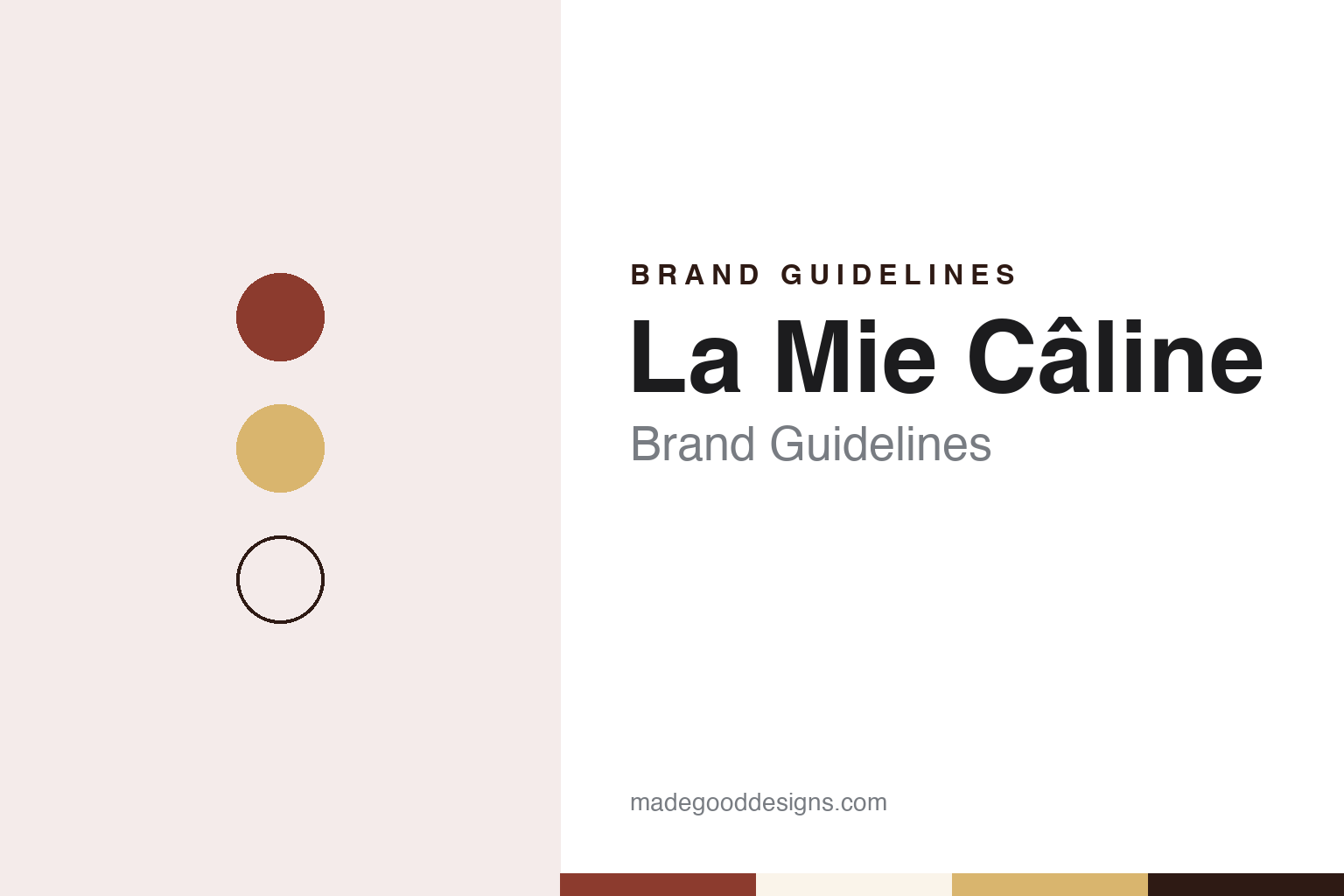
This guide’s La Mie Câline palette is Crust red #8C3B2E, Oven brown #2E1A14, Wheat #D9B56E, Flour #FAF4EA and Paper #FFFFFF. The tones are the guide’s own unofficial interpretation, not official La Mie Câline hex codes.
When was La Mie Câline founded?
La Mie Câline was founded in 1985 (as La Croissanterine), in Challans, Vendée, France.
Who founded La Mie Câline?
La Mie Câline was founded by André Barreteau in 1985 (as La Croissanterine).