Marie Blachère Brand Guidelines
A Provence bakery chain built on edge-of-town shops and bread baked on site.
Aa
Two constants: a Marie Blachère crust, wheat and flour palette and a warm serif register. Abstract homage — not a Marie Blachère product or mark; no logo, sign or packaging is reproduced.
Salon-de-Provence
A market gardener, a fruit shop and a daughter’s name.
Marie Blachère opened its first bakery in Salon-de-Provence in 2004. Its founder, Bernard Blachère, came to bread from fruit and vegetables: English Wikipedia and the French broadcaster BFM TV describe him as a market gardener from the Ardèche. La Dépêche du Midi reported in January 2024 that he opened his first fruit-and-vegetable shop in 1981 and that by the early 2000s he had more than 200 shops under the Provenc’Halles name; the business site L’Essentiel de l’Éco dated the founding of Provenc’Halles to 1985.
The bakery idea came from that trade. BFM TV reported in July 2022 that in the 1980s Blachère wanted to put a bakery next to his fruit-and-vegetable shop in Aubenas, was turned down by the bakers he approached, and so recruited a baker of his own to work out the concept with him: larger bakeries than usual, on the edge of towns, kneading bread on site but borrowing the marketing habits of supermarkets.
The chain is named after his daughter. BFM TV and La Dépêche du Midi both say the first shop took the name of the founder’s daughter, Marie; French Wikipedia and L’Essentiel de l’Éco say the company was founded by Bernard Blachère together with his children, Marie and Jean. It is part of the Groupe Blachère, run from Châteaurenard in the Bouches-du-Rhône, La Dépêche du Midi reported.
The start was not smooth. According to La Dépêche du Midi, the first attempt in Salon-de-Provence did not work, and the founder took time to rework the formula: baking in every shop, bread and pastries laid out on stalls like a market, and careful lighting and awnings to show off the products. French Wikipedia records how quickly the network then grew: the 100th shop opened in February 2011 and the 200th in September 2013.
Colour
Big shops, a short baguette and three bakes.
The Marie Blachère format is large and suburban. BFM TV reported in 2022 that its bakeries averaged about 400 square metres, sat on the outskirts of towns and had wide car parks; L’Essentiel de l’Éco gave the standard formats in February 2026 as between 300 and 500 square metres. La Dépêche du Midi noted the nickname the chain has picked up in France: “the roundabout bakery.”
The bread has its own name. L’Essentiel de l’Éco dates the chain’s signature baguette, “la Marie,” to 2005, and BFM TV describes the “baguette de Marie” as a little shorter and wider than a traditional baguette. Since the start, BFM TV reported, customers have been able to choose one of three bakes for a baguette: pale, golden or well done. La Dépêche du Midi described the same choice in 2024.
Where the baking happens is central to how the chain presents itself. BFM TV reported in 2022 that about 2,000 of the group’s 11,000 staff were bakers who made bread, tarts and pizzas in the shops rather than finishing products prepared in a factory. French Wikipedia says the company has no central factory and that production is done on site, while noting that viennoiseries and some other products are frozen. The company’s website says the flour for its baguettes has come from 100% French wheat from the beginning, which is its own claim.
Lunch is a large part of the offer. BFM TV described salads, sandwiches and pizzas added for the midday break, with a few tables and a counter turning the bakery into a quick-service restaurant. The website now groups its range into breads, viennoiseries, snacking and a “Tarterie” of tarts and cakes, under the line “Le bon produit, au bon prix,” the right product at the right price. A shop near Amboise that opened in summer 2026, described by the trade paper Zepros that November, shows the format at full size: 500 square metres beside a supermarket, a 300-square-metre production room where all the bread and snacks are made, and 70 seats.
Typography
How the chains present themselves.
Europe’s bakery, sandwich, coffee and pizza chains present themselves first through the shop: the fascia over the door, the counter, the bags and cups, and the names of the products on the menu board. Chains in France, Spain, Belgium, Germany and Finland publish their menus by named ranges, such as sandwiches, salads, pastries and coffee, and their websites usually add a store finder, a loyalty app and a section for prospective franchisees.
Many of these brands sit inside larger groups, and ownership is often the clearest way to read their history. The Barcelona sandwich chain Pans & Company passed from the Catalan food group Agrolimen to the Portuguese restaurant group Ibersol in October 2016, according to Ibersol. In 2014, the agricultural trade paper Agra reported that the industrial baker Neuhauser owned two quick-service chains, Pomme de Pain in France and Crobag in Germany, as the grain group Soufflet took control of it. Pomme de Pain later went back to independence when its managers bought it from InVivo in July 2023, Réussir reported.
Shop networks are published by the companies and counted by the trade press, and the counts change. Franchising can carry a brand abroad, sometimes through a master franchise for a whole country, as Pomme de Pain did in Morocco and Tunisia, according to French Wikipedia; airport and railway-station sites can form a separate channel, such as the travel division through which Ibersol runs Café Pans counters in Spanish airports. A chain’s count of restaurants is therefore always a figure for a given date.
Identity changes are usually reported in the trade press when a refit is unveiled: a new logo, a new typeface, new uniforms and a pilot shop in a symbolic location. This guide sets out what can be checked about each brand, who founded it, who owns it and how its shops and packaging have changed, and attributes claims to the company where they rest on its own word.
Aa
A warm, slightly old-fashioned serif for a bakery sign. (Specimen set in Fraunces, a serif STAND-IN; NOT the Marie Blachère logo.)
Marie Blachère
A family-held network, mostly run by the company.
The network grew fast after 2013. BFM TV counted 700 bakeries in July 2022; La Dépêche du Midi counted 783, with more than 12,000 staff, in January 2024; and French Wikipedia gives more than 830 shops in France in 2025. As of July 2022, BFM TV reported, Paris was the one place in France without a Marie Blachère bakery.
A partnership shaped where many shops stand. La Dépêche du Midi reported that in 2008 Bernard Blachère reached an agreement with the Grand Frais fresh-food stores, under which a Marie Blachère bakery would open beside each Grand Frais store; BFM TV noted in 2022 that the bakeries were generally placed next to Grand Frais shops. L’Essentiel de l’Éco reported in February 2026 that, by early that year, the Blachère group was also running about thirty fruit-and-vegetable departments inside Carrefour hypermarkets and supermarkets.
Abroad, the chain has moved slowly. French Wikipedia dates its first shop outside France to March 2014, at Messancy in Belgium, and BFM TV listed two bakeries in New York, one in Lisbon and several in Belgium as of July 2022.
The company opened a franchise route in 2016, French Wikipedia and L’Essentiel de l’Éco say, but most shops are still run by the group. L’Essentiel de l’Éco put franchised shops at less than 5% of the network in February 2026, with the rest company-run or operated under location-gérance, a French arrangement in which a manager runs a business under the company’s name; it said 54 shops moved to that arrangement in 2025. The group remains in family hands: La Dépêche du Midi reported in January 2024 that Bernard Blachère held all of it, while English Wikipedia and L’Essentiel de l’Éco put his stake at 91%.
For a design guide, Marie Blachère shows how a bakery can borrow the look of a market stall and the logic of an out-of-town store at the same time. Compare La Mie Câline, another French bakery chain from outside Paris, and Greggs, a British bakery chain. For this guide we use crust brown, wheat gold and flour white with a serif, an unofficial interpretation; no product or logo is reproduced.
Explore & save
Keep Marie Blachère’s identity on hand — save it to a board in the Made Good inspiration library.
Marie Blachère identity set
Pin the Marie Blachère crust, wheat and flour palette and the warm serif register to your own board.
Source & notes
Frequently Asked Questions
What font can I use to match the Marie Blachère look?
This guide describes Marie Blachère’s type as “A warm, slightly old-fashioned serif for a bakery sign”. Its type specimen is set in Fraunces from Google Fonts as a stand-in; Fraunces is not Marie Blachère’s own lettering.
What colours are in the Marie Blachère palette?
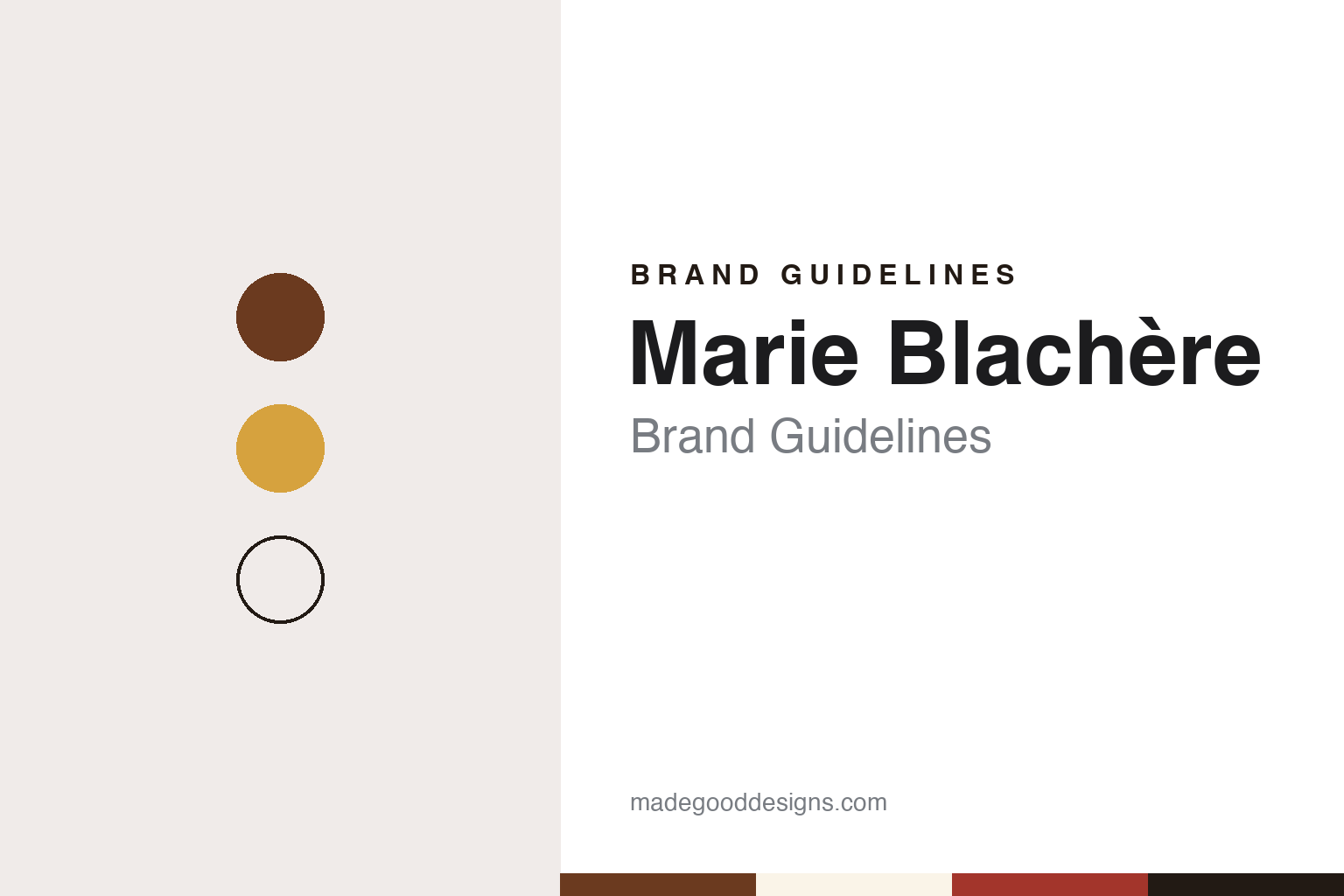
This guide’s Marie Blachère palette is Crust brown #6B3A1F, Oven black #221A14, Flour white #FAF4E8, Wheat gold #D6A23E and Awning red #A3352B. The tones are the guide’s own unofficial interpretation, not official Marie Blachère hex codes.
When was Marie Blachère founded?
Marie Blachère was founded in 2004, in Salon-de-Provence, France. Marie Blachère is known for The “Marie” baguette, three bakes, large edge-of-town shops.
Who founded Marie Blachère?
Marie Blachère was founded in 2004 by Bernard Blachère, with his children Marie and Jean.