Brioche Dorée Brand Guidelines
A 1976 Brest bakery counter that grew into Groupe Le Duff.
Aa
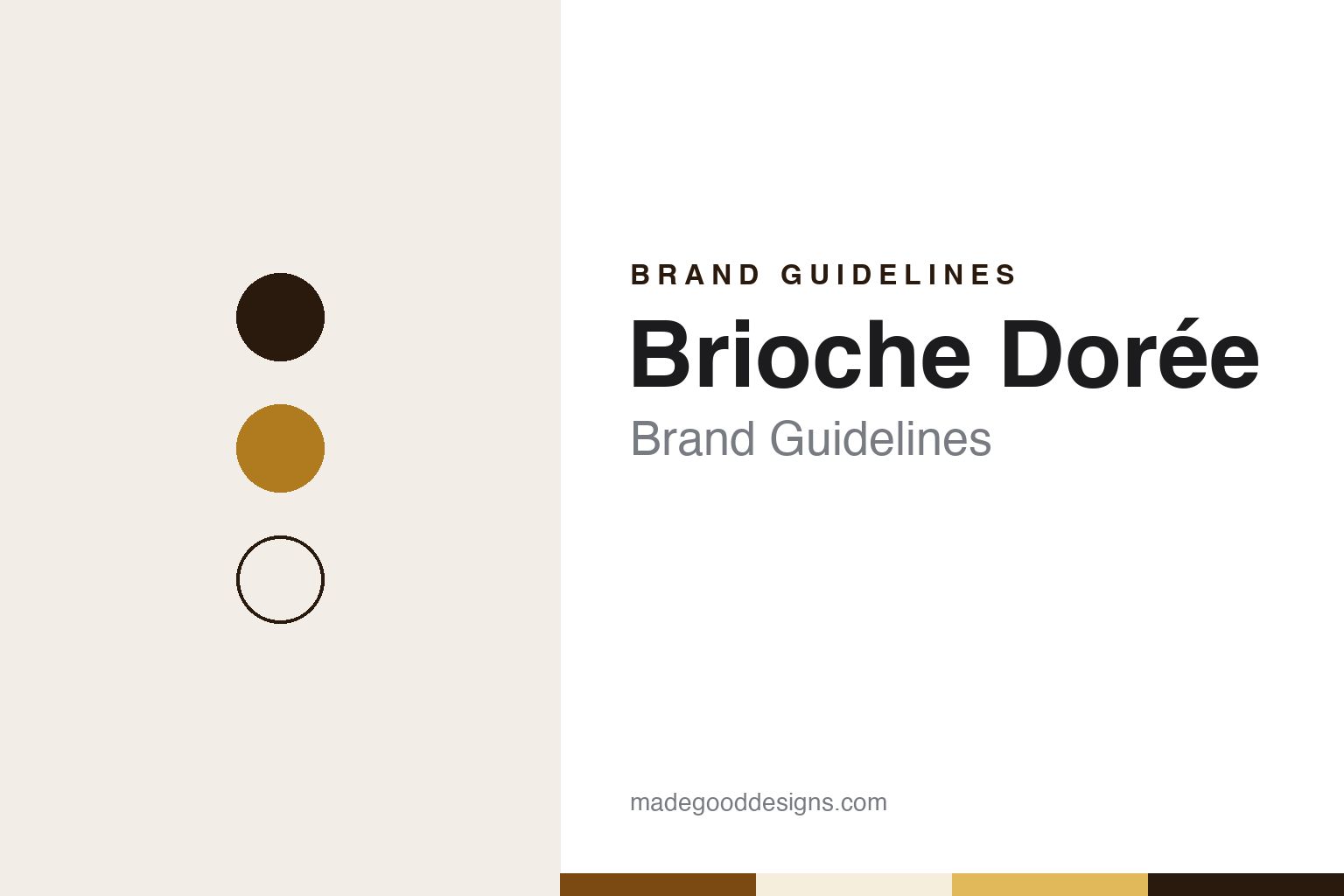
Two constants: a crust gold, deep brown and cream palette and a Warm serif register. Abstract homage — not a Brioche Dorée product or mark; no shopfront, logo or packaging is reproduced.
Brest, 1976
One shop at the western tip of Brittany.
Brioche Dorée began in Brest, the port city at the western tip of Brittany, in 1976. French Wikipedia, citing L’Express in 2006, says Louis Le Duff opened the first shop under the name that year with a modest personal stake; citing L’Express again in 2011, it says he brought the idea of quick, French-style counter service back from stays in the United States. The name joins two plain French words: the brioche, an enriched yeast bread, and “dorée,” golden. The chain has kept it for half a century.
That single shop became the seed of a group. English Wikipedia describes Groupe Le Duff as a French restaurant conglomerate founded in 1976 with the opening of the Brest Brioche Dorée, and gives its headquarters as Rennes. French Wikipedia lists Brioche Dorée itself as a simplified joint-stock company based in Rennes and a subsidiary of the group, with Louis Le Duff’s holding company named as its head. The founder is still at the top of the business: Le Journal des Entreprises, reporting from Rennes in May 2026, describes the chain as the one “founded by Louis Le Duff” and says the appointment of its new head was settled after a conversation with him.
Around the first counter the group spread into other formats. English and French Wikipedia, citing Les Échos in 2013, say Le Duff started the Pizzeria Lucio chain in 1983, which later merged with Pizza Del Arte, bought from Accor in 1996 and renamed Del Arte. Citing Ouest-France in 2010, they say the first Bridor bakery plant opened in Montreal in 1984 and that a first French unit followed four years later in Servon-sur-Vilaine, near Rennes. French Wikipedia adds that the group bought the Fournil de Pierre bakery chain in 1989 and, in 2002, La Madeleine, a chain of French-style restaurants in the southern and eastern United States.
Colour
Viennoiserie, a counter and a café.
The chain sells coffee, sandwiches, viennoiserie and pastries, the four product groups French Wikipedia lists for the company. Viennoiserie is the core. Le Journal des Entreprises reported in May 2026 that a new store concept, launched in 2024, puts the emphasis back on viennoiserie, which the paper calls the chain’s historic product, so that the brand has a clear and distinct signature. The same report describes a reworked savoury range built around the Clubs Briochés, presented as an alternative to the traditional sandwich, and a new range of indulgent drinks made to order and aimed at younger customers.
At the time of that report the new concept was in eight restaurants, including one on the place de l’Opéra in Paris, opened in June 2025, which the newspaper called the emblem of the format. The network it describes is large and mostly franchised: 314 outlets in about ten countries, among them Argentina, Egypt and India, with two-thirds in France, and 66 per cent of restaurants run by franchisees, as of May 2026. French Wikipedia illustrates the company with a Brioche Dorée in Prague’s main railway station.
Supply sits inside the group. Le Figaro reported in November 2013 that Le Duff’s Bridor subsidiary then had five bread and viennoiserie plants in France and North America, and that Bridor had been supplying hotels and restaurants in Japan for seven years — the route, Louis Le Duff told the paper, by which Japanese customers had come to know the group’s products.
Brioche Dorée has long been the group’s lead name abroad. The same Le Figaro report said Le Duff had signed a development agreement on 12 November 2013 with Pronto, a subsidiary of the Japanese drinks group Suntory, to bring Brioche Dorée to Japan; that the first Brioche Dorée in Seoul had opened a few weeks earlier; and that the group had been present in China since 2012 with three restaurants. In April 2015 Le Figaro described Brioche Dorée as the group’s flagship brand, with about ten outlets already in Bavaria. English Wikipedia lists the German bakery chain Kamps among the group’s holdings. In the United States, English Wikipedia says, the Dallas-based Le Duff America runs the group’s chains, chiefly La Madeleine, Brioche Dorée and Mimi’s Cafe.
Typography
Bakery names and the quick lunch.
Europe’s bakery, sandwich, coffee and pizza chains present themselves first through the shop: the fascia over the door, the counter, the bags and cups, and the names of the products on the menu board. Chains in France, Spain, Belgium, Germany and Finland publish their menus by named ranges, such as sandwiches, salads, pastries and coffee, and their websites usually add a store finder, a loyalty app and a section for prospective franchisees.
Many of these brands sit inside larger groups, and ownership is often the clearest way to read their history. The Barcelona sandwich chain Pans & Company passed from the Catalan food group Agrolimen to the Portuguese restaurant group Ibersol in October 2016, according to Ibersol. In 2014, the agricultural trade paper Agra reported that the industrial baker Neuhauser owned two quick-service chains, Pomme de Pain in France and Crobag in Germany, as the grain group Soufflet took control of it. Pomme de Pain later went back to independence when its managers bought it from InVivo in July 2023, Réussir reported.
Shop networks are published by the companies and counted by the trade press, and the counts change. Franchising can carry a brand abroad, sometimes through a master franchise for a whole country, as Pomme de Pain did in Morocco and Tunisia, according to French Wikipedia; airport and railway-station sites can form a separate channel, such as the travel division through which Ibersol runs Café Pans counters in Spanish airports. A chain’s count of restaurants is therefore always a figure for a given date.
Identity changes are usually reported in the trade press when a refit is unveiled: a new logo, a new typeface, new uniforms and a pilot shop in a symbolic location. This guide sets out what can be checked about each brand, who founded it, who owns it and how its shops and packaging have changed, and attributes claims to the company where they rest on its own word.
Aa
A warm serif for a bakery name. (Specimen set in Fraunces, a serif STAND-IN; NOT the Brioche Dorée logo.)
Fifty years on
A new head and a new concept.
The chain reached its 50th year in 2026. Le Journal des Entreprises reported in May 2026 that Olivier Voarick took charge of Brioche Dorée in November 2025, after earlier roles at Ladurée, Sodexo and Le Nôtre, and that he spoke of reawakening a brand he likened to a sleeping beauty. The paper presented the 2024 concept, the Clubs Briochés and the drinks range as the main levers of that relaunch, set against a changing quick-service market.
Ownership has stayed in the family group. As of May 2026 Brioche Dorée was a subsidiary of Groupe Le Duff, according to Le Journal des Entreprises, and the group around it has bought and sold other businesses over the years. English Wikipedia says Le Duff bought the American bagel chain Bruegger’s in 2011 and sold it to Caribou Coffee in 2017, and that in July 2022, citing Food Business News, it bought Lecoq Cuisine, a Connecticut maker of French-style pastries. French Wikipedia lists Ferme des Loges and Cité Gourmande among the group’s food-production businesses.
For designers, the interest lies in a name that does most of the work. “Brioche” names a product and “dorée” names a colour, so the brand’s own words already suggest a palette of baked gold and cream before any logo is drawn. The chain’s settings vary widely — Paris squares, station concourses, franchised counters in Egypt or Argentina — and a bakery-led identity has to read the same in all of them, from a café seat to a takeaway bag.
For a design guide, Brioche Dorée shows how a French bakery word and a single historic product, viennoiserie, can hold together a franchised network across about ten countries. Compare the Pomme de Pain brand guidelines, another French quick-service chain, and the Greggs brand guidelines, a British bakery chain. For this guide we use crust gold, deep brown and cream with a serif, an unofficial interpretation; no product or logo is reproduced.
Explore & save
Keep Brioche Dorée’s identity on hand — save it to a board in the Made Good inspiration library.
Brioche Dorée identity set
Pin the crust gold, deep brown and cream palette and the Warm serif register to your own board.
Source & notes
Frequently Asked Questions
What font can I use to match the Brioche Dorée look?
This guide describes Brioche Dorée’s type as “A warm serif for a bakery name”. Its type specimen is set in Fraunces from Google Fonts as a stand-in; Fraunces is not Brioche Dorée’s own lettering.
What colours are in the Brioche Dorée palette?
This guide’s Brioche Dorée palette is Crust gold #B07A1E, Deep brown #2A1A0E, Cream #F6EEDC, Butter #E2B95A and Paper #FBF8F2. The tones are the guide’s own unofficial interpretation, not official Brioche Dorée hex codes.
When was Brioche Dorée founded?
Brioche Dorée was founded in 1976, in Brest, Brittany. This guide lists Groupe Le Duff, Rennes as its owner.
Who founded Brioche Dorée?
Brioche Dorée was founded by Louis Le Duff in 1976.
Who owns Brioche Dorée?
Brioche Dorée is owned by Groupe Le Duff, Rennes. This guide dates Brioche Dorée to 1976, in Brest, Brittany.