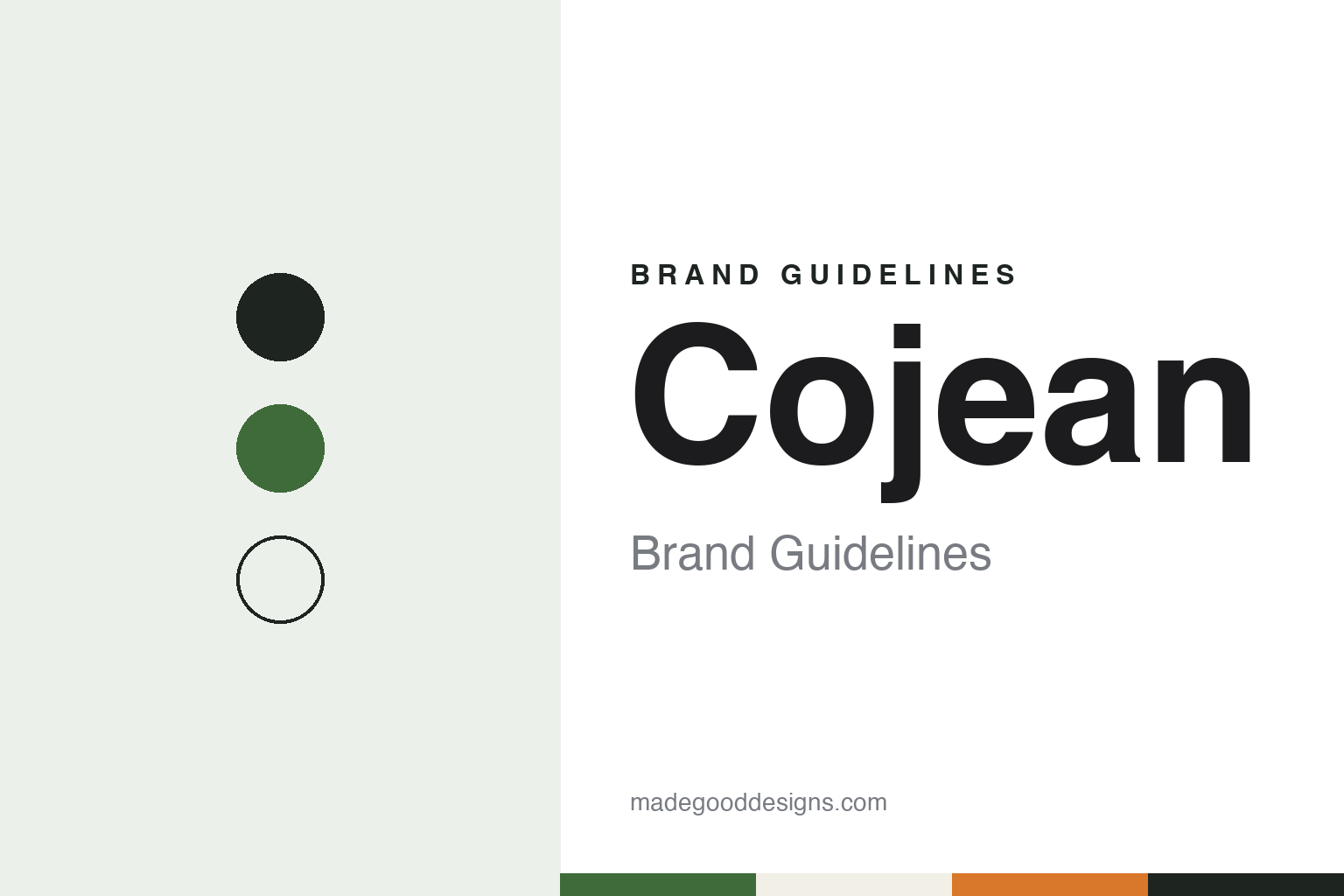
Cojean Brand Guidelines
A 2001 Madeleine lunch counter and its own Paris kitchen.
Aa
Two constants: a leaf green, linen and carrot palette and a Clean sans register. Abstract homage — not a Cojean product or mark; no shopfront, logo or packaging is reproduced.
La Madeleine, 2001
A lunch counter near a Paris church square.
Cojean opened its first restaurant in Paris in November 2001, near the place de la Madeleine, Le Figaro reported in April 2011. Defense-92, a local news site for the La Défense business district, named the founders in January 2010 as Alain Cojean, Frédéric Maquair and Jean-Philippe Christol. French Wikipedia says Alain Cojean set up the company in 2000 and opened the first restaurant the following year. Before that, Le Figaro said, he had run research and development at McDonald’s France, and left to start a different kind of quick-service restaurant: upmarket, with 35 to 40 per cent of the menu vegetarian, according to the paper in 2011.
Growth was steady rather than fast. The 17th Cojean opened on 11 January 2010 in the newly renovated CNIT, the vaulted exhibition hall at La Défense, Defense-92 reported; it covered about 200 square metres, had about 80 seats and also sold food to take away. By April 2011 there were 19 restaurants and some 450 staff, according to Le Figaro, which said the company had opened about two restaurants a year since it began, all of them company-run. French Wikipedia, citing the French press, says the chain later reached some thirty-five addresses in Paris and London.
The kitchen has always been at the centre of the business. In 2010 Defense-92 reported that about 30 of the company’s 300 staff prepared the dishes that were then delivered to the restaurants. In 2011 Le Figaro described a central kitchen receiving a tonne of fresh fruit and vegetables every day, and quoted Alain Cojean on the point: the company grates its own carrots. That model — one kitchen supplying a ring of small restaurants — has stayed in place as the network has grown.
Colour
Soups, salads and a seasonal menu.
The range is lunch-led and changes with the seasons. Defense-92 listed mini-sandwiches, quiches, soups and salads in 2010; Le Figaro in 2011 named salads, soups and hot dishes, often made with organic produce. The company’s website in November 2026 organises the menu around a seasonal card — an autumn menu at the time of writing — a brunch offer and hot dishes, with a coffee-shop range of lattes and matcha alongside. Among recent additions the company lists a ceremonial-grade organic matcha selected with the Paris pastry and coffee house La Main Noire.
The format was quickly copied. Defense-92 wrote in 2010 that the concept had inspired other Paris chains, naming Jour and Naked among them. The same report described Cojean as present only in Paris and its surrounding area, said many of its products, among them the bread and the fruit, were organic, and added that the founders did not want that to become a marketing argument for franchising. Le Figaro reported in 2011 that the company had, by the founder’s account, received more than 2,000 franchise requests in France and abroad and turned them down, preferring to keep control of its capital, its management and its kitchens.
The map shows it. The company’s restaurant finder lists 40 restaurants as of November 2026, most of them in Paris, under names such as Madeleine, Opéra and Bourse, with others in Levallois, Neuilly, Saint-Ouen, Suresnes and La Défense. No London address appears in that list. The company’s website also describes Le Petit Café par Cojean, a café inside the Fondation Cartier pour l’art contemporain on the place du Palais-Royal, in a Haussmann-era building reworked by the architect Jean Nouvel, open to visitors with a museum ticket.
Typography
Bakery names and the quick lunch.
Europe’s bakery, sandwich, coffee and pizza chains present themselves first through the shop: the fascia over the door, the counter, the bags and cups, and the names of the products on the menu board. Chains in France, Spain, Belgium, Germany and Finland publish their menus by named ranges, such as sandwiches, salads, pastries and coffee, and their websites usually add a store finder, a loyalty app and a section for prospective franchisees.
Many of these brands sit inside larger groups, and ownership is often the clearest way to read their history. The Barcelona sandwich chain Pans & Company passed from the Catalan food group Agrolimen to the Portuguese restaurant group Ibersol in October 2016, according to Ibersol. In 2014, the agricultural trade paper Agra reported that the industrial baker Neuhauser owned two quick-service chains, Pomme de Pain in France and Crobag in Germany, as the grain group Soufflet took control of it. Pomme de Pain later went back to independence when its managers bought it from InVivo in July 2023, Réussir reported.
Shop networks are published by the companies and counted by the trade press, and the counts change. Franchising can carry a brand abroad, sometimes through a master franchise for a whole country, as Pomme de Pain did in Morocco and Tunisia, according to French Wikipedia; airport and railway-station sites can form a separate channel, such as the travel division through which Ibersol runs Café Pans counters in Spanish airports. A chain’s count of restaurants is therefore always a figure for a given date.
Identity changes are usually reported in the trade press when a refit is unveiled: a new logo, a new typeface, new uniforms and a pilot shop in a symbolic location. This guide sets out what can be checked about each brand, who founded it, who owns it and how its shops and packaging have changed, and attributes claims to the company where they rest on its own word.
Aa
A clean, rounded sans for a lunch counter. (Specimen set in Outfit, a sans STAND-IN; NOT the Cojean logo.)
Cojean today
From a founder-led firm to a wider shareholding.
Cojean was never a one-person company. In April 2011 Le Figaro reported that Alain Cojean and two partners held 51 per cent of the capital, that the investment company Pléiade Investissement held nearly 40 per cent and had backed the business from the start, and that the fund IDI held 6 per cent.
The founder later stepped back. French Wikipedia, citing Les Échos in September 2017, says Alain Cojean sold the company in 2017 while remaining its chairman, and that restaurant managers were given the chance to become shareholders; it says he left the chairmanship in 2019. The business has kept its founder’s surname as its brand, and the company’s website still dates its approach to the start of the century, describing a recipe that has guided it for 25 years.
For designers, Cojean is a case of a restaurant name that is also a person’s name, used plainly. There is no mascot and no invented word: the surname, a seasonal menu and a recognisable lunchtime ritual carry the brand from the Madeleine to the Fondation Cartier. The restaurants are small and city-centre, so the identity has to work on a narrow shopfront, a takeaway bag and a menu board read in a queue, and to signal freshness without a long list of claims.
For a design guide, Cojean shows how a compact, company-run network built around one central kitchen can keep a short, consistent visual vocabulary across 40 Paris-area restaurants. Compare the Pret A Manger brand guidelines, the London sandwich chain, and the Exki brand guidelines, a Belgian quick-service chain. For this guide we use leaf green, linen and a carrot orange with a sans, an unofficial interpretation; no product or logo is reproduced.
Explore & save
Keep Cojean’s identity on hand — save it to a board in the Made Good inspiration library.
Cojean identity set
Pin the leaf green, linen and carrot palette and the Clean sans register to your own board.
Source & notes
Frequently Asked Questions
What font can I use to match the Cojean look?
This guide describes Cojean’s type as “A clean, rounded sans for a lunch counter”. Its type specimen is set in Outfit from Google Fonts as a stand-in; Outfit is not Cojean’s own lettering.
What colours are in the Cojean palette?
This guide’s Cojean palette is Leaf green #3F6B3A, Ink #1E2420, Linen #F1EFE6, Carrot #D9772B and Paper #FAFAF6. The tones are the guide’s own unofficial interpretation, not official Cojean hex codes.
When was Cojean founded?
Cojean was founded in November 2001, in Paris, place de la Madeleine.
Who founded Cojean?
Cojean was founded in November 2001 by Alain Cojean, Frédéric Maquair and Jean-Philippe Christol.


