Pomme de Pain Brand Guidelines
A 1980 rue de Rivoli sandwich chain and its owners.
Aa
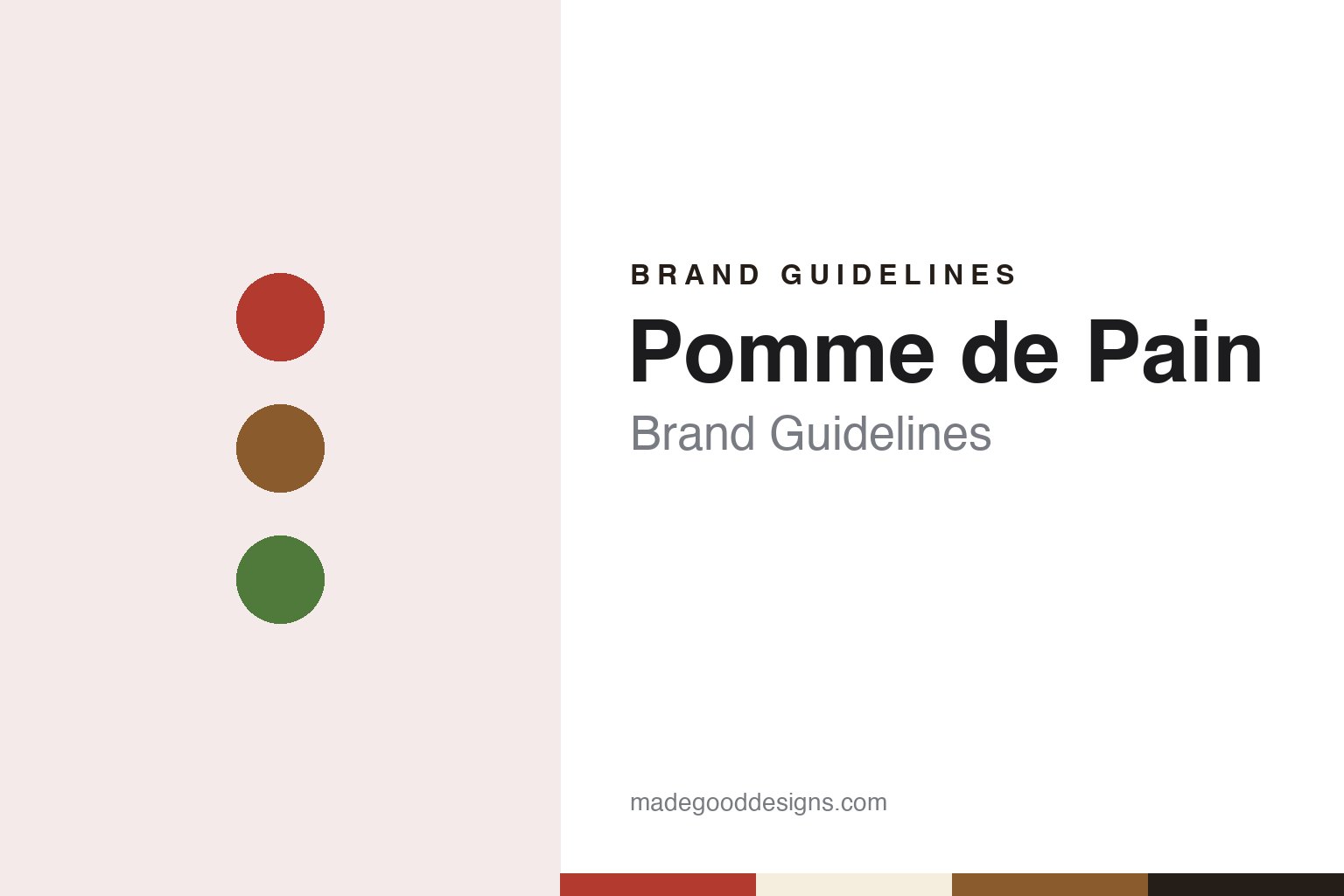
Two constants: an apple red, crust brown and cream palette and a bistro serif register. Abstract homage — not a Pomme de Pain product or mark; no logo, bag or shopfront is reproduced.
Rue de Rivoli
A Paris sandwich counter with a long line of owners.
Pomme de Pain is a French chain of sandwich restaurants whose first shop opened on the rue de Rivoli in Paris in 1980, French Wikipedia says. It names three founders, Laurent Caraux, Bernard Vaillant and Pierre Truchet, and says they came back from a trip to the United States with the idea of joining American quick service to French cooking. Its timeline continues with Lyon in 1983 and a restaurant on the Champs-Élysées in 1988.
The chain then passed through a long line of owners. French Wikipedia says the catering and concessions group Elior bought it in 1998 and opened its first motorway sites; that the investment fund Finama took it over in 2004; that the first franchised restaurant opened on the boulevard du Montparnasse in Paris in 2005; and that master franchises followed abroad, in Morocco in 2008 and Tunisia in 2012.
By 2014 the chain belonged to Neuhauser, a family-run industrial bakery group from Moselle. When the grain trader and processor Soufflet announced on 3 June 2014 that it was taking a majority holding in Neuhauser, after clearance from France’s competition authority on 27 May, the agricultural trade paper Agra reported that Neuhauser’s business included two fast-food chains with 250 outlets between them: Pomme de Pain in France and Crobag in Germany. Soufflet had been a shareholder in Neuhauser since 2011, Agra said, and the group’s statement, as quoted by the paper, described Neuhauser as a maker of bread, viennoiserie and pastry with 18 industrial sites in France and Portugal. The agricultural cooperative group InVivo took over Soufflet in 2021, and with it the sandwich chain, Toute la Franchise and Réussir reported in August 2023.
Colour
Made to order, in a run of shop concepts.
The offer has centred on the sandwich made to order. The company’s website says its sandwiches are prepared when ordered so that they stay crisp, and French Wikipedia lists salads, hot and cold drinks, pastries, viennoiseries and desserts alongside them, adding that more than 80 per cent of recipes are made on site. French Wikipedia also says the brand uses organic coffee and tea, bread and viennoiserie made mostly with French wheat, Comté cheese, and pork, chicken and beef of French origin.
The shops have been reworked several times. French Wikipedia records a concept called “La Maison du Sandwich” in 2016 and a new one named “Renaissance” in 2023. In the summer of 2023 a pilot restaurant in Boulogne-Billancourt, just west of Paris, was testing a new model of restaurant, Réussir and Toute la Franchise reported, and the chain’s head office was then at Ivry-sur-Seine, according to Toute la Franchise.
One site shows the arc of the network. Pomme de Pain was long a fixture of the Westfield Les 4 Temps shopping centre at La Défense, the business district west of Paris, the local news site Defense-92 reported in February 2026: at its peak in the 2000s the chain had up to half a dozen outlets in the district, before narrowing to a single restaurant there, which had recently taken on the brand’s new image. At that date, Defense-92 said, the chain was present in France and Morocco.
Typography
Bakery, sandwich and café chains.
Europe’s bakery, sandwich, coffee and pizza chains present themselves first through the shop: the fascia over the door, the counter, the bags and cups, and the names of the products on the menu board. Chains in France, Spain, Belgium, Germany and Finland publish their menus by named ranges, such as sandwiches, salads, pastries and coffee, and their websites usually add a store finder, a loyalty app and a section for prospective franchisees.
Many of these brands sit inside larger groups, and ownership is often the clearest way to read their history. The Barcelona sandwich chain Pans & Company passed from the Catalan food group Agrolimen to the Portuguese restaurant group Ibersol in October 2016, according to Ibersol. In 2014, the agricultural trade paper Agra reported that the industrial baker Neuhauser owned two quick-service chains, Pomme de Pain in France and Crobag in Germany, as the grain group Soufflet took control of it. Pomme de Pain later went back to independence when its managers bought it from InVivo in July 2023, Réussir reported.
Shop networks are published by the companies and counted by the trade press, and the counts change. Franchising can carry a brand abroad, sometimes through a master franchise for a whole country, as Pomme de Pain did in Morocco and Tunisia, according to French Wikipedia; airport and railway-station sites can form a separate channel, such as the travel division through which Ibersol runs Café Pans counters in Spanish airports. A chain’s count of restaurants is therefore always a figure for a given date.
Identity changes are usually reported in the trade press when a refit is unveiled: a new logo, a new typeface, new uniforms and a pilot shop in a symbolic location. This guide sets out what can be checked about each brand, who founded it, who owns it and how its shops and packaging have changed, and attributes claims to the company where they rest on its own word.
Aa
A warm bistro serif, our choice for a Paris sandwich counter. (Specimen set in Fraunces, a serif STAND-IN; NOT the Pomme de Pain logo.)
Independence and reorganisation
A management buyout, then a court-supervised restructuring.
In 2023 InVivo let the brand go. Four members of the management team, the chief executive who had joined in July 2020 and the directors in charge of finance and administration, of marketing and communication, and of operations, bought the brand from InVivo with effect from 28 July 2023, in a transaction approved by the commercial court of Créteil, Réussir reported on 18 August 2023. Toute la Franchise described Pomme de Pain as independent from that date, and reported that the new owners had announced a series of meetings, at the Boulogne-Billancourt pilot restaurant, at the head office and by video, to set out their strategy for the brand. At the end of 2023 the network counted 108 restaurants, according to French Wikipedia.
The years that followed were a period of contraction. On 1 February 2026 Defense-92, citing the trade site Snacking, reported that the company had asked the commercial court in Nanterre to place it in redressement judiciaire, the French court-supervised reorganisation procedure, in order to complete its restructuring. Since the 2023 buyout, the report said, the network had shrunk from 108 to 36 restaurants as the management cleared out sites, repositioned the brand and worked on new products aimed at younger customers; the company said it still carried contracts and overheads designed for more than a hundred units; 24 franchisees had been secured, the site added. The official bulletin of commercial notices, BODACC, records the judgment opening the procedure at the economic activities court of Nanterre on 4 February 2026. French Wikipedia puts the network in January 2026 at 36 restaurants, 12 run by the company and 24 by franchisees. As of February 2026 the chain was trading under the procedure, according to Defense-92.
For a design guide, Pomme de Pain shows how a French sandwich name has been carried through a long run of owners and shop concepts since 1980, from a single counter on the rue de Rivoli to motorway, shopping-centre and franchised sites. Compare Brioche Dorée, another French bakery-café chain, and Pans & Company, the Barcelona sandwich chain that opened in 1991. For this guide we use an apple red, a crust brown and a crumb cream with a serif, an unofficial interpretation; no product or logo is reproduced.
Explore & save
Keep Pomme de Pain’s identity on hand — save it to a board in the Made Good inspiration library.
Pomme de Pain identity set
Pin the apple red, crust brown and cream palette and the bistro serif register to your own board.
Source & notes
Frequently Asked Questions
What font can I use to match the Pomme de Pain look?
This guide describes Pomme de Pain’s type as “A warm bistro serif, our choice for a Paris sandwich counter”. Its type specimen is set in Fraunces from Google Fonts as a stand-in; Fraunces is not Pomme de Pain’s own lettering.
What colours are in the Pomme de Pain palette?
This guide’s Pomme de Pain palette is Apple red #B23A2E, Crust brown #8A5B2C, Crumb cream #F5EEDF, Leaf green #4F7A3C and Ink #241D18. The tones are the guide’s own unofficial interpretation, not official Pomme de Pain hex codes.
When was Pomme de Pain founded?
Pomme de Pain was founded in 1980 (rue de Rivoli), in Paris, France.
Who founded Pomme de Pain?
Pomme de Pain was founded in 1980 (rue de Rivoli) by Laurent Caraux, Bernard Vaillant and Pierre Truchet.