La Anónima Brand Guidelines
A 1908 Patagonian trading house turned supermarket chain.
Aa
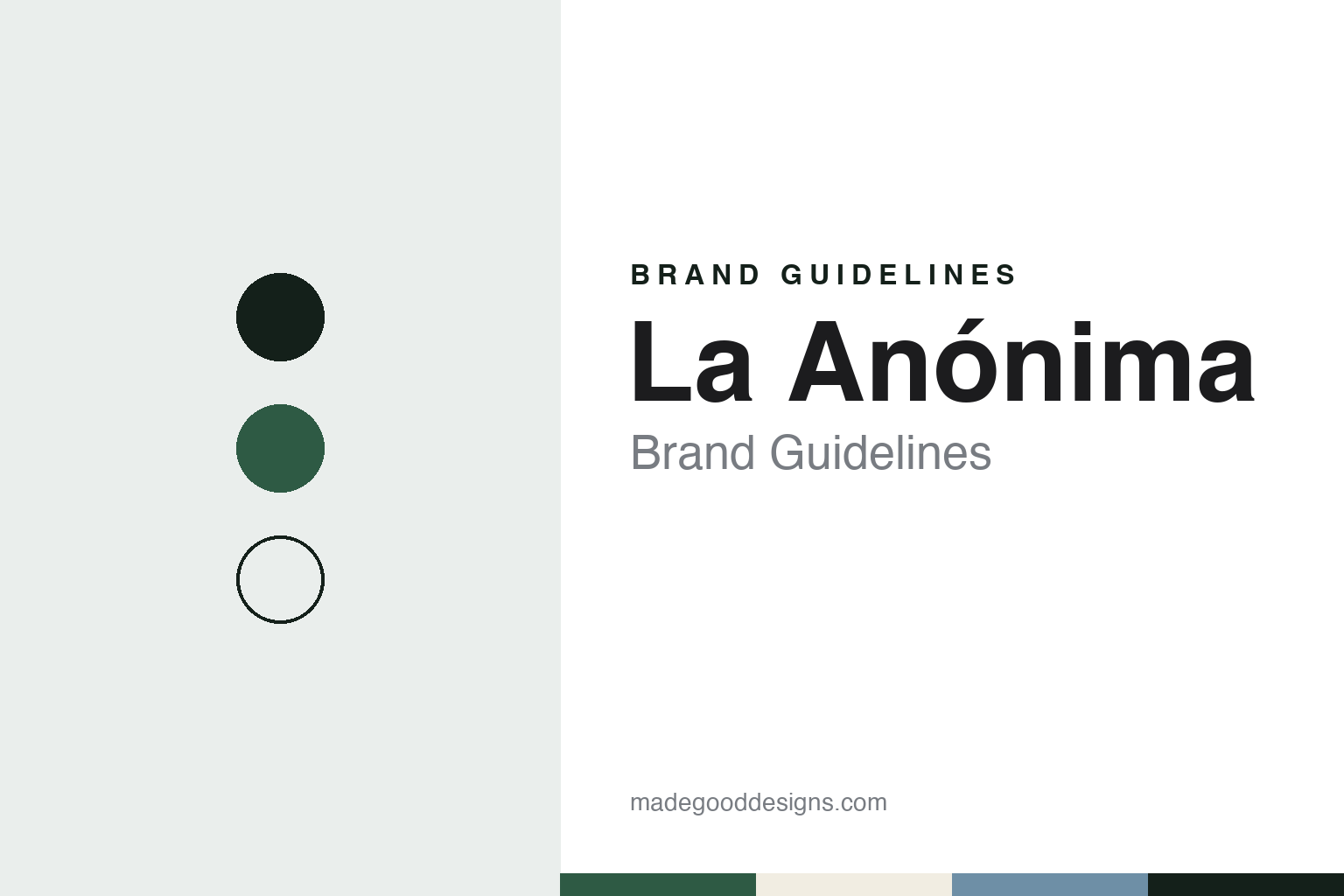
Two constants: a steppe green, wool cream and wind blue palette and a Plain grotesque register. Abstract homage — not a La Anónima product or mark; no sign, logo or store front is reproduced.
The Anonymous Company
Two trading houses, one long name.
La Anónima began as a merger of trading houses at the far south of the Americas. On 10 June 1908, according to a chronology published by Memoria Chilena, the heritage site of the National Library of Chile, the merchants behind the house of José Menéndez and the firm of Braun & Blanchard signed a contract that fused their businesses into one company: the Sociedad Anónima Importadora y Exportadora de la Patagonia. The two houses had competed for the trade of Argentine Patagonia, run from Punta Arenas in Chile, which Memoria Chilena describes as the economic centre of the whole region at the end of the nineteenth century.
English Wikipedia names José Menéndez, Mauricio Braun and Gastón Blanchard as the partners, and says the company was first based in Punta Arenas, passed into Argentine jurisdiction in 1910 and moved its head office into Argentina in 1918. Spanish Wikipedia names Menéndez and Mauricio Braun as its founders and gives Trelew, in Chubut, among the towns where it began. Mauricio Braun was president of the company until 1932, when Carlos Menéndez Behety succeeded him, both encyclopaedias say.
The nickname came from the name itself. English Wikipedia says the company’s full title was so long that people in Patagonia simply called it “La Anónima” — “the anonymous one,” from the Spanish for a limited company — and the name stuck. English Wikipedia still describes S.A. Importadora y Exportadora de la Patagonia as doing business as La Anónima.
The early business was not a supermarket. By 1911, English Wikipedia says, it ran general stores in a warehouse format and a fleet of its own, with passenger and cargo lines between Buenos Aires and Punta Arenas calling at Argentine Patagonian ports; by 1929 it had 25 branches across southern Argentina and four ships. From 1929 to 1968 it published a magazine, La Argentina Austral. In 1942 it opened its capital to the public, and its shares have traded on the Buenos Aires stock exchange since then, under the ticker PATA.
Colour
From general stores to supermarkets.
The company reached well beyond shops. In 1957, La Anónima and other partners created the airline Austral Líneas Aéreas, whose name reflected the southern identity of its owners, both encyclopaedias say; Spanish Wikipedia says La Anónima owned it until 1980, when it sold its shares to the Argentine state.
The turn to supermarkets came in the late 1960s. From 1967 the company sold off ships, warehouses and many buildings, and the same year it began converting its stores to the supermarket format, starting with Trelew; the change was complete by 1971, English Wikipedia says. In the early 1980s the shareholding was concentrated again in the Braun family, which took over the running of the business and, English Wikipedia says, adopted a new corporate identity alongside a growth plan for the Patagonian region.
Expansion came through formats and purchases. In 1991 it opened a small chain of convenience stores in Buenos Aires, which it sold to Carrefour in 2010; it kept that chain’s name as one of its own-label brands. In 2005 it bought the Quijote supermarkets of Santa Fe province from the Williner family, later reopening the remaining stores as La Anónima. In November 2014 it agreed to buy the Neuquén chain Topsy, with its subsidiary Bomba, and took over the stores from 2 February 2015, Spanish Wikipedia says. The company also runs meat-packing plants, and took full control of the Pampa Natural plant in 2017, according to English Wikipedia; it launched its own credit card in 2009.
In 2026 the chain moved into the centre and north of the country. On 18 March 2026, Infobae reported, La Anónima and Grupo Libertad agreed that La Anónima would take over 12 Libertad hypermarkets, a logistics centre and more than 1,600 employees — four stores in Córdoba, two in Tucumán, and others in Rosario, Salta, San Juan, Rafaela, Posadas and Santiago del Estero. Libertad had been part of the Salvadoran Grupo Calleja since early 2024, the paper reported. According to iProfesional, the stores passed to La Anónima on 28 May 2026, closed briefly for new signs, systems and shelving, and reopened under the La Anónima name in stages in the first half of June.
Typography
Supermarkets of the Southern Cone.
Colombia, Peru and Argentina have large retail chains that grew from a single shop into national networks, and most of them present themselves first through their formats. A company’s own pages usually set out its hypermarkets, supermarkets, discount stores, department stores, home-improvement centres and pharmacies as separate banners, each with its own name and fascia. In Colombia, Olímpica’s formats were listed in 2024 by El Heraldo as supertiendas, superalmacenes, superdroguerías and droguerías, while Grupo Éxito runs the Éxito and Carulla banners and the Viva shopping centres, according to Spanish Wikipedia.
Own-label ranges carry much of the identity inside the shop. Grupo Éxito sells its own clothing labels, People, Arkitect and Bronzini, El Colombiano reported in March 2024, and Olímpica has private labels across supermarket, textile, appliance, technology and home categories, according to El Heraldo. Seasonal campaigns, printed leaflets and anniversary promotions are published on the chains’ websites next to store finders and online shops.
Ownership is part of the story, and it often crosses borders. Grupo Éxito passed from the French group Casino to the Salvadoran Grupo Calleja through tender offers that closed in January 2024, according to the company’s own filing, and in March 2026 its Argentine subsidiary agreed to hand twelve stores to the Patagonian chain La Anónima. Several Peruvian chains belong to wider groups, and each guide here names the owner with the date a source gives.
Corporate pages fill in the rest: founders and founding dates, stock-exchange listings and investor filings, and the family holding companies behind many of the chains. This guide sets out what can be checked about each brand from dated press, registers and the companies’ own filings, and keeps company descriptions marked as the company’s own word.
Aa
A plain grotesque for a long company name. (Specimen set in Archivo, a sans STAND-IN; NOT the La Anónima logo.)
La Anónima
A southern chain moving north.
The chain is still run by the Braun family. In October 2026, the regional business site InfoNegocios reported the opening of La Anónima’s 184th branch, at Bell Ville in Córdoba province, which made it the 99th city in the company’s network. Before that opening, the site reported, La Anónima had 183 branches in 98 cities across 16 provinces, all of them outside the city of Buenos Aires. It described Federico Braun, the company’s president, as a member of the fourth generation of the founding family, sharing the running of the business with his son, general manager since 2020. Spanish and English Wikipedia give the head office as Ituzaingó, in Buenos Aires province.
The stores carry own-label ranges. InfoNegocios reported more than 1,000 products under the La Anónima name and its second own brand, alongside a meat counter supplied from the company’s own production chain. Around the shops sit a closed-loop store card, Tarjeta La Anónima, a loyalty programme called PLUS, an app, and an online store that has run for about ten years, with in-store pick-up, the site reported.
The pattern is one of growth from south to north. A company that began as a Patagonian trading house, with ships, warehouses and general stores, became a regional supermarket chain in the 1970s and, with the Libertad stores in 2026, a chain with branches from Patagonia to Salta and Posadas. Its own name, a nickname for a long legal title, became its brand.
For a design guide, La Anónima shows how a plain nickname can carry a company for more than a century. Compare Coto, a Buenos Aires chain that grew from butcher shops, and Carrefour, which bought its convenience stores in 2010. For this guide we use a steppe green, a wool cream and a wind blue with a sans, an unofficial interpretation; no product or logo is reproduced.
Explore & save
Keep La Anónima’s identity on hand — save it to a board in the Made Good inspiration library.
La Anónima identity set
Pin the La Anónima steppe green, wool cream and wind blue palette and the Plain grotesque register to your own board.
Source & notes
Frequently Asked Questions
What font can I use to match the La Anónima look?
This guide describes La Anónima’s type as “A plain grotesque for a long company name”. Its type specimen is set in Archivo from Google Fonts as a stand-in; Archivo is not La Anónima’s own lettering.
What colours are in the La Anónima palette?
This guide’s La Anónima palette is Steppe green #2E5A44, Ink #14201A, Wool cream #F1EDE2, Wind blue #6E8FA6 and Paper #F9F8F4. The tones are the guide’s own unofficial interpretation, not official La Anónima hex codes.
When was La Anónima founded?
La Anónima was founded in 1908 (merger), in Punta Arenas and Patagonia.