Waldo’s Brand Guidelines
A 1999 Tijuana dollar store that grew into a 900-branch chain.
Aa
Two constants: a Waldo’s shelf red and marigold palette and a Rounded sans register. Abstract homage — not a Waldo’s product or mark; no sign, logo or packaging is reproduced.
Waldo’s Holdings
A US company and a border city.
Waldo’s is a Mexican chain of discount shops that began as a dollar store. Its Mexican story starts in Tijuana, the border city in Baja California, in 1999, according to Alto Nivel in April 2024 and Infobae in December 2023. Infobae reported that the business was set up as Waldo’s Holdings, a US company formed in 1998, only a year before it reached Mexico, and that its Mexican arm traded as Waldo’s Dollar Mart de México, a subsidiary of that holding company. The company writes its name with an apostrophe, Waldo’s, and Spanish Wikipedia gives its full trading name as Waldo’s Dolár Mart de México.
The idea was simple and borrowed from north of the border. Infobae described how single-price shops had become popular in the United States in the last decades of the twentieth century, selling household goods, school and office supplies, hobby items and food at one fixed price, and how, after the North American free-trade agreement came into force in the 1990s, chains of this kind began to open in Mexico, especially in the northern states. Waldo’s, it said, set out to compete with the large supermarkets on the promise that everything in the shop cost the same.
Growth was quick. Alto Nivel listed 46 stores by 2001, opened in several parts of the country, and in 2006 the chain opened two distribution centres in Tijuana and one in San Martín Obispo, in the State of Mexico, giving it warehouse space both at its starting point on the border and near the capital. Spanish Wikipedia adds that from 2002 the chain spread well beyond Baja California, into states such as Nuevo León, Jalisco, Puebla, Veracruz and Mexico City.
Colour
From one price to many.
The single price did not last. Spanish Wikipedia says that in 2012 Waldo’s stopped selling everything at one price and moved to a range of price points, adding goods such as speakers, hardware tools and pet products, and a clothing line under the Eleczion name. The same year brought new money. According to Alto Nivel, Waldo’s received a capital injection in 2012 from new partners and from Grupo Vizion, and in 2014 those partners and Grupo Vizion took control of the business, bringing in Eleczion, a chain of 298 stores, under the same umbrella.
Grupo Vizion remains the owner. El Siglo de Torreón described it in June 2026 as a private investment group with interests in retail, manufacturing, commerce and real estate, and said its management had been central to the chain’s expansion. Spanish Wikipedia records that in 2017 the company created a smaller format, Waldo’s Express, in premises that had once been Exprezión or Eleczión shops, together with a loyalty card.
What the shops sell has widened with each step. El Siglo de Torreón listed household goods, groceries, decoration and clothing, including the Eleczion label, and said the chain had added a much larger range of imported Asian products — drinks, ramen, biscuits and sweets — as well as services such as remittance payments at the till. Alto Nivel dated the chain’s online shop to 2020 and its own mobile app to 2021, and reported that from 2022 the range took in electric bicycles, motorcycles and ride-on toys.
Motorcycles became a format of their own. Forbes México reported in May 2023 that Waldo’s had begun selling motorcycles in 2022 through its website and some of its shops, and had then opened stores devoted only to them, under the name Waldo’s Motos, in towns in the Bajío and in western and south-eastern Mexico. At that point, the magazine said, motorcycles were on sale in 160 branches, in about 30 models aimed at delivery work, leisure and everyday transport, under the Vento and Kiwo brands, with credit offered on them.
Typography
Design and documentation.
Mexican supermarket, pharmacy, discount and footwear chains tend to show their identity less through one logo than through a family of names. A grocer may run a hypermarket, a supermarket, a warehouse store and a neighbourhood shop side by side, and the format names do the sorting: a prefix or suffix such as Híper, Súper, Mercado or Express, or a diminutive for the smallest stores, tells shoppers what size of shop to expect before they walk in.
Promotions and own programmes carry weight too. Seasonal campaigns with their own names, loyalty cards and printed or online flyers appear on the companies’ own pages as part of how the stores present themselves, and some promotion names have outlived the chains that created them, moving with the stores when they changed hands. Mascots, catalogues and house ranges play a similar role for pharmacy and footwear sellers, and a guide can describe them only as the companies publish them.
Ownership is usually stated plainly. Several of these groups began as family shops in a single city and still describe their founders, holding companies and stock-exchange listings on corporate pages; takeovers between rivals recur, and a store can carry several names over its life. Regulators have a part in that story: competition reviews can decide which stores a buyer may keep.
For a designer, the useful lesson is the system rather than any single mark: how a palette, a sans and a set of format names can scale from a large hypermarket to a corner store without losing the parent name. In this guide the palette and type are an unofficial interpretation; no logo, fascia or product is reproduced.
Aa
A rounded sans — a name with its apostrophe. (Specimen set in Rubik, a sans STAND-IN; NOT the Waldo’s logo.)
Waldo’s
A name with its apostrophe.
The store count is the clearest measure of how far the chain has come since Tijuana, and every figure needs its date. Spanish Wikipedia records the opening of the chain’s 400th shop in September 2019, at Tijuana airport, and its 500th in June 2022, in a shopping centre in Tizayuca, Hidalgo, a milestone also reported by El Universal. Forbes México reported that the chain opened its 800th store in early May 2023. In June 2026 El Siglo de Torreón put the total at more than 900 branches, spread across the country. Alto Nivel reported that the chain marked its 25th anniversary in 2024 with an event for customers in Tijuana, the city where it started.
The identity has changed with the business. The name still recalls the dollar-store origin, even though the shops long ago moved away from a single price. Spanish Wikipedia says that in February 2024 Waldo’s changed the look of its shop fronts and interiors and updated the lettering of its logo; the company has not published brand guidelines, and its colours and typefaces are not documented in the sources used here, so the palette in this guide is our own.
Two naming points matter for anyone writing about the chain. The apostrophe is part of the brand, so Waldo’s, not Waldos, is the form the company uses, while the web address drops it. And the chain uses several labels alongside the main name: Eleczion for clothing, Waldo’s Express for the smaller shops and Waldo’s Motos for motorcycles.
For a design guide, Waldo’s shows how a retail name can keep the memory of a pricing idea after the idea itself has gone, and how one name can stretch from a border dollar store to a national discount chain. Compare Bodega Aurrera, the discount banner of Walmart de México, and OXXO, another Mexican chain built on small shops close to home. For this guide we use a shelf red and a marigold with a rounded sans, an unofficial interpretation; no product or logo is reproduced.
Explore & save
Keep Waldo’s’s identity on hand — save it to a board in the Made Good inspiration library.
Waldo’s identity set
Pin the Waldo’s shelf red and marigold palette and the Rounded sans register to your own board.
Source & notes
Frequently Asked Questions
What font can I use to match the Waldo’s look?
This guide describes Waldo’s’ type as “A rounded sans — a name with its apostrophe”. Its type specimen is set in Rubik from Google Fonts as a stand-in; Rubik is not Waldo’s’ own lettering.
What colours are in the Waldo’s palette?
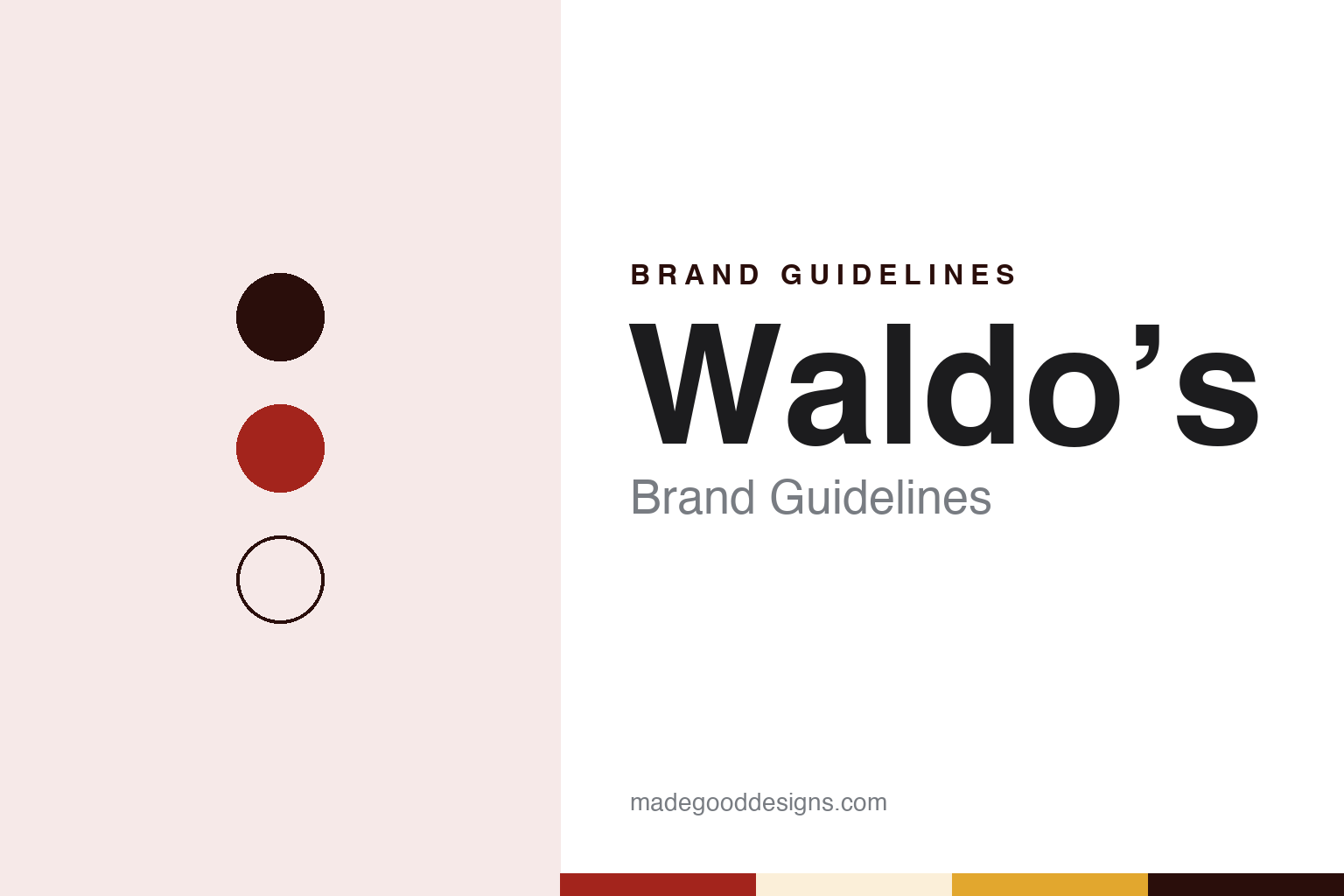
This guide’s Waldo’s palette is Shelf red #A3241C, Dark cocoa #2A0E0B, Cream #FBEFD9, Marigold #E2A72E and Paper #FCF8F2. The tones are the guide’s own unofficial interpretation, not official Waldo’s hex codes.
Who owns Waldo’s?
Waldo’s is owned by Grupo Vizion (control from 2014).