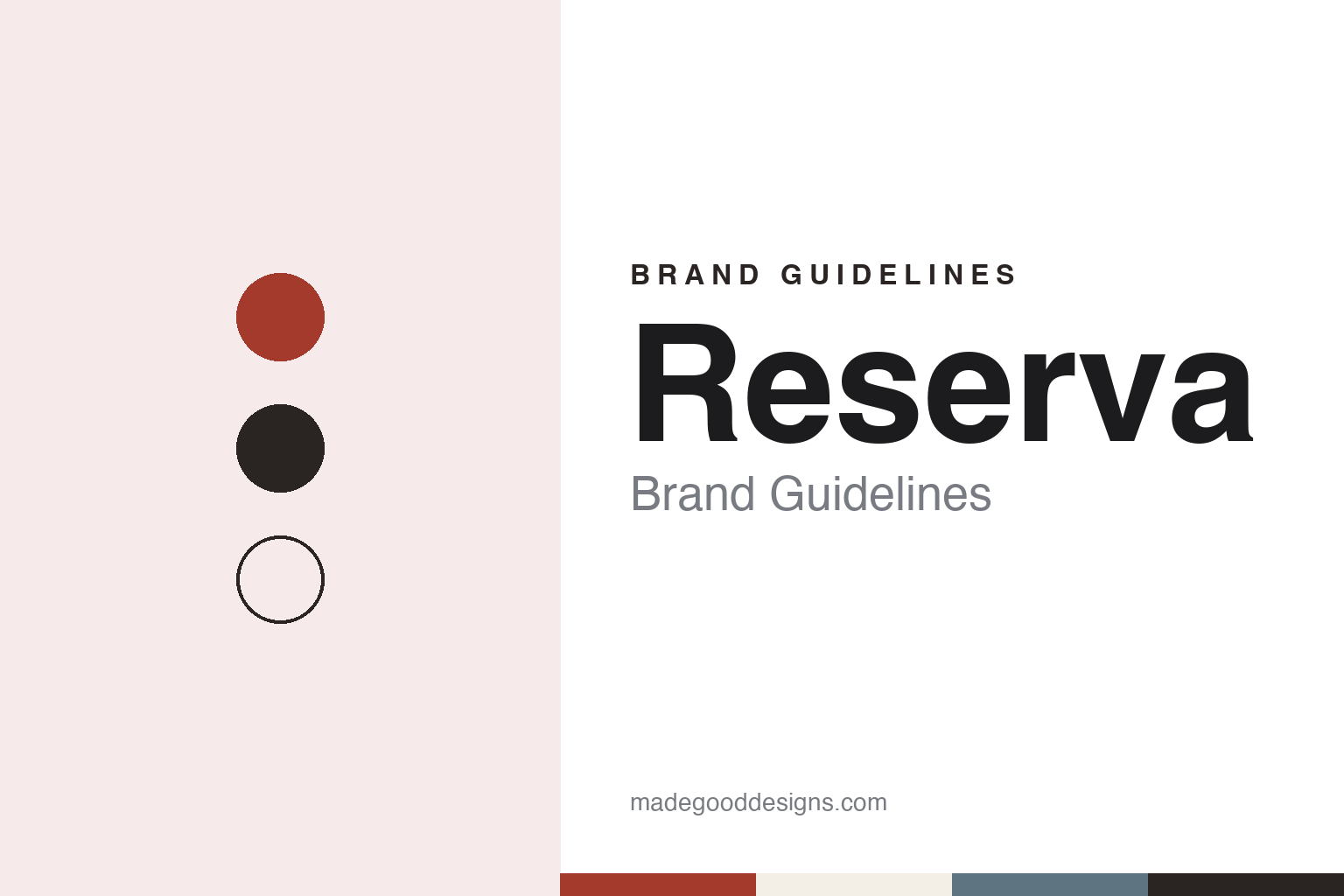
Reserva Brand Guidelines
A Rio shorts label that grew into a house of brands under one red woodpecker.
Aa
Two constants: a brick red, sand and slate palette and a bold grotesque sans register. Abstract homage — not a Reserva product or mark; no woodpecker, logo or garment is reproduced.
Five pairs of shorts
A gym, a beach name and a batch of 300 shorts.
Reserva is a menswear label from Rio de Janeiro. Its founders are Rony Meisler, a production engineer, and Fernando Sigal, who worked in advertising; they were childhood friends, according to Portuguese Wikipedia. Exame told the start of the story in January 2015: in 2006 the two noticed, at their gym, five men wearing near-identical shorts, and decided to test the demand for menswear even though neither came from fashion. Meisler, then working at the consultancy Accenture, had 300 pairs of shorts made, printed with the phrase “Be yourself, but not always the same,” the title of an album by the Brazilian rapper Gabriel o Pensador, and friends sold the lot.
The partners used the takings for a first collection of shorts and T-shirts and, Exame reported, left their jobs in 2006 to start the company, selling only wholesale at first. Meisler rented a car and went from one multibrand shop to the next with rails of samples. The same 2015 article says the first company store opened in Ipanema in 2006. Portuguese Wikipedia adds that the name honours the group’s favourite beach and that the business soon moved into a small studio in Gávea. Dates differ slightly across the press: a 2020 Exame report on the Arezzo deal gives the founding year as 2004, while Meisler himself was quoted by Mercado & Consumo in October 2020 as saying the company began “in 2006,” selling door to door. In September 2026 the brand held a party for its twentieth anniversary at the Museu do Amanhã in Rio, Exame reported.
Growth came through new labels. Portuguese Wikipedia dates a first show at São Paulo Fashion Week to 2008, alongside the first stores in São Paulo malls, and the children’s line Reserva Mini to 2009, followed by the women’s label Eva. By the end of 2014, Exame reported, Reserva had 36 company stores, five franchised stores and about 1,400 multibrand points of sale across 14 states.
Colour
A woodpecker on the chest.
The brand’s recurring sign is a bird. In January 2015 Exame described Reserva clothes carrying the red woodpecker (pica-pau) on the chest, and the magazine has since called the bird the brand’s historic symbol. The brand is willing to play with it: in October 2025, Exame reported, Reserva swapped the woodpecker for a tortoise on its social-media accounts to announce Reserva Sprint, a 40-piece athleisure line, with the tortoise used as a temporary symbol taken from the fable of the hare and the tortoise.
The woodpecker also groups the labels together. In March 2024 Exame visited Casa Reserva, a 250-square-metre store on the ground floor of the Morumbi mall in São Paulo that gathered the four labels carrying the woodpecker logo: Reserva itself, the women’s label Reversa, Reserva Mini and the footwear label Reserva Go. The store mixed these with items from other brands and licensed Reserva products such as glasses and helmets, and offered customisation and events.
The tone of the brand’s communication is part of its identity in the press. Exame in 2015 described it as frank and informal, and noted that Meisler’s business card replaced his job title with the word “sorridente” (smiling) written over a red scribble. Campaigns lean on humour and Rio culture: the twentieth-anniversary party, Exame reported, featured Buchecha, DJ Marlboro and the Baile Charme de Madureira.
Typography
Brazilian fashion and footwear.
Brazil’s fashion and footwear brands cover a wide range: rubber flip-flops and plastic jelly shoes, women’s shoes and handbags, beachwear and printed dresses, and men’s basics and denim. Many of them sit inside a small number of listed groups, and their corporate pages set out founders, owners and stock-market listings alongside the product ranges.
Footwear is led by large manufacturers. Alpargatas, founded in São Paulo in 1907, has made Havaianas since 1962, and Portuguese Wikipedia describes it as an Itaúsa company since its 2017 change of ownership. Grendene, founded in Farroupilha in 1971 and listed on the São Paulo stock exchange since 2004, makes Melissa, Ipanema and Rider, with plants in the north-eastern states of Ceará and Bahia, according to Portuguese Wikipedia.
Clothing and women’s shoes have consolidated too. Portuguese Wikipedia says Azzas 2154 was formed in 2024 from the merger of Arezzo&Co, the Belo Horizonte shoe group behind Arezzo and Schutz, and Grupo Soma, the Rio de Janeiro group built on Animale and Farm, which had bought Cia. Hering in 2021. Ownership in the sector changes often, so each guide in this series states its brand’s owner as a dated fact.
These brands present themselves through campaigns with well-known faces, collaborations with foreign labels and their own stores and brand spaces, from Galeria Melissa in São Paulo to Casa Ipanema in Rio de Janeiro. This guide sets out what can be checked about each brand — who founded it, who owns it and where it says its products are made — and marks clearly what rests only on the company’s own word.
Aa
A bold grotesque sans for a frank, informal brand voice. (Specimen set in Archivo, a sans STAND-IN; NOT the Reserva logo or woodpecker.)
Arezzo, Azzas, Soma
From founder-run label to a listed group, and a split.
Reserva stopped being independent in 2020. On 23 October 2020 the footwear group Arezzo&Co announced an agreement to take over the Grupo Reserva, Exame and Mercado & Consumo reported. The deal covered six labels — Reserva, Reserva Mini, Oficina Reserva, Reserva Go, Eva and Ink — and, at the time, a group with 78 company stores, 32 franchises and about 1,500 multibrand outlets. Arezzo&Co set up a lifestyle arm, AR&Co, with Meisler as chief executive, and kept Reserva’s head office in Rio. Exame later dated the completed purchase to the end of 2020.
In 2024 Arezzo&Co merged with Grupo Soma, owner of Farm, Animale and Hering. InfoMoney reported in May 2024 that the combined company would be renamed Azzas 2154, the number taken from a long-term phrase used by the controlling Birman family, and the merger took effect on 31 July 2024, according to Diário do Comércio. In August 2024, Mercado & Consumo reported, the four Reserva founders — Meisler, Sigal, Jayme Nigri Moszkowicz and José Alberto da Silva — said they would leave their executive posts at AR&Co in December 2024, when the contracts signed in 2020 ended; by then AR&Co also included Reversa, Oficina, Simples, Baw and Foxton.
The group is now being divided. On 2 September 2026 the two controlling blocs signed a binding agreement to split Azzas 2154 into two listed companies, Mercado & Consumo reported: Arezzo&Co, with shoes, bags and Hering, and Soma, with Animale, Reserva and its spin-off labels, Oficina and Foxton, while Farm Rio goes into a jointly owned company. Brazil’s competition authority, Cade, cleared the reorganisation without restrictions in October 2026, Diário do Comércio reported, but it still needs board and shareholder approval and a stock-exchange listing for Soma. The split was agreed in September 2026; not completed at the time of writing.
For a design guide, Reserva shows how one small, repeated animal mark can hold together a growing family of labels across menswear, womenswear, children’s clothes and shoes. Compare Animale, which is set to sit beside Reserva at Soma, and Hering, its partner in Azzas 2154. For this guide we use brick red, sand and slate with a sans, an unofficial interpretation; no product or logo is reproduced.
Explore & save
Keep Reserva’s identity on hand — save it to a board in the Made Good inspiration library.
Reserva identity set
Pin the Reserva brick red, sand and slate palette and the bold grotesque sans register to your own board.
Source & notes
Frequently Asked Questions
What font can I use to match the Reserva look?
This guide describes Reserva’s type as “A bold grotesque sans for a frank, informal brand voice”. Its type specimen is set in Archivo from Google Fonts as a stand-in; Archivo is not Reserva’s own lettering.
What colours are in the Reserva palette?
This guide’s Reserva palette is Woodpecker brick #A33A2C, Ipanema sand #E4D8C4, Atlantic slate #5E7480, Charcoal #2A2422 and Cotton white #F3EEE6. The tones are the guide’s own unofficial interpretation, not official Reserva hex codes.
When was Reserva founded?
Reserva was founded in 2006 (Exame, 2015); 2004 in a 2020 Exame report, in Rio de Janeiro, Brazil.
Who founded Reserva?
Reserva was founded by Rony Meisler and Fernando Sigal in 2006 (Exame, 2015); 2004 in a 2020 Exame report.
Who owns Reserva?
Reserva is owned by Azzas 2154 (since July 2024) (Split into Arezzo&Co and Soma agreed September 2026; not completed).