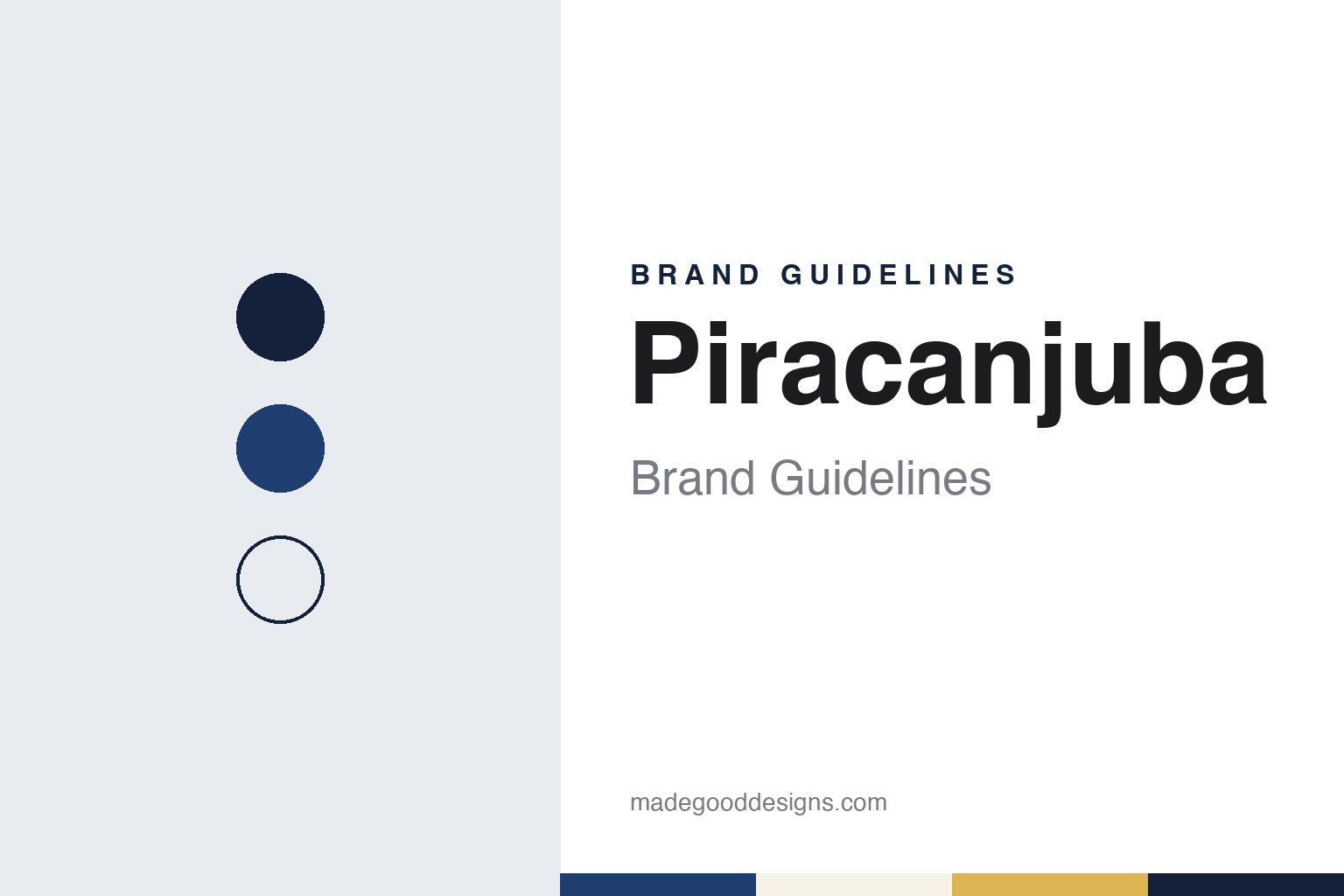
Piracanjuba Brand Guidelines
A 1955 Goiás butter maker named after a cerrado fish.
Aa
Two constants: a deep blue, milk white and butter yellow palette and a friendly rounded sans register. Abstract homage — not a Piracanjuba product or mark; no carton, logo or pack is reproduced.
A butter maker in Goiás
A town’s name, a Tupi word and a butter churn.
Piracanjuba began in 1955 as a butter maker in the town of Piracanjuba, in the interior of Goiás, about 80 kilometres from Goiânia. Exame reported in February 2026 that the business was backed by a small rural producer and named after its home town; the company’s own timeline calls the first firm Laticínios Piracanjuba. The name comes from Tupi-Guarani and refers to the piracanjuba, a fish of the Brazilian cerrado, the Recife business site Movimento Econômico reported in May 2025.
The business grew from the 1970s, when the Helou family took over its operation, Exame reported; in 1985 the brothers Cesar and Marcos Helou took charge. In 1986, according to the company’s timeline, the firm opened a plant in Bela Vista de Goiás and took that town’s name. The legal company is still Laticínios Bela Vista, while Piracanjuba is the brand. Portuguese Wikipedia gives the corporate name as Laticínios Bela Vista S/A: in January 2023 the farm paper O Presente Rural reported that the company had converted from a limited company into a privately held sociedade anônima, with no change to its ownership.
For decades the firm worked mainly with milk from Brazil’s Centre-West. From the 2000s, Exame reported, it began processing milk from other regions too, and the company lists plant purchases in Maravilha, Santa Catarina, in 2010, Governador Valadares, Minas Gerais, in 2014, and Sulina, Paraná, in 2017. In 2015 the brand marked its 60th anniversary.
Colour
Ninho, Molico and a national range.
The step that made the business national came in August 2019. Valor Econômico reported that Nestlé had announced the sale of its long-life (UHT) milk units in Brazil to Laticínios Bela Vista, ten years after building its first UHT plant in the country, and had licensed its Ninho and Molico brands to the Goiás company. The company’s timeline lists plants in Araraquara (São Paulo), Três Rios (Rio de Janeiro) and Carazinho (Rio Grande do Sul) for 2019, and Exame described three former Nestlé factories in those states as giving the business real weight. The group says it still sells Ninho and Molico UHT milk under licence, alongside a licence for Blue Diamond’s Almond Breeze, a partnership its timeline dates to 2018.
The range began with butter, which the company says is still in it. In May 2025 Movimento Econômico put the portfolio at about 200 products, among them UHT milk, condensed milk, cream, dairy drinks, cheeses, yoghurts, requeijão and butter, plus a lactose-free line. The company’s timeline adds screw-cap UHT cartons in 2008, a Piracanjuba Whey line in 2018 and the Piracanjuba Excellence line in 2022, the same year it records a packaging redesign. Another group brand, LeitBom, began in 1964 as a butter factory in Morrinhos and was bought by the group in 2015, the company says.
Advertising has leaned on a famous face. The singer Ivete Sangalo starred in Piracanjuba’s campaign for a second year in 2020, the O Povo advertising column reported that March. The film, created by the agency 4barra12, showed her shopping in a supermarket and spelling out the brand name syllable by syllable; it ran on national free-to-air television, backed by point-of-sale material and the brand’s social media. The company’s timeline also lists a 2024 sponsorship of the Brazilian Gymnastics Confederation.
Typography
Packaging, names and owners.
The food brands in this group sit on supermarket shelves across Brazil, Colombia and Argentina: milk, cheese, biscuits, coffee, sauces and other pantry staples bought week after week. Their identities are built for that setting. Cartons, tins, jars and packets carry the brand name in large type, named ranges sit under one master brand, and television campaigns often put a well-known face beside the pack, as Piracanjuba did with the singer Ivete Sangalo, according to the O Povo advertising column in 2020.
Many of these names began as small regional firms and took the name of a town, a region or a family. Piracanjuba is named after the Goiás town where it began as a butter maker in 1955, and that town’s name comes from a Tupi-Guarani word for a fish of the cerrado. A single company can also own several brands at once, some built from scratch and some bought in, as Grupo Piracanjuba does with Piracanjuba, LeitBom and Emana, according to Exame and the company.
Ownership takes several forms. Some brands belong to family-owned companies that do not publish accounts; others belong to listed food groups or to multinationals; and brands also move between owners through purchases, licences and court-supervised sales. Valor Econômico reported in 2019 that Nestlé licensed its Ninho and Molico milk brands to the company behind Piracanjuba, and Globo Rural reported in 2015 that Italac’s owner bought the Nilza brand after its former company’s bankruptcy.
This guide sets out what can be checked about each brand: who founded it, who owns it today, where it makes its products and how its range and campaigns are presented. Ownership changes are given with their dates, and anything that rests only on a company’s own corporate pages is attributed to the company.
Aa
A friendly rounded sans for a dairy brand named after a fish. (Specimen set in Figtree, a sans STAND-IN; NOT the Piracanjuba logo.)
Grupo Piracanjuba
From one butter plant to a national group.
In 2024 the company introduced a corporate name, Grupo Piracanjuba, which Portuguese Wikipedia dates to that year. In the same year, Exame reported, the group bought all of Emana, a supplements brand founded in 2021 by partners led by the actor Rodrigo Hilbert, who continues to run it. Since 2020 the group has also run its own online store and sold through marketplaces, the magazine added, though most of its sales still come through supermarkets and cash-and-carry stores. In February 2026 the magazine described the group as having nine plants in eight states, under its president, Luiz Claudio Lorenzo; the company names its administrative headquarters in Goiânia.
Expansion has continued. In May 2025 the group agreed to buy Natulact, a cheese maker in Nossa Senhora da Glória, Sergipe, which would be its first plant in Brazil’s North-East; at that date the deal was pending approval by CADE, Brazil’s competition authority, Movimento Econômico and O Povo reported. A new plant at São Jorge d’Oeste, in south-west Paraná, was already making cheese in February 2026, Exame reported, and O Presente Rural reported its inauguration in March 2026, with butter and cheese in its first stage.
In November 2026, after CADE approval, the group took over the dairy plant of a farmers’ cooperative in Morrinhos, Goiás, together with its Compleite brand, the retail title SuperVarejo reported, putting the group at 13 plants by that title’s count. The cooperative kept its other businesses and its role collecting milk from members. The agribusiness site AgFeed noted in April 2025 that Goiás is home to large dairy companies such as Piracanjuba and Italac.
For a design guide, Piracanjuba shows how a small-town butter maker can carry its town’s name, and a Tupi word, onto a national dairy range sold beside licensed multinational brands. Compare Italac, the other large dairy from Goiás, and Nestlé, whose Ninho and Molico UHT milk the group sells under licence. For this guide we use a deep blue, milk white and butter yellow with a sans, an unofficial interpretation; no product or logo is reproduced.
Explore & save
Keep Piracanjuba’s identity on hand — save it to a board in the Made Good inspiration library.
Piracanjuba identity set
Pin the Piracanjuba deep blue, milk white and butter yellow palette and the friendly rounded sans register to your own board.
Source & notes
Frequently Asked Questions
What font can I use to match the Piracanjuba look?
This guide describes Piracanjuba’s type as “A friendly rounded sans for a dairy brand named after a fish”. Its type specimen is set in Figtree from Google Fonts as a stand-in; Figtree is not Piracanjuba’s own lettering.
What colours are in the Piracanjuba palette?
This guide’s Piracanjuba palette is Cerrado deep blue #1D3E6E, Ink blue #13223A, Milk white #F6F2E8, Butter yellow #DDB451 and River teal #2F7472. The tones are the guide’s own unofficial interpretation, not official Piracanjuba hex codes.
When was Piracanjuba founded?
Piracanjuba was founded in 1955, in Piracanjuba, Goiás, Brazil. Piracanjuba is known for Butter, UHT milk, cheese, Piracanjuba Whey.