Fruco Brand Guidelines
The 1948 Cali tomato sauce that passed to CPC and Unilever.
Aa
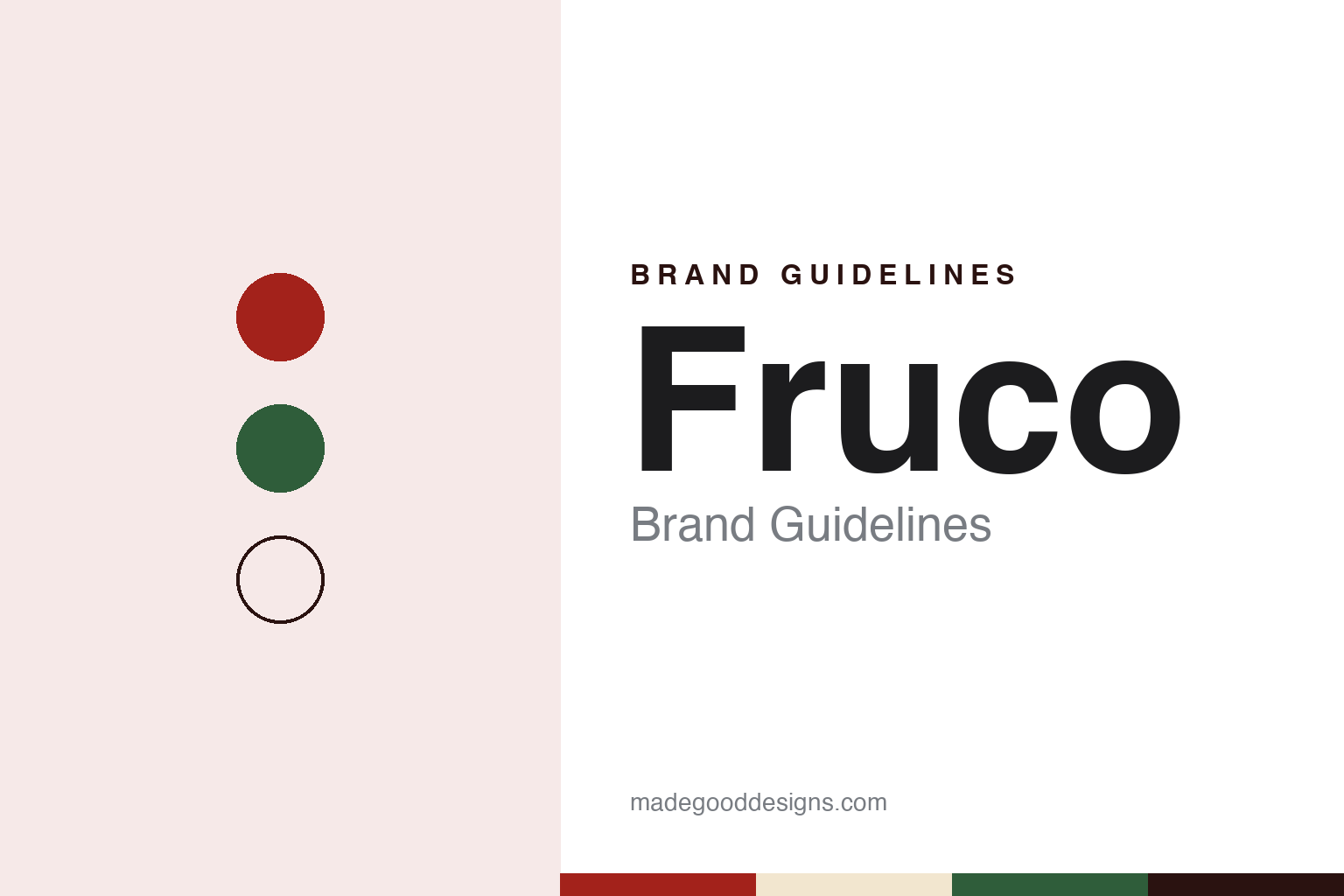
Two constants: a sauce red, leaf green and cream palette and a rounded kitchen sans register. Abstract homage — not a Fruco product or mark; no bottle, label, character or logo is reproduced.
Frutera Colombiana
Jams and vinegar in a Cali garage.
Fruco began in Cali, in Colombia’s Valle del Cauca, in 1948. Portafolio, the Bogotá business daily, reported in 2013 that the brand was founded by the company Frutera Colombiana, which started with a small range of jams and vinegar and, two years later, moved into tomato sauce and mayonnaise. A longer history in Portafolio in 2019 names the founder as Marco Leo Feldsberg, an Austrian with a background in agriculture and food production, and says he began in a garage in Cali’s Santander neighbourhood; the same paper spells the surname both Feldsberg and Felsberg, and Publimetro in 2025 calls him Leo Feldsberg.
The recipes came soon after. According to Portafolio in 2019, Feldsberg went into partnership in 1950 with Félix Zweig, a food engineer who developed the formulas for Fruco’s mayonnaise and tomato sauce; Publimetro describes Zweig as a chemist and says the two families worked on a thick tomato sauce meant for everyday Colombian dishes.
The brand reached its 65th anniversary in 2013, when Portafolio reported that Unilever was marking the date and pushing a new idea for the brand: using its sauces as cooking ingredients rather than only as table condiments. In November 2025 Publimetro reported on its 75th anniversary, describing a family venture in Cali that had become a fixture of Colombian kitchens.
Colour
Fruquita, glass bottles and named ranges.
Fruco’s identity has long leaned on a character. Portafolio reported in 2019 that in the 1950s the company made Fruquita the image of Fruco and began advertising through mass media, so the figure belongs to the brand’s first decade rather than to a later relaunch.
Packaging has changed more than once. In 2013 a Unilever marketing manager told Portafolio that the company had moved from the traditional glass bottle to plastic in the 1990s, presenting the switch as a matter of ease of use for home cooks. Glass came back for some lines: in 2019 Portafolio reported that the new Mayonesa Receta Artesanal came in a glass jar, described by the company as a nod to the old days, and in 2025 Publimetro called the Fruco glass bottle a symbol of national pride. The same 2019 report said the whole portfolio had been given a new look the previous year, in 2018.
The named ranges are easy to trace in the press. Unilever launched Fruco Deli in 2014, with mayonnaise-mustard, a sweetened mayonnaise and tartare sauce, followed by Guiso Casero, a cooking base, in 2017, according to Portafolio in 2019. By October 2026, Portafolio listed the Colombian range as including hot sauces, mustards, mayonnaises and liquid sauces as well as tomato sauce, barbecue sauce and salsa rosada, the pink sauce of Colombian tables. Earlier coverage also mentions seasonings, jams, vinegars and tomato paste carried under the same name.
Production sits in the Valle del Cauca. In July 2023 Forbes Colombia reported that Unilever had opened a food plant at its Hub Palmira, where the Fruco line is made alongside Maizena and the group’s home and personal care brands, after consolidating its Colombian production and logistics at the site. The same report said the Palmira hub ships products to sixteen countries in South America, Central America and the Caribbean, so a sauce created for Cali kitchens now comes out of one of Unilever’s regional manufacturing centres. Portafolio reported in 2019 that some ingredients, among them sugar, vinegars and starch, were sourced in Colombia, and that Unilever had run trials with seeds and partners on growing industrial tomatoes in the country.
Typography
How Latin American pantry brands present themselves.
The food brands in this group sit on supermarket shelves across Brazil, Colombia and Argentina: milk, cheese, biscuits, coffee, sauces and other pantry staples bought week after week. Their identities are built for that setting. Cartons, tins, jars and packets carry the brand name in large type, named ranges sit under one master brand, and television campaigns often put a well-known face beside the pack, as Piracanjuba did with the singer Ivete Sangalo, according to the O Povo advertising column in 2020.
Many of these names began as small regional firms and took the name of a town, a region or a family. Piracanjuba is named after the Goiás town where it began as a butter maker in 1955, and that town’s name comes from a Tupi-Guarani word for a fish of the cerrado. A single company can also own several brands at once, some built from scratch and some bought in, as Grupo Piracanjuba does with Piracanjuba, LeitBom and Emana, according to Exame and the company.
Ownership takes several forms. Some brands belong to family-owned companies that do not publish accounts; others belong to listed food groups or to multinationals; and brands also move between owners through purchases, licences and court-supervised sales. Valor Econômico reported in 2019 that Nestlé licensed its Ninho and Molico milk brands to the company behind Piracanjuba, and Globo Rural reported in 2015 that Italac’s owner bought the Nilza brand after its former company’s bankruptcy.
This guide sets out what can be checked about each brand: who founded it, who owns it today, where it makes its products and how its range and campaigns are presented. Ownership changes are given with their dates, and anything that rests only on a company’s own corporate pages is attributed to the company.
Aa
A rounded, friendly sans for a kitchen brand. (Specimen set in Rubik, a sans STAND-IN; NOT the Fruco logo.)
Fruco
From Frutera Colombiana to a multinational.
Fruco has had three owners in the press record, and the dates differ by source. Portafolio reported in 2019 that the brand was sold to a US food business in 1962, the year a new Fruco plant opened in Malambo, in the Atlántico department; its 2013 report put the sale “around 1964” and named the buyer as the American firm CPC, which already owned Maizena. Both reports then move the brand to Unilever: the 2019 article says Unilever acquired it in 2000, while the 2013 article says Unilever bought CPC’s former Colombian subsidiary in 2001, bringing Fruco with it.
In Colombia, Unilever sells Fruco alongside Knorr, Maizena and Hellmann’s, Portafolio reported in 2026.
A further change of structure is pending. Portafolio reported in October 2026 that Unilever had agreed, in an announcement of 31 March 2026, to combine its global food business with McCormick & Company, and that the deal covers Fruco, Knorr, Maizena and Hellmann’s in Colombia. A pre-evaluation request had reached Colombia’s competition and consumer regulator, the Superintendencia de Industria y Comercio. The combination was agreed in March 2026; not completed at the time of writing, and still subject to regulatory and shareholder approvals, the paper reported. The report also noted that the combined company would carry the McCormick name.
For a design guide, Fruco shows how a regional pantry brand can keep its founding story through changes of owner: a character from the 1950s, a bottle shape that moved from glass to plastic and partly back, and named ranges added one by one. Compare Unilever, its current owner, and Kraft Heinz, another sauce maker built from older food names. For this guide we use a sauce red, a leaf green, mustard and cream with a rounded sans, an unofficial interpretation; no product or logo is reproduced.
Explore & save
Keep Fruco’s identity on hand — save it to a board in the Made Good inspiration library.
Fruco identity set
Pin the Fruco sauce red, leaf green and cream palette and the rounded kitchen sans register to your own board.
Source & notes
Frequently Asked Questions
What font can I use to match the Fruco look?
This guide describes Fruco’s type as “A rounded, friendly sans for a kitchen brand”. Its type specimen is set in Rubik from Google Fonts as a stand-in; Rubik is not Fruco’s own lettering.
What colours are in the Fruco palette?
This guide’s Fruco palette is Sauce red #A3221B, Leaf green #2F5D3A, Mustard #D9A62E, Cream #F2E6CF and Ink #2A1210. The tones are the guide’s own unofficial interpretation, not official Fruco hex codes.
When was Fruco founded?
Fruco was founded in 1948 (as Frutera Colombiana), in Cali, Colombia.
Who founded Fruco?
Fruco was founded by Leo Feldsberg in 1948 (as Frutera Colombiana).