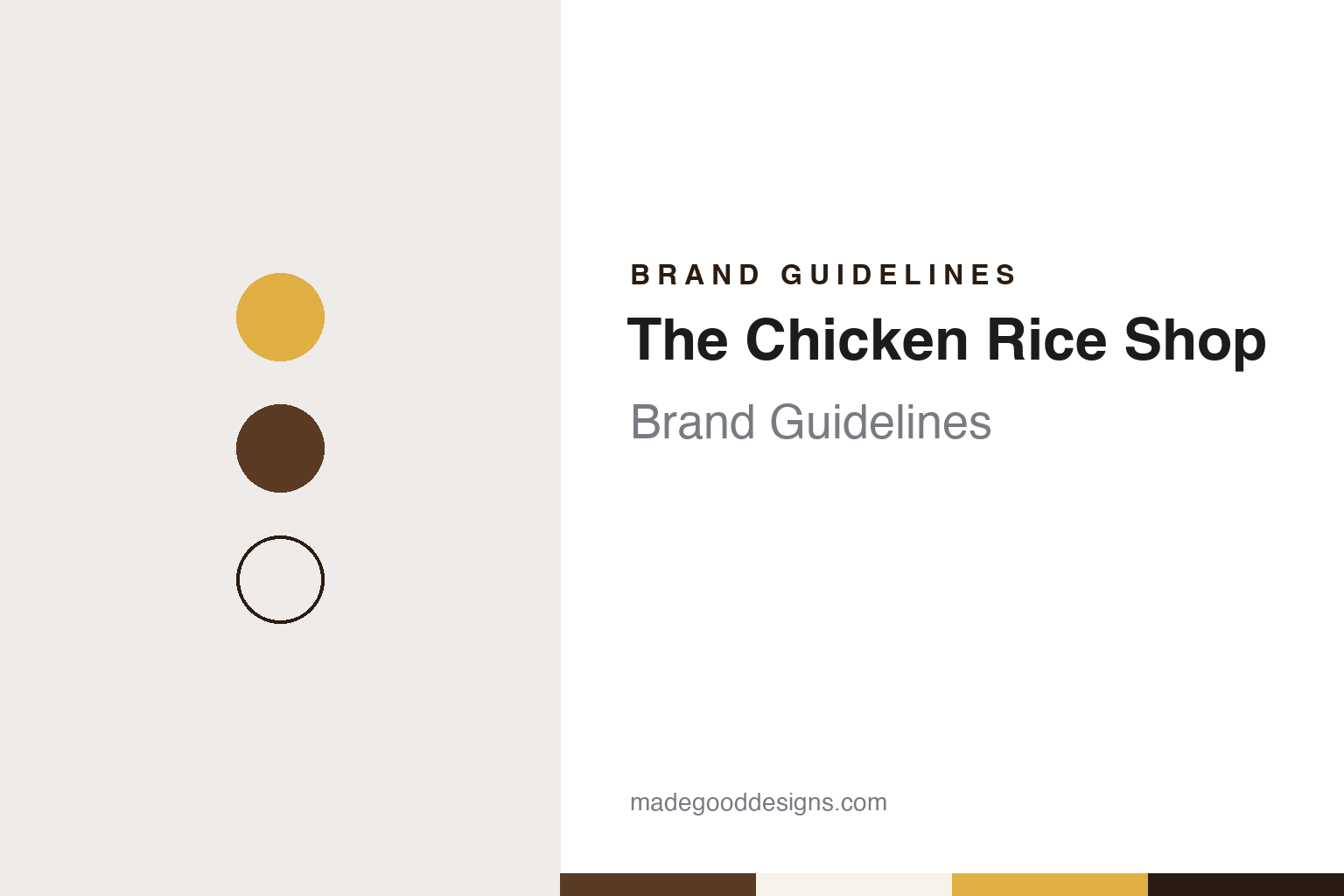
The Chicken Rice Shop Brand Guidelines
A Subang Jaya chicken rice chain from 2000, now part of Zensho.
Aa
Two constants: a ginger-yellow, soy-brown and rice-white palette and a soft serif register. Abstract homage — not a The Chicken Rice Shop product or mark; no dish, logo or mascot is reproduced.
Taipan, USJ
A fast-food veteran and a local dish.
The Chicken Rice Shop, often shortened to TCRS, is a Malaysian restaurant chain built around Hainanese chicken rice. Its operating company is TCRS Restaurants Sdn Bhd, and English Wikipedia dates the business to June 2000. The first outlet opened that year in Taipan, USJ, a commercial district of Subang Jaya in Selangor, Vulcan Post reported in May 2023.
The founder is Gaik Wong. According to Vulcan Post and English Wikipedia, she had been chief operating officer and a director of KFC Holdings (Malaysia) Bhd and had worked in fast food for 25 years before starting TCRS. Her daughter Wong Kah Lin encouraged her to start the venture, the two said in an interview with the radio station BFM 89.9, which Vulcan Post drew on for its profile. They saw room in the market for a restaurant run on an international fast-food model but serving local dishes. Chicken rice was a natural choice: Gaik Wong’s mother-in-law came from Hainan and her own parents from Penang, Vulcan Post wrote.
The positioning was deliberately broad. Chicken rice is sold at coffee shops and hawker stalls across Malaysia, and Gaik Wong herself called the dish “generic” in the BFM interview. Wong Kah Lin described the aim as a family restaurant: “It’s a place where everyone can get together and the kind of food that we serve actually caters to every age profile.” As a chain, Vulcan Post noted, TCRS could standardise its dishes and offer a consistent halal meal from one outlet to the next, which the magazine called key to expanding in Malaysia.
Wong Kah Lin used the big Western chains to make the point. Fried chicken, she argued in the interview, is nothing novel; what McDonald’s and KFC built was a brand, through the way they positioned and ran their restaurants. Vulcan Post summed up the lesson for TCRS in the same terms: the dish is common, so the difference lies in branding, positioning and operation.
Colour
Steamed, roasted and soy sauce.
The menu starts from the two classic ways of serving Hainanese chicken: traditionally steamed and crispy roasted. Vulcan Post listed honey-barbecued and soy-sauce chicken alongside them, and local dishes such as Hainanese curry chicken, Nyonya pai tee and Penang rojak. In the BFM interview Gaik Wong argued for steady change around a fixed core — “your signature of chicken rice must still be there,” she said, while warning that many companies fail through a lack of innovation — and in 2012, according to Vulcan Post, the chain was adding new dishes every few months. Its owner today describes the offer plainly: traditionally prepared chicken served with chicken-flavoured rice, in restaurants that are all halal-certified, according to the Zensho Holdings brand page.
TCRS also grew into a small family of brands. Vulcan Post reported that TCRS Restaurants went on to run Dubuyo, a halal Korean chain first known as Dubu Dubu, and Sepiring, which serves local dishes such as curry chicken, Ipoh hor fun and, again, Hainanese chicken rice. The company also ran Pancake House, a franchise from Manila, which it later closed. The chain’s loyalty app, SedapZ, lets customers collect and redeem points.
Sound is part of the brand too. Vulcan Post opened its 2023 profile with the chain’s advertising jingle, which it called an earworm, before turning to the business behind it.
Typography
Design and documentation.
Malaysian and Singaporean food chains tend to tell their story through the shop itself. Kopitiam chains present a coffee-shop past inside modern premises: Ya Kun Kaya Toast puts the same posters about its old stall in every outlet, according to a case study by the World Intellectual Property Organization, while Killiney Kopitiam still trades from the shophouse where its predecessor opened in 1919. Bakery, cake and bubble-tea chains often lean instead on bright counters, packaged goods and the look of the cup, box or bag a customer carries away.
Menus are written dish by dish and drink by drink. Kaya toast, soft-boiled eggs, laksa and nasi lemak appear under their everyday names, and coffee and tea orders often keep the local shorthand of the kopitiam, such as kopi O or teh C, which some chains explain on their own websites for newcomers.
Store networks are something the companies publish themselves. Websites list outlets at home and abroad, often in malls, food courts and airport terminals, and franchise pages set out what a partner receives: the trade name, trademarks, training and support. Counts change quickly, so this guide gives each one with the date and source it comes from.
Ownership is described plainly. Some chains remain family businesses passed to a second generation; others belong to listed groups or larger food companies, or have changed hands as their franchise networks grew. Corporate pages on founders, owners and franchise partners are where each company sets out its own account, and this guide marks clearly which facts rest only on that account.
Aa
A soft, warm serif for a family restaurant. (Specimen set in Fraunces, a serif STAND-IN; NOT The Chicken Rice Shop logo.)
Zensho ownership
A Japanese restaurant group buys a Malaysian chain.
In June 2019 the Japanese restaurant group Zensho Holdings, whose chains include the beef-bowl restaurant Sukiya, announced that it was acquiring TCRS. In its statement, Free Malaysia Today reported on 13 June 2019, Zensho said it counted roughly 100 TCRS locations; the deal added to Zensho’s existing operations in Malaysia, Indonesia, Thailand and Vietnam. The purchase went through: by June 2023 the British trade title Restaurant Online listed The Chicken Rice Shop among Zensho’s businesses outside Japan, alongside Sukiya and Hama-sushi, describing it as a chain of halal-certified chicken rice shops in Malaysia; the same report covered Zensho’s purchase of the Snowfox Group, owner of YO! Sushi. English Wikipedia groups TCRS with Zensho’s family-restaurant brands, alongside Coco’s, Big Boy and Jolly Pasta. Zensho’s own brand page still lists it as a chicken rice specialty chain “primarily operating in Malaysia.” Through the group, the SedapZ app also covers Zensho restaurants in Malaysia such as Sukiya and Ichiban Ramen, Vulcan Post reported, and Zensho’s brand page lists Malaysia among the overseas markets of Sukiya as well as the home of TCRS.
Outlet counts vary by date. Zensho put the network at roughly 100 locations in 2019; in May 2023 Vulcan Post counted 135 outlets on the chain’s store locator. English Wikipedia says there are more than 100 locations across Peninsular and East Malaysia, including shopping-mall sites such as Mid Valley Megamall, and one outside Malaysia, at AEON Mall BSD City in Tangerang, Indonesia.
For a design guide, The Chicken Rice Shop shows how a single everyday dish can be presented as a family-restaurant brand, with a standard menu, a jingle and a halal promise carried from mall to mall. Compare KFC, the chicken chain whose Malaysian operator TCRS’s founder once helped run, and Marrybrown, another Malaysian chicken chain. For this guide we use a ginger yellow, a soy brown and a rice white with a soft serif, an unofficial interpretation; no product or logo is reproduced.
Explore & save
Keep The Chicken Rice Shop’s identity on hand — save it to a board in the Made Good inspiration library.
The Chicken Rice Shop identity set
Pin The Chicken Rice Shop ginger-yellow, soy-brown and rice-white palette and the soft serif register to your own board.
Source & notes
Frequently Asked Questions
What font can I use to match the The Chicken Rice Shop look?
This guide describes The Chicken Rice Shop’s type as “A soft, warm serif for a family restaurant”. Its type specimen is set in Fraunces from Google Fonts as a stand-in; Fraunces is not The Chicken Rice Shop’s own lettering.
What colours are in the The Chicken Rice Shop palette?
This guide’s The Chicken Rice Shop palette is Ginger yellow #E0B044, Soy brown #5A3A22, Rice white #F7F3EA, Chilli red #A8402E and Pandan green #4F7438. The tones are the guide’s own unofficial interpretation, not official The Chicken Rice Shop hex codes.
When was The Chicken Rice Shop founded?
The Chicken Rice Shop was founded in June 2000, in Taipan, USJ, Subang Jaya, Malaysia.
Who founded The Chicken Rice Shop?
The Chicken Rice Shop was founded by Gaik Wong in June 2000.
Who owns The Chicken Rice Shop?
The Chicken Rice Shop is owned by Zensho Holdings (acquisition announced June 2019).