Tostao Brand Guidelines
Bogotá’s coffee-and-bread chain, its yellow and its paper bag.
Aa
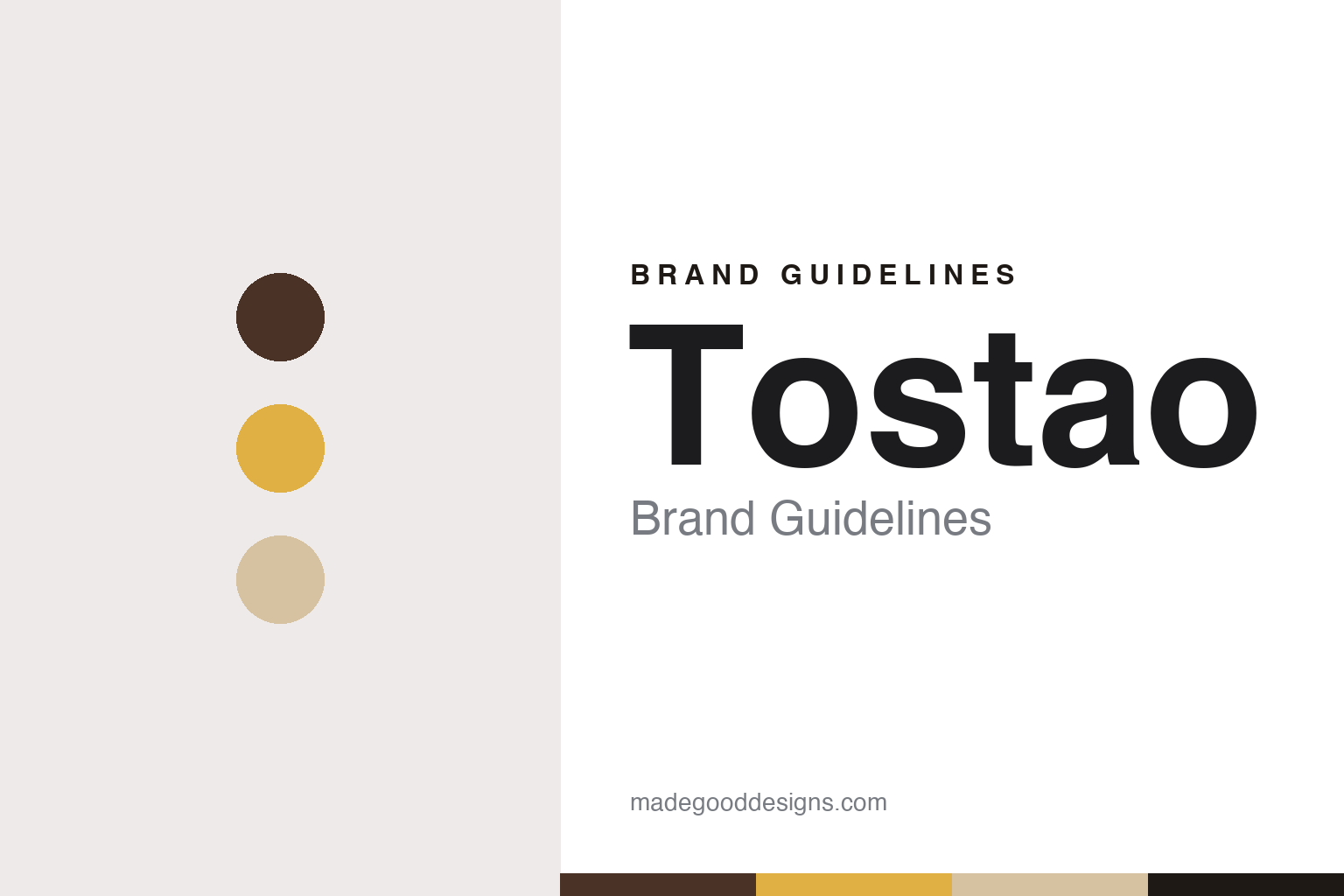
Two constants: a roast brown, mustard yellow and paper-bag tan palette and a warm display serif register. Abstract homage — not a Tostao’ product or mark; no shop front, logo or packaging is reproduced.
Café & Pan
Coffee and bread for every neighbourhood.
Tostao’ Café & Pan is a Colombian chain of coffee-and-bread shops that began in Bogotá at the end of 2015. Semana reported in December 2017 that the chain opened its first two stores in December 2015. The magazine described a group of businesspeople who had studied coffee and bakery formats in the United States and Europe and then shaped the concept around the Colombian market, at prices meant to reach households across the whole income scale rather than only the wealthier districts. Pedro Gasca told El Espectador that the aim was a Tostao’ near people’s homes, workplaces and places of study, from Suba to Soacha.
The company behind the shops is Bakery Business International, which El Espectador described in September 2017 as a Panamanian company; in Colombia it trades through BBI Colombia S.A.S. Its head at the time was Pedro Gasca. El Espectador named the German entrepreneur Michael Olmi, founder of the D1 discount chain, as one of the founders of BBI. Semana linked BBI to the investor group behind the Justo & Bueno low-cost supermarkets, and reported that the two chains at first grew in neighbouring premises.
Growth was fast. Asuntos Legales reported that the chain passed 100 stores by the end of 2016. El Espectador counted 188 in September 2017, and Semana reported 242 points of sale at the end of that year, 230 of them in Bogotá and the rest in and around Medellín, with 155 opened during 2017 alone. By July 2018 Portafolio counted 338 stores: 293 in Bogotá and 45 in Medellín.
In those years the shops were small and plain. Semana reported in 2017 that each store employed three to five people, with no area supervisors, that only about one in ten had seats or wifi, and that most sales were to take away; the chain also avoided expensive rents. El Espectador added that there was no table service and no crockery: products were handed over in a paper bag with a napkin, and most shops had nowhere to sit. The company told El Espectador that it was not offering franchises.
Colour
Coffee from Manizales, bread baked in the shop.
The offer is in the name: coffee and bread. El Espectador reported in 2017 that the coffee was Colombian, processed at the company’s own roaster in Manizales and ground in each shop; Semana named Café Kumanday, a Colombian coffee company, as a partner and supplier. For bread, the chain relied on ultra-freezing: part of the range was imported frozen from Europe and baked in each store through the day, while sweet breads and cakes came largely from Colombian suppliers. The company told Semana in 2017 that only 18 of the more than 170 items in its range were imported.
In July 2018 the chain launched a second format, Tostao’ Estación, with two shops in Bogotá. Portafolio reported that it added seating, sofas and a hot counter with dishes such as chicken fricassee, chicken curry and beef stew, along with salads and fresh juices. The space was designed by BBI Colombia’s own architects with the firm H+H Arquitectos and the agency Mundano, which the company said had also created the Tostao’ and Justo & Bueno brands. Portafolio described bamboo ceilings brought from Quindío, in the coffee region, chairs made by hand by artisans from the Caribbean coast, mosaic floors and industrial steel decking in the chain’s characteristic yellow, a deliberate contrast of craft and industry.
The new name went through a trademark test. Asuntos Legales reported in October 2018 that Colombia’s Superintendence of Industry and Commerce granted BBI Colombia the mixed mark Tostao’ Estación in classes covering bakery goods, advertising and restaurant services. It declared unfounded an opposition from Alimentos Tostao, an unrelated maker of wholegrain foods, finding that the two marks, taken as a whole, were not likely to be confused.
Typography
Design and documentation.
Latin American restaurant, burger, chicken and café chains tend to present themselves first through the street. A shop front carries the name, a short line of colour and often a counter or an ice-cream window that can be read from the pavement, and many chains run more than one format under the same name: a quick-service counter, a table-service restaurant, a kiosk in a shopping centre or a separate ice-cream shop. Drive-through lanes, delivery apps and self-service ordering screens have since joined the shop front as places where the name has to work.
Menus do much of the brand work. Chains in the region usually give their signature dishes their own names, from a house burger to a named roast chicken or a crêpe, and repeat those names across menu boards, packaging and campaigns. Mascots and characters appear in some of these identities, and seasonal campaigns are often built around a new named dish or a limited line rather than around the company itself.
Ownership is often a group matter. Several of the larger chains belong to food or restaurant groups that run a number of brands side by side, sometimes including franchises of international names, and the parent usually describes each brand as a separate business with its own identity. Others have stayed in the hands of their founding families for decades and present that continuity as part of the story.
Corporate pages and the business press fill in the rest: who founded the chain, in which city and year, who owns it now, and where it has opened abroad, usually through franchising in neighbouring countries, Spain or the United States. For a design reader, the useful evidence is what each company itself publishes, and how consistently its name, colours and dishes carry from one format to the next.
Aa
A warm display serif for a coffee-and-bread register. (Specimen set in DM Serif Display, a serif STAND-IN; NOT the Tostao’ logo.)
Tostao’
Reorganisation, a licence and a new owner.
The rapid growth was followed by restructuring. In July 2020 Colombia’s Superintendence of Companies admitted BBI Colombia to a reorganisation process, Portafolio reported; the company had applied on 26 June 2020, after several landlords complained of unpaid rent. In February 2021 the Superintendence confirmed a reorganisation agreement reached through an emergency-negotiation procedure, with a term of nine years, Portafolio reported. On 28 May 2025 it confirmed a reform of that agreement, approved by 60.74 per cent of voting rights, Forbes Colombia reported; the regulator then described the chain as having more than 500 points of sale.
In September 2021 the Organización Ardila Lülle, through its drinks company Postobón and its food company Nutrium, took an exclusive Colombian licence to sell packaged Tostao’ coffee in channels outside the chain’s own shops, such as neighbourhood stores and supermarkets, and took over the Manizales roaster, Portafolio reported. The agreement did not include the shops: Tostao’ kept the operation of its 525 stores, which also began to sell Postobón drinks.
As of September 2026, ABC Economía reported that BBI Colombia belonged to Grupo Colpatria, had completed the reform of its reorganisation agreement and operated more than 300 shops in about 40 cities across 15 departments, supplied by a frozen-bakery plant in Tocancipá, Cundinamarca.
For a design guide, Tostao’ shows how a low-cost format can carry an identity through a single yellow, a paper bag and plain, repeatable shops. Compare Juan Valdez, the café brand of Colombia’s coffee growers, and Starbucks. For this guide we use a roast brown, a mustard yellow and a paper-bag tan with a serif, an unofficial interpretation; no product or logo is reproduced.
Explore & save
Keep Tostao’s identity on hand — save it to a board in the Made Good inspiration library.
Tostao identity set
Save the Tostao roast brown, mustard yellow and paper-bag tan palette and the warm display serif register to your own board.
Source & notes
Frequently Asked Questions
What font can I use to match the Tostao look?
This guide describes Tostao’s type as “A warm display serif for a coffee-and-bread register”. Its type specimen is set in DM Serif Display from Google Fonts as a stand-in; DM Serif Display is not Tostao’s own lettering.
What colours are in the Tostao palette?
This guide’s Tostao palette is Roast brown #4A3226, Ink #1E1915, Mustard yellow #E0B044, Paper-bag tan #D6C2A1 and Cream #FAF6EE. The tones are the guide’s own unofficial interpretation, not official Tostao hex codes.
When was Tostao founded?
Tostao was founded in December 2015, in Bogotá, Colombia. Tostao is known for Coffee, bread baked in store.