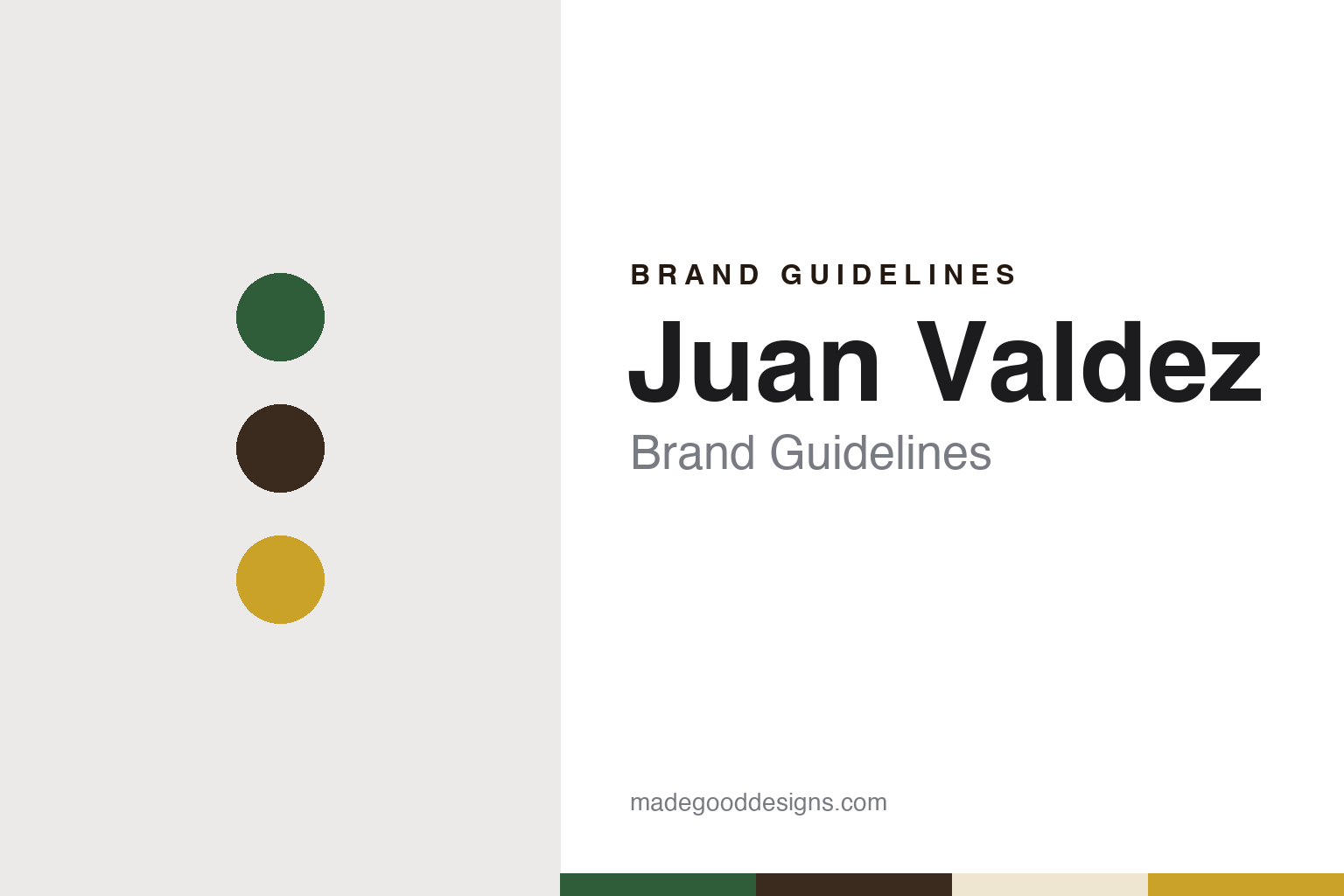
Juan Valdez Brand Guidelines
The Colombian coffee growers’ farmer, his mule and the café chain.
Aa
Two constants: an Andes green, roast brown and straw palette and a storybook serif register. Abstract homage — not a Juan Valdez product or mark; no character, logo or package is reproduced.
A face for Colombian coffee
A farmer drawn up by a New York agency.
Juan Valdez is not a company but a character, and a mark owned by Colombia’s coffee growers. He was created for the Federación Nacional de Cafeteros de Colombia (FNC), the growers’ federation founded in 1927, by the New York advertising agency Doyle Dane Bernbach. English Wikipedia dates the campaign to 1958 and credits the agency’s founder, William Bernbach; Spanish Wikipedia and the brand’s own website give 1959, the year the first actor took the role. English Wikipedia describes the federation as owned and controlled by Colombia’s coffee farmers, who number over 500,000.
The reason was commercial. In a case study on the federation, the World Intellectual Property Organization (WIPO) says that in the late 1950s the price of Colombian coffee fell from US$0.85 to $0.45 a pound, that roasters blended beans of unspecified origin, and that only 4 percent of consumers in the United States knew Colombia produced coffee. The FNC’s answer, WIPO says, was to put “a face on Colombian coffee”: Juan Valdez, “a fictional character wearing a sombrero and leading his mule Conchita,” shown in North American television commercials in the 1960s hand-picking ripe beans. Spanish Wikipedia describes his poncho, carriel shoulder bag and alpargatas as the dress of the arriero, the muleteer of Colombia’s coffee region.
Three men have played him. The first, the Cuban actor José F. Duval, did so from 1959 to 1969, according to English and Spanish Wikipedia. Carlos Sánchez, from Antioquia, took over in 1969; English Wikipedia says his commercials were voiced by Norman Rose, and that he appeared as Juan Valdez in the 2003 film Bruce Almighty. Sánchez announced his retirement in 2006, NBC News reported, and the federation chose Carlos Castañeda, a coffee grower from Andes, Antioquia, who was presented on 29 June 2006 after a selection among more than 380 applicants, Spanish Wikipedia says. Castañeda played the role until his death in April 2024; Daily Coffee News reported that the federation thanked him for 20 years of service personifying Colombian coffee growers.
Colour
From advertising character to licensed mark.
The character became a trademark. WIPO says the federation’s first trademark, “Juan Valdez,” was registered with the United States Patent and Trademark Office in 1960, and that the word mark “100% Colombian coffee” followed in 1969. During the early 1980s, WIPO says, the FNC “designed and registered the now familiar Juan Valdez logo”; Spanish Wikipedia describes it as Juan Valdez with Conchita and the Andes mountains behind them. WIPO gives no exact year for the logo, so we do not.
The logo was meant to be licensed. WIPO says the plan was to license the mark to roasters for their own products if those products contained only Colombian coffee and met the federation’s quality standards — “a trademark-based ingredient branded strategy,” in the words of Luis Fernando Samper, the FNC’s intellectual-property director, “much like the use of the ‘Intel inside’ sign on computers today.” Because some roasters would not accept those terms, WIPO says, the Republic of Colombia, working with the FNC, also registered “Colombian” as a certification mark for coffee in the United States and Canada.
The federation later turned to geographical indications. WIPO says the FNC asked the Colombian government in December 2004 to recognise “Café de Colombia” as a geographical indication, applied in 2005 for protection in the European Union — the first such application for a product from outside the EU — and gained Protected Geographical Indication status there in September 2007. WIPO also cites surveys by KRC Research showing that by 2004 awareness of Colombia as a coffee-growing country had reached 91 percent or more in Canada, the United States and Spain.
The federation has defended the character. In 2006 it took action against the Costa Rican roaster Café Britt over T-shirts printed with the slogan “Juan Valdez drinks Costa Rican coffee”; English Wikipedia says the federation filed suit on 7 July 2006, that Café Britt answered with an affidavit from a Costa Rican man named Juan Valdez, and that all charges were later dropped.
Typography
Coffee and origin.
The seven brands in this group all sell coffee, and they come from four countries of the Americas: Café Bustelo, Community Coffee, Folgers and Maxwell House from the United States, Juan Valdez from Colombia, Café Britt from Costa Rica, and Pilão from Brazil. Each guide follows its own name back to where it started and forward to whoever owns it today, rather than treating the group as one story.
A coffee brand’s identity is usually carried by a name, a pack and a promise about the cup, and the beans behind it may have been grown far from where the name on the front was roasted. That makes the plain questions behind each name worth asking: who started it, who owns it now, where its coffee is bought, and where it is actually roasted and packed.
Each guide separates what independent sources record from what the company says about itself — its founding story, its owners over time, where its coffee comes from and where it is roasted — and marks plainly what rests only on the company’s own word.
Aa
A storybook serif — for a brand built on a character. (Specimen set in Alegreya, a serif STAND-IN; NOT the Juan Valdez logo.)
Juan Valdez Café
The character becomes a shop sign.
In 2002 the federation turned the character into a retail brand. English Wikipedia says Juan Valdez Café was established in September 2002 through Procafecol S.A., a company set up that year, with the first shop in Bogotá, followed by Medellín and Cali; Spanish Wikipedia names the federation as the chain’s parent and Camila Escobar as its president. English Wikipedia notes that the federation had opened outlets in Argentina and Spain in the 1960s and 1970s, and that they closed before 1985.
The chain went abroad from 2005, to cities including Miami, New York, Madrid, Lima, Quito and Santiago, according to English Wikipedia, which also records closures in the United States and Spain and a move to franchising. The Global Coffee Report covered the opening of its 500th store in July 2022, and Spanish Wikipedia says the chain announced its 600th outlet, at Istanbul’s Sabiha Gökçen airport, in August 2024. The brand’s website now also promotes “Juan Valdez 1959,” a restaurant concept whose name, it says, marks the year in which “a symbol was born to represent Colombian coffee to the world” (our translation).
For a design guide, Juan Valdez shows how a growers’ federation built a character, then a licensed logo, then a café chain on the same figure. Compare Peet’s Coffee, the Berkeley roaster, and Lavazza, the Italian family roaster. For this guide we use Andes green, roast brown, cream and straw gold with a serif, an unofficial interpretation; no product or logo is reproduced.
Explore & save
Keep Juan Valdez’s identity on hand — save it to a board in the Made Good inspiration library.
Juan Valdez identity set
Pin the Juan Valdez green, brown and straw palette and the storybook serif register to your own board.