Pepperidge Farm Brand Guidelines
Margaret Rudkin’s Connecticut kitchen bakery, under Campbell’s since 1961.
Aa
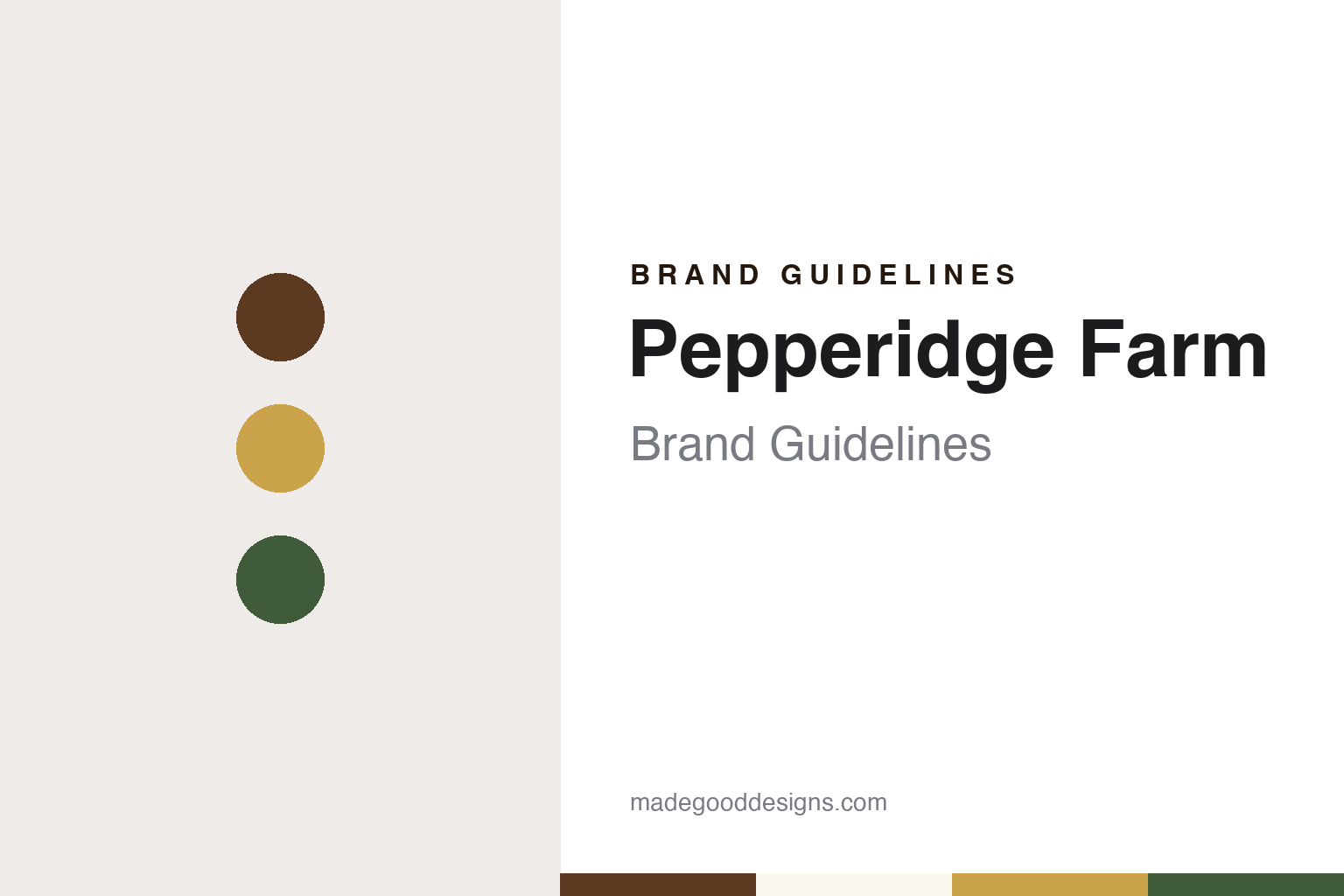
Two constants: a Pepperidge Farm brown, gold and green palette and a Bookish serif register. Abstract homage — not a Pepperidge Farm product or mark; no cookie, bag, mill or logo is reproduced.
Fairfield
A kitchen, a farm named after a tree, and a loaf of bread.
Pepperidge Farm began as bread. Margaret Rudkin started baking whole-wheat loaves in her kitchen in 1937, at the family’s property in Fairfield, Connecticut, the company says. The property was called Pepperidge Farm after a tree on the grounds: English Wikipedia describes a 123-acre farm named for the pepperidge tree, and says the Rudkins had moved there in 1929; the company calls it “an ancient tree.” The company says Rudkin, born Margaret Fogarty in New York City, married the Wall Street broker Henry Rudkin in 1923, and that she began baking for her youngest son.
The first commercial sale, English Wikipedia says, was to her local grocer in Fairfield, Mercurio’s Market. Henry Rudkin took loaves with him to New York, where they were sold in specialty shops. The company says production reached 500,000 loaves by 1939, and a million six months later — figures we give as its own.
The business moved from the kitchen to the garage and then, in 1940, to its first factory, according to English Wikipedia. Rationing during the Second World War limited the ingredients Rudkin could buy and forced her to cut production. After the war, on 4 July 1947, the company says, it opened its first modern bakery, in Norwalk, Connecticut; English Wikipedia adds that plants in Illinois and Pennsylvania followed soon after.
Norwalk became the company’s home. English Wikipedia describes Pepperidge Farm as based there, and reports that on 18 January 2023 the company announced it would close its Norwalk headquarters and move those jobs to Campbell’s headquarters in Camden, New Jersey.
Colour
Distinctive cookies, a Swiss fish and a grist mill.
Rudkin built the range on finds from abroad. On a trip to Europe in the 1950s, English Wikipedia says, she came across fancy chocolate cookies, bought the rights to make and sell them, and so began the Distinctive cookie line, whose varieties are named after European cities, such as the Milano and the Brussels. The company dates the Milano to 1955 and says it was discovered in Belgium and produced under a licensing agreement. English Wikipedia says it grew out of an earlier Pepperidge Farm cookie called the Naples, and that it is sold in Canada as the Monaco, because a local bakery already held the Milano name there. A second line, Farmhouse, covers the plainer cookies, such as chocolate chip and shortbread.
The other import was a cracker. English Wikipedia says Oscar J. Kambly created goldfish-shaped crackers at the Swiss biscuit maker Kambly in 1958, and that Rudkin, having tried them on holiday in Switzerland, introduced Goldfish to the United States in 1962; the company gives the same year. Wikipedia says smiles were added to some of the crackers in 1997, with the slogan “The snack that smiles back,” and that the brand’s mascot is Finn, a goldfish in sunglasses.
The company’s logo is a building. English Wikipedia says it is based on the Grist Mill in Sudbury, Massachusetts, which supplied Pepperidge Farm with 48 tons of whole-wheat flour a month from 1952 to 1967. In the 1970s and 1980s the brand ran a long television campaign under the line “Pepperidge Farm remembers,” which leaned on nostalgia for life in the early 20th century, Wikipedia says.
Pepperidge Farm also became an importer. English Wikipedia says it began bringing Arnott’s Tim Tam biscuits, made in Australia, into the United States in 2008, while both companies belonged to Campbell.
Typography
Biscuits, branding and documentation.
The seven brands in this group all make biscuits, and they come from four countries: LU and St Michel from France, Loacker, Balocco and Mulino Bianco from Italy, Arnott’s from Australia, and Pepperidge Farm from the United States. Biscuit brands in general sit at many different points in the trade, from family firms that still bake in the town where they started to names that have passed between food groups several times, and a single packet can carry the history of more than one owner.
A biscuit brand’s identity is usually carried less by a recipe than by a pack, a shape and a name, because the biscuit on the shelf may be baked a long way from the place the name recalls. That makes the questions behind each name worth asking plainly: who started it, who owns it now, how its packaging came to look the way it does, and where its biscuits are actually made.
Each guide separates what independent sources record from what the company says about itself — its founding story, its owners over time, its pack and where it bakes — and marks plainly what rests only on the company’s own word.
Aa
A bookish serif — for a brand that grew out of one woman’s kitchen. (Specimen set in Libre Baskerville, a serif STAND-IN; NOT the Pepperidge Farm logo or lettering.)
Pepperidge Farm
A founder on the Campbell board.
Pepperidge Farm has belonged to Campbell for longer than it was independent. In 1961 Rudkin sold the business to the Campbell Soup Company; English Wikipedia’s article on the company gives the price as $28 million, and its article on Rudkin as $28.2 million in Campbell stock. The deal gave her a seat on Campbell’s board, and both Wikipedia and the company say she was the first woman to serve on it. She published The Margaret Rudkin Pepperidge Farm Cookbook in 1963.
English Wikipedia says the brand’s range now covers breads, crackers, cookies and desserts. Campbell’s own snack business also widened: English Wikipedia says it bought Snyder’s-Lance, the maker of Lance crackers and Snyder’s of Hanover pretzels, in December 2017. Pepperidge Farm’s Australian sister company, Arnott’s, left the group when Campbell agreed in July 2019 to sell it to the private-equity firm KKR.
The parent has since changed its own name. English Wikipedia says that on 11 September 2024 Campbell announced it would become The Campbell’s Company, and that shareholders approved the change on 19 November 2024. The bakery’s website carries the copyright line of Pepperidge Farm Incorporated, and English Wikipedia describes it as a subsidiary of The Campbell’s Company.
On the design side, the identity has two documented anchors: the grist-mill logo drawn from a working flour supplier in Massachusetts, and the habit of naming its Distinctive cookies after European cities, from Milano to Brussels. The company’s Our Story page still opens with Rudkin and her Fairfield kitchen.
For a design guide, Pepperidge Farm shows how a founder’s story — a farm, a mill and a kitchen — can remain the brand long after the business joined a larger group. Compare Oreo, another American cookie with a long-lived design, and Hershey’s, a founder-named American confectioner. For this guide we use mill brown, gold and farm green with a serif, an unofficial interpretation; no product or logo is reproduced.
Explore & save
Keep Pepperidge Farm’s identity on hand — save it to a board in the Made Good inspiration library.
Pepperidge Farm identity set
Pin the Pepperidge Farm brown, gold and green palette and the Bookish serif register to your own board.